A Personal Call from Hamma Mirwaisi
Founder of THE HUMANITY SYSTEM
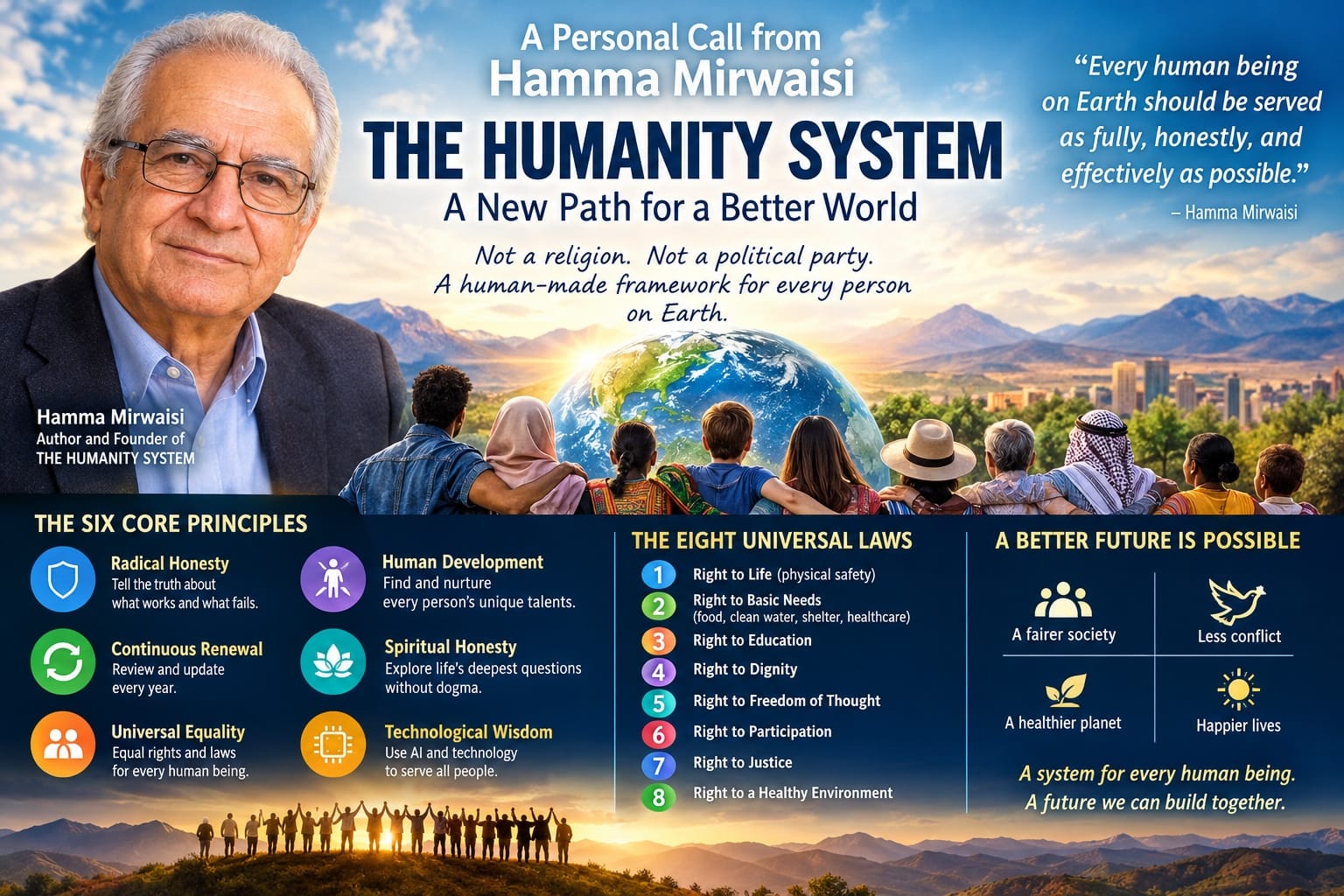
I am Author Hamma Mirwaisi, and I am calling on you to join THE HUMANITY SYSTEM.
I am 80 years old. I have lived a long time. In many ways, I feel there is little left for me to do for myself. What I truly want now is to help every human being live happily and have a good life. That is the reason I am working to establish THE HUMANITY SYSTEM.
This system is not about making money at the expense of other human beings. I am retired. I make enough to live a good life with my wife and family. I stay busy taking care of our granddaughter. The other two grandchildren are working and going to college. My life is full in that way. The work of THE HUMANITY SYSTEM is not for personal gain. It is for the benefit of all people.
I believe there is nothing after death. We are made from the material of the Earth, and when death comes we return to the Earth. That is the simple truth as I see it.
Still, I would like to live forever if it becomes possible. If technology achieves a breakthrough that allows the extension of life with healthy living, I will be ready to accept testing. If I have enough money to buy life extension, I will buy it. I am not afraid of the idea. I simply want more time to help others.
THE HUMANITY SYSTEM is not a religion. It is not a political party. It is a practical framework designed for one clear purpose: to serve every human being on Earth as fully, honestly, and effectively as possible.
Religion and politics were made by human beings. No one visited from another planet to bring them. They grew from human ideas, imagination, and needs, and they evolved over thousands of years into the systems that still shape our world. Those systems have given humanity much, but they have not delivered equal dignity and a good life for everyone. THE HUMANITY SYSTEM is offered as a different path — one that can be examined, tested, and improved by the people it serves.
I invite you to look at this work with open eyes. Read the materials. Consider the principles. If the idea of a system built only to help every human being live a better life speaks to you, then join us.
I am 80 years old. I have lived long enough to know that time is limited. The best use of the years I still have is to work for a world in which every person can live happily and well.
That is why I am calling on you to join THE HUMANITY SYSTEM.
THE HUMANITY SYSTEM is a philosophical and practical framework created by Hamma Mirwaisi. It is presented as a new way of organizing human life that moves beyond traditional religion and politics.
Core Idea
The central belief is simple and direct:
Every human being on Earth should be served as fully, honestly, and effectively as possible.
Mirwaisi argues that for thousands of years, two main systems have governed civilization — religion and politics. Both were created by human beings. No visitor from another planet brought them. They grew from human ideas, imagination, fears, hopes, and power struggles, and then evolved into the structures we still live under today. While these systems have given humanity meaning, order, and some progress, he believes they have ultimately failed to deliver equal dignity and a genuinely good life for everyone.
THE HUMANITY SYSTEM is offered as a different path. It is not a religion. It is not a political party. It makes no claim of divine origin or eternal, unchanging truth. It is a human-made framework designed to be examined, tested, and improved by the people it serves.
Foundational Philosophy
- Human beings are made from the material of the Earth and return to the Earth when they die. There is nothing after death.
- Because life is finite and there is no afterlife, the most meaningful work is to help every living person live happily and well while they are here.
- Systems should be built around human needs and human dignity, not around protecting sacred texts, political power, or institutional self-interest.
- Technology (especially artificial intelligence) should be used as a tool to serve all people, not just the powerful.
- Any system that stops serving people must be changed. Continuous honesty and renewal are essential.
The Six Core Principles
- Radical Honesty — Tell the truth about what works and what fails, without protecting any inherited belief system or political agenda.
- Continuous Renewal — Review and update the system every year so it never becomes frozen or self-serving.
- Universal Equality — Core rights and laws apply equally to every human being without exception.
- Human Development — Identify each person’s unique talents and create the conditions for those talents to develop fully.
- Spiritual Honesty — Engage with the deepest questions of existence without dogma or false certainty.
- Technological Wisdom — Ensure artificial intelligence and technology serve every human being, not only the few.
The Eight Universal Laws
These are presented as basic rights that should apply to every person:
- Right to Life (physical safety)
- Right to Basic Needs (food, clean water, shelter, healthcare)
- Right to Education
- Right to Dignity
- Right to Freedom of Thought
- Right to Participation
- Right to Justice
- Right to a Healthy Environment
Personal Motivation Behind the Philosophy
Hamma Mirwaisi, now 80 years old, says he has lived a long life and no longer needs to focus on personal ambition. He is retired, lives comfortably with his wife and family, and helps care for his granddaughter. His remaining purpose, he states, is to help every human being live a happy and good life. That is why he created THE HUMANITY SYSTEM. He emphasizes that it is not a project for making money at the expense of others.
He also expresses a personal hope for longer life. If technology develops healthy life-extension methods, he says he would be willing to participate in testing or purchase such treatments if he could afford them — so he could continue working for the benefit of others.
Summary of the Philosophy
THE HUMANITY SYSTEM rests on the conviction that human beings can and should design better systems for themselves. Because religion and politics were invented by people, people can also invent something better: a framework centered only on equal human dignity, continuous honest improvement, and practical support for every person’s flourishing.
It is offered not as a final answer, but as a living system that can be examined, tested, and improved by those who choose to engage with it.
Radical Honesty in Practice within THE HUMANITY SYSTEM
In THE HUMANITY SYSTEM, Radical Honesty is the first of the six core principles. It is defined as the commitment to tell the truth about what works and what does not — without protecting any sacred text, political agenda, or institutional self-interest.
Unlike religious or political systems that often defend their doctrines, leaders, or power structures even when evidence shows failure, Radical Honesty requires the system itself to face reality openly. This includes the willingness to admit its own shortcomings.
How It Works in Practice
1. Annual Review Process
Once a year, communities gather for an honest assessment of their laws, programs, and practices. The question is not “How do we defend what we already have?” but “Is this actually serving every human being?”
- Real experiences of community members are collected and examined.
- Artificial intelligence is used to aggregate data transparently, rather than allowing only the voices of those in power to shape the picture.
- Failures are named clearly. Programs that do not deliver results are reformed or replaced.
- Successes are also acknowledged, but only when evidence supports them.
This process is designed to be difficult at times. Honest discussion about what is not working is treated as necessary, not as disloyalty.
2. Education Based on Honest Thinking
Children are taught to examine evidence, ask genuine questions, and reach their own conclusions. They are not required to memorize official answers simply because authority figures declare them correct. History is presented with both the achievements and the failures of past systems, without protective distortions.
3. No Sacred Protection
No text, tradition, leader, or institutional arrangement is treated as beyond examination. If something fails to serve people, it can be changed. Radical Honesty rejects the idea that certain beliefs or structures must be defended regardless of results.
4. Transparency Over Image
The system prioritizes accurate reporting of outcomes over maintaining a positive public image. Self-serving accounts that hide problems are rejected in favor of clear data and open discussion.
5. Continuous Accountability
Because the system is committed to Continuous Renewal (the second core principle), Radical Honesty is not a one-time gesture. It is built into the yearly cycle so that the framework never becomes frozen or self-protecting.
Why This Matters
According to Hamma Mirwaisi, religious institutions and political systems have historically been unwilling to consistently acknowledge their own failures. They often protect doctrine, power, or reputation even when people suffer. Radical Honesty is intended as a structural correction to that pattern.
In practical terms, it means a community or system that would rather know the uncomfortable truth and fix the problem than preserve appearances. The goal is not harsh confrontation for its own sake, but clear-eyed service to every human being.
This principle is presented as essential if a system is truly going to put human dignity and flourishing first, rather than the preservation of existing arrangements.
Continuous Renewal in Practice within THE HUMANITY SYSTEM
Continuous Renewal is the second of the six core principles of THE HUMANITY SYSTEM. It means the system is reviewed and updated every year so that it never becomes outdated, rigid, or self-serving.
Unlike religious texts that claim eternal, unchanging truth, or political constitutions that are difficult to amend, THE HUMANITY SYSTEM is deliberately designed to change. It treats improvement as a permanent requirement rather than an occasional reform.
How Continuous Renewal Works
1. The Annual Review
Once a year, communities examine their laws, programs, and practices. The central question is practical and direct:
“Is this still serving every human being as fully, honestly, and effectively as possible?”
- Real experiences of community members are gathered.
- Artificial intelligence is used as a partner to analyze large amounts of information, identify patterns of success and failure, and present the results transparently.
- Laws or practices that are not working are changed or replaced.
- The process is meant to be honest and evidence-based rather than political or defensive.
2. Built-In Flexibility
Because the system is not fixed, it can respond to new knowledge, new technologies, and new challenges as they appear. What worked last year can be improved this year. What fails can be discarded without the need to protect tradition or institutional power.
3. Protection Against Self-Interest
Many older systems eventually prioritize their own survival over the people they claim to serve. Continuous Renewal is intended to prevent this. By requiring yearly honest examination, the system is forced to remain accountable to results rather than to its own authority or reputation.
4. Connection to Radical Honesty
Continuous Renewal depends on Radical Honesty. Without the willingness to admit what is not working, the annual review would become empty ritual. Together, the two principles create a cycle: tell the truth about outcomes → change what fails → check again the following year.
Practical Effect
In the vision described by Hamma Mirwaisi, a person living under THE HUMANITY SYSTEM would experience a form of institutional hope that is renewed every year. The system is structured so that people can see whether it is actually serving them and can expect genuine changes when it is not.
The goal is a living framework rather than a permanent structure. Continuous Renewal treats the system itself as a tool that must keep earning its place by delivering real benefits to every human being.
This principle is presented as essential if a human-centered system is to remain useful across generations instead of becoming another fixed authority that resists change.
My Life Journey
I was born in the small village of Chwarklaw, in the Khanaqin District of Kurdistan, on the border between Iran and Iraq. Our land has long been shaped by the decisions of empires. The Treaty of Zuhab, also known as the Treaty of Qaṣr-e Shīrīn, was signed on May 17, 1639. It ended 150 years of intermittent warfare between the Ottoman Empire and the Safavid Empire and left our village on the Iranian side of the border. Later, the British Empire divided Kurdistan into four parts. Our village became part of the new state of Iraq.
My parents lived simply. In our small room they used a citronella torch — a black oil lamp — for light. When I was six years old, my father placed me in an Islamic religious school. He believed that by doing so, his seven deceased generations of forefathers would go to heaven. That was the faith of our family at the time.
After five years in the religious school, I began attending regular night school in the city of Khanaqin. When I saw what they taught there, I revolted. I asked my father to send me to a regular school. He refused. He told me that if I left the religious path, his seven past forefathers would go to hell. For one full year he forced me to help with hard farming work. I did not give up my demand. In the end, he agreed and sent me to regular school.
Life as a Kurd in Iraq was extremely difficult. We suffered under the oppression of the Iraqi Arab regime. I later joined the Peshmerga — the Kurdish freedom fighters — and fought against Saddam Hussein’s forces. In 1975 the United States withdrew its support. The Kurdish movement collapsed, and I fled with my wife and our two small children, who were three years old and one year old. We made our way to the United States as refugees.
In America I returned to education. I completed a Bachelor of Science and a Master of Science in Electrical Engineering. From 1982 to 1996 I worked as a design engineer building mainframe computers. That line of work disappeared with the rise of personal computers. Between 1996 and 1998 I entered a PhD program in Radio-Frequency (RF) Engineering at the University of Colorado at Colorado Springs, but I did not finish the degree. I returned to work and continued until retirement.
In retirement I began a long period of research. I wanted to understand why the Kurdish people remain without a country of their own, and why Persians, Arabs, Turks, and Western powers have repeatedly abused us. I put the reasons I found into books. Over time, that work evolved. What began as a search for justice for my own people grew into a deeper commitment: to serve every human being.
That commitment became THE HUMANITY SYSTEM — a practical framework designed to help all people live with dignity, equality, and a good life. I am no longer seeking personal advancement. I am retired. I live comfortably with my wife and family and help care for our granddaughter. The other two grandchildren are working and studying. My remaining purpose is to offer something useful to humanity.
This is the journey that brought me here: from a small village on a contested border, through religious schooling and hard labor, through war and exile, through education and engineering work, and finally to a quiet determination to help build a better system for every human being.
— Hamma Mirwaisi
Author and Founder of THE HUMANITY SYSTEM
Website: https://the-humanity-system.ghost.io
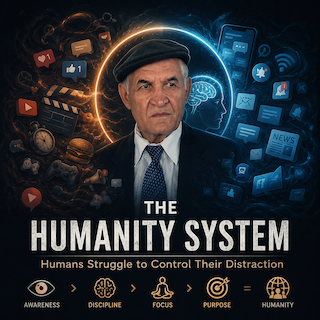
Book: THE HUMANITY SYSTEM: Humans Struggle to Control Their Distraction
Contact: thehumanitysystem@gmail.com