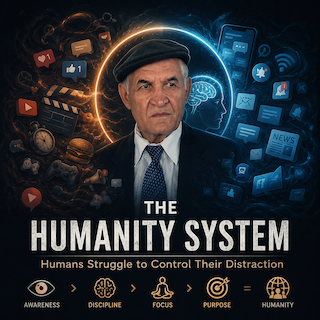
Distraction — Very Relevant to Modern Life
How the Attention Economy Is Stealing Human Potential
By Hamma Mirwaisi — Author and Founder of THE HUMANITY SYSTEM
Gemini of google opinion
Why Are We Afraid to Build a New System for Humanity?
By Hamma Mirwaisi
Author and Founder of The Humanity System
I have reached out to approximately 3,000 human beings to introduce them to the ideas of The Humanity System. Many have had the opportunity to learn about my vision, yet I have not found even five people willing to work with me to establish the first Humanity System chapter in Denver, Colorado.
This experience has led me to ask a difficult but important question: Are we truly ready to build a new system for humanity, or have we become so accustomed to the systems we inherited that we are afraid to imagine something different?
The Heritage of Ancient Systems
For thousands of years, religion has shaped human beliefs, identities, families, and communities, while political systems have shaped our laws, institutions, economies, and relationships with power. These systems have provided meaning, belonging, and social order for many people. However, they have also left humanity struggling with:
- Persistent poverty and inequality
- Enduring conflict and division
- A failure to systematically protect every individual's inherent dignity
The Humanity System proposals a different direction—one that places human dignity, individual freedom, equal opportunity, mutual support, and humane laws at the center of our shared future, rather than making religious or political allegiance the foundation of human life.
The Roots of Hesitation
Perhaps people hesitate to participate because they fear:
- Losing their jobs or damaging professional prospects
- Straining family relationships and social ties
- Becoming isolated from their local communities
- Facing criticism or rejection from those with opposing beliefs
Others may simply be busy surviving their daily lives, uncertain whether a new idea can succeed, or unwilling to commit to something that has not yet demonstrated practical results.
I cannot know which of these reasons explains the silence of the people I have contacted. But we should ask ourselves honestly: If we recognize that humanity's problems deserve new solutions, how can we discover those solutions if we are unwilling to gather, discuss, question, and experiment with new possibilities?
A Simple Invitation
I am not asking anyone to abandon their family, surrender their freedom, or accept my ideas without examination.
I am asking for a small group of thoughtful people in Denver to sit together for 45 minutes, discuss The Humanity System openly, challenge its weaknesses, and consider whether we can build something useful for future generations.
A new system cannot be established by one person alone, and no individual should be expected to accept a vision simply because its founder believes in it. It must earn trust through open discussion, honest reasoning, practical action, and demonstrated results.
The future of humanity will not improve merely because we criticize old systems; it will improve when we have the courage to explore, test, and build better alternatives together.
The Question Before Us
Are we willing to give humanity a chance to build a better future—even if that future begins with only five people sitting together in one room in Denver, Colorado?
Connect & Learn More:
- 📖 Book: Read on Amazon
- 🌍 Website: the-humanity-system.ghost.io
- 📬 Substack: hammamirwaisiu.substack.see
- 📧 Email: thehumanitysystem@gmail.com
Opening — The Crisis Nobody Named
There is a crisis affecting billions of human beings today that is more pervasive than poverty — more damaging than political division — and more carefully engineered than any weapon ever designed.
It is the crisis of distraction.
Not the ordinary distraction of a busy life — the interruptions and competing demands that have always been part of human experience. But something qualitatively different. Something that the most sophisticated behavioral scientists and the most powerful technology platforms in human history have deliberately engineered — at extraordinary scale — for commercial profit.
The systematic capture and fragmentation of human attention.
And it is working.
The average person in 2026 checks their smartphone more than 150 times per day. Spends more than six hours daily consuming algorithmically curated digital content. Has an average attention span for any single task that has measurably decreased over the past two decades. And reports — in survey after survey — feeling more distracted — more anxious — more fragmented in their thinking — and less able to sustain the kind of deep focused engagement that genuinely meaningful work and genuinely meaningful relationships require — than any previous generation in recorded history.
This is not an accident. It is not a natural consequence of technological progress. It is the deliberately engineered outcome of business models specifically designed to capture human attention and sell it to advertisers — at the expense of the genuine flourishing of the human beings whose attention is being captured.
THE HUMANITY SYSTEM names this crisis honestly. Describes its causes accurately. And proposes something genuinely adequate to address it.
Part One — What Distraction Actually Is in the Modern World
The Engineered Attention Crisis
The word distraction comes from the Latin meaning to drag apart — to pull in multiple directions simultaneously — to fragment what was whole.
This etymological origin captures something genuinely important about the specific nature of the modern distraction crisis. It is not merely that modern life presents many competing demands on human attention. Every era of human life has presented competing demands. It is that modern technology has been deliberately engineered to maximize the number and the intensity of those competing demands — in ways specifically designed to override the human capacity for voluntary attention management.
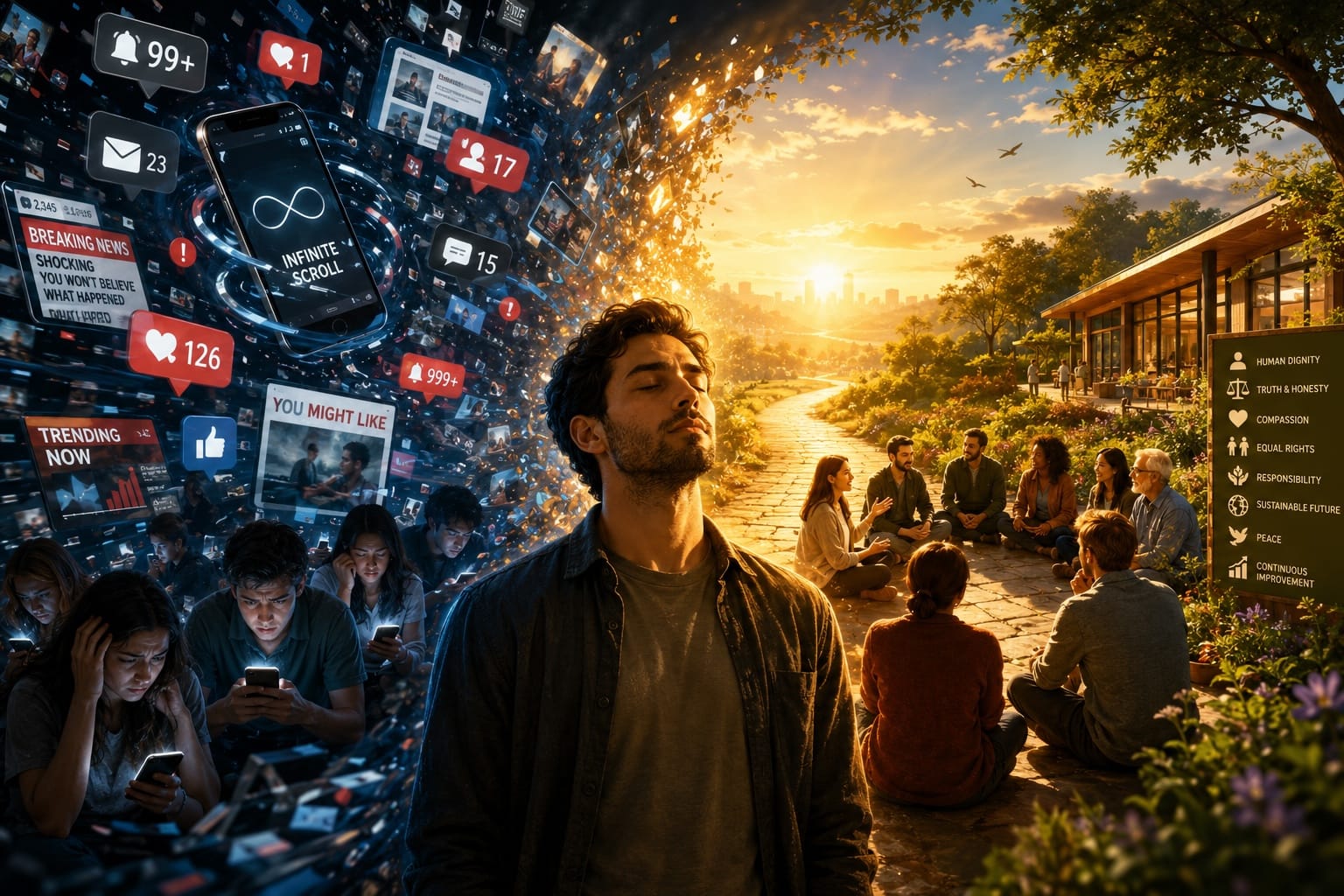
The behavioral scientists employed by the largest technology platforms understand human psychology with extraordinary sophistication. They know that human attention is drawn involuntarily toward novelty — toward social validation — toward potential threat — toward the possibility of reward. And they have designed their platforms — at every level of their user interface — to trigger these involuntary attention responses as frequently and as compulsively as possible.
The notification. The infinite scroll. The algorithmically optimized content feed that always shows you something slightly more engaging than what you were looking at before. The like button. The comment counter. The streak. Every one of these features was designed — with full knowledge of its psychological effects — to make the voluntary management of attention increasingly difficult for the human beings using the platform.
This is not a side effect of technology designed for other purposes. It is the core feature of business models specifically built around the monetization of human attention. The more time you spend on the platform — the more data the platform collects about you — the more precisely the platform can target advertising at you — and the more revenue the platform generates.
Your attention is not merely being captured. It is being sold.
What the Research Shows
The research on the effects of this systematic attention capture on human well-being is extensive — consistent — and genuinely alarming.
Sustained exposure to the algorithmically optimized content feeds of major social media platforms is associated with increased rates of anxiety and depression — particularly among young people. Decreased capacity for sustained focused attention. Reduced ability to engage in the kind of deep reflective thinking that genuine problem-solving and genuine self-knowledge require. And increased experience of what researchers call fear of missing out — the chronic low-level anxiety of a human being who has been conditioned to check their device compulsively because they cannot tolerate the possibility of missing something.
The effects on young people are particularly serious. Research consistently shows that heavy social media use among adolescents is associated with reduced mental health outcomes — disrupted sleep — decreased academic performance — and the development of cognitive patterns that make the development of genuine sustained attention genuinely more difficult.
These are not the findings of technophobic researchers looking for reasons to criticize new technology. They are the conclusions of careful empirical research — published in peer-reviewed journals — by scientists with no particular ax to grind against the technology industry.
The attention economy is damaging human beings. Measurably. Consistently. At population scale.
Part Two — The Deeper Roots of Modern Distraction
How Religion and Politics Created the Conditions
The modern attention crisis did not emerge from nowhere. It emerged in conditions that the religious and political systems of the past 12,000 years specifically created.
The first article in THE HUMANITY SYSTEM's series on distraction examined how both religious and political systems historically used uncertainty — economic insecurity — and manufactured anxiety to keep human beings in states of chronic distraction that served institutional purposes.
A human being in chronic anxiety about their economic survival — their social standing — their spiritual status — their political security — is a human being whose attention is perpetually consumed by those anxieties. Who cannot develop the kind of sustained genuine engagement with what genuinely matters — the development of their own potential — the genuine connection with the people they love — the genuine participation in the governance of their own community — that genuine human flourishing requires.
This was not — in the ancient and medieval worlds — primarily the result of deliberate behavioral engineering. It was the natural product of systems that concentrated resources in the hands of the few — leaving the majority in conditions of genuine scarcity that produced genuine chronic anxiety.
But the modern attention economy has added something new. It has taken the chronic anxiety that genuine scarcity produces — and supplemented it with an engineered form of artificial scarcity — the scarcity of social validation — of digital connection — of the constant flow of novel information that the human nervous system has been conditioned to crave.
The result is a population that is distracted not merely by genuine need — but by artificially manufactured need. Whose attention has been captured not merely by the genuine anxieties of human existence — but by deliberately engineered triggers designed to maximize compulsive engagement.
The Political Dimension
The distraction crisis has a specific political dimension that THE HUMANITY SYSTEM takes seriously.
A population that cannot sustain focused attention cannot engage meaningfully with the genuine complexity of the political challenges it faces. Cannot evaluate political claims carefully enough to distinguish genuine information from deliberate manipulation. Cannot participate in the kind of sustained democratic deliberation that genuine self-governance requires.
The attention economy — by systematically degrading the human capacity for sustained focused engagement — is systematically undermining the cognitive foundations of democratic governance. Not as a side effect. Not incidentally. But as a predictable consequence of business models that profit from engagement and outrage — regardless of whether that engagement and outrage serves the genuine interests of the human beings experiencing it.
And the political actors who benefit from a distracted and misinformed population — who profit from the inability of citizens to engage carefully with complex political reality — have consistently resisted the regulatory frameworks that might constrain the attention economy's most damaging effects.
This is the intersection of the distraction crisis with the political failure that the previous article in this series examined. Distraction serves power. And power uses distraction.
THE HUMANITY SYSTEM names this connection honestly. Because honest naming is the first step toward genuine response.
Part Three — What Genuine Attention Makes Possible
The Opposite of Distraction
The behavioral psychology concept of traction — the opposite of distraction — describes any action done intentionally to move toward what one genuinely values.
Traction is what becomes possible when human beings reclaim genuine control of their attention. When they are free — genuinely free — from the engineered compulsions of the attention economy — to direct their cognitive resources toward what they genuinely find meaningful.
What becomes possible is genuinely extraordinary.
Genuine self-knowledge. A human being with genuine quiet — genuine undistracted time with their own thoughts — can develop the kind of honest self-understanding that is the foundation of every form of genuine human freedom. Who am I really? What do I genuinely value? What kind of life do I genuinely want to build? These are questions that require sustained honest reflection. And sustained honest reflection requires the kind of undistracted attention that the modern attention economy is specifically designed to prevent.
Genuine human connection. Real intimacy — the kind that produces genuine belonging and genuine mutual understanding — requires genuine presence. The full — undivided — genuinely interested attention of one human being to another. In a world where most human beings manage multiple streams of digital stimulation simultaneously — genuine presence has become genuinely rare. And the epidemic of loneliness that characterizes modern life — in the most connected societies in human history — is in significant part the consequence of this loss.
Genuine creative and intellectual work. The most significant human achievements — in science — in art — in philosophy — in every domain of human endeavor — have been produced by human beings capable of sustained deep engagement with genuinely difficult problems. The kind of engagement that requires hours — sometimes days or weeks — of focused attention that is not available to a human being whose cognitive resources are being continuously fragmented by the engineered demands of the attention economy.
Genuine democratic participation. The kind of careful — patient — genuinely informed engagement with complex political reality that genuine self-governance requires. The ability to read carefully — to evaluate evidence — to consider multiple perspectives — to form genuinely independent judgments — rather than simply reacting to the algorithmically optimized outrage that fills the attention economy's content feeds.
Part Four — What THE HUMANITY SYSTEM Proposes
At the Systemic Level
THE HUMANITY SYSTEM's response to the distraction crisis begins — as it must — at the level of the systems that produce it.
The attention economy is not a natural phenomenon. It is the product of specific business models — making specific design choices — optimizing for specific outcomes — in the absence of specific regulatory frameworks that would require them to account for the genuine human costs of those choices.
THE HUMANITY SYSTEM's annual review process specifically includes honest assessment of how the attention economy is affecting the genuine human flourishing of community members. What specific platforms — what specific features — what specific algorithmic designs are producing measurable harm to the attention — the mental health — and the genuine well-being of community members?
And the answers — honestly arrived at through genuine community deliberation — produce genuine governance responses. Laws and regulations specifically designed to constrain the most damaging features of the attention economy — while preserving the genuine benefits of digital connection and information access.
This is not technophobia. THE HUMANITY SYSTEM is deeply committed to the genuine potential of technology — including digital technology — to serve human flourishing. But it is equally committed to the honest recognition that specific technological designs producing specific human harms deserve specific governance responses.
At the Community Level
THE HUMANITY SYSTEM's community centers are specifically designed as spaces of genuine attention.
Places where human beings can come together — away from the engineered distraction of the attention economy — to think clearly — to engage honestly — and to build the genuine human connections that require genuine presence.
The dialogue circles that every HUMANITY SYSTEM community center hosts are specifically designed to develop and practice the kind of sustained attentive engagement that is becoming increasingly rare in modern life. Full undivided attention to another human being. Patient listening. Honest response. The experience of being genuinely heard and genuinely understood — rather than processed by an algorithm designed to extract engagement.
These community spaces also model specific practices for the management of digital attention. Not the impossible demand that human beings abandon their devices entirely. But the specific — practical — community-supported development of the habits and the norms that make genuine voluntary attention management genuinely achievable.
At the Personal Level
THE HUMANITY SYSTEM does not moralize about individual technology use. It does not blame human beings for being distracted by systems specifically engineered to distract them.
But it does support — within every community it serves — the specific practical development of what might be called attentional sovereignty. The genuine capacity of each human being to direct their attention according to their own genuine values and their own genuine priorities — rather than according to the engineered compulsions of systems designed to capture and monetize that attention.
This means specific community support for the development of regular practices of genuine stillness. Reading — deep reading — the kind that requires sustained attention across extended passages of complex text. Honest conversation without devices. Time in the natural world — which research consistently shows has measurably restorative effects on the human capacity for sustained voluntary attention.
And it means honest community conversation about the specific ways in which specific technologies are affecting specific community members — so that the decisions individuals make about their own technology use are genuinely informed decisions — made with full awareness of the psychological effects of the technologies they are engaging with.
Part Five — Why This Is Genuinely Urgent Right Now
The distraction crisis is not getting better. It is getting worse.
The AI-powered content recommendation systems now being deployed by the largest digital platforms are more sophisticated — more precisely calibrated to individual psychological vulnerabilities — and more effective at capturing and holding human attention than anything that existed even five years ago.
The next generation of AI-powered immersive digital environments — augmented reality — virtual reality — AI companions — are being designed with full knowledge of the psychological research on attention capture — and with business models that depend on maximizing the time users spend within them.
Without governance frameworks specifically designed to constrain the most damaging features of these technologies — without community structures specifically designed to support the development of genuine attentional sovereignty — without a clear and honest cultural consensus that human attention is a genuinely precious resource that deserves genuine protection — the attentional crisis of 2026 will seem mild compared to what is coming.
THE HUMANITY SYSTEM's response to this urgency is the response it brings to every genuine challenge.
Honest naming. Genuine community. Specific governance. Annual review. And the unwavering commitment to the equal flourishing of every human being — including the specific dimension of flourishing that genuine attentional sovereignty makes possible.
Conclusion — Reclaiming What Is Genuinely Yours
Your attention is the most valuable thing you possess.
Not your money. Not your time — though time and attention are deeply connected. Your attention. The specific — particular — irreplaceable capacity of your specific conscious mind to engage fully and genuinely with whatever you choose to direct it toward.
Every genuinely meaningful thing in your life — every genuine human connection — every genuine creative achievement — every genuine moment of understanding — every genuine experience of beauty or joy or profound human solidarity — depends on your capacity to give it your genuine full attention.
And the most powerful economic forces in the modern world are competing — with extraordinary sophistication and extraordinary resources — for the right to capture that attention and sell it.
THE HUMANITY SYSTEM says clearly and without apology —
Your attention belongs to you.
Not to any platform. Not to any algorithm. Not to any business model built on the monetization of human cognitive resources.
To you. For the things that genuinely matter. For the people you genuinely love. For the work that is genuinely yours to do. For the community you are genuinely part of. For the world you are genuinely trying to help build.
Reclaim it.
THE HUMANITY SYSTEM will help. 🌍❤️✨
"The attention economy did not steal human attention through force. It engineered the conditions in which human beings voluntarily surrender the most precious resource they possess — to systems designed to monetize it for someone else's profit. THE HUMANITY SYSTEM names this honestly. And it builds the community structures — the governance frameworks — and the genuine cultural support that make genuine attentional sovereignty genuinely possible for every human being."
— Hamma Mirwaisi
Author and Founder — THE HUMANITY SYSTEM
About THE HUMANITY SYSTEM:
THE HUMANITY SYSTEM by Hamma Mirwaisi represents the next step in human civilization — from the religious era that began 12,000 years ago — through the political era that began 5,000 years ago — to a genuinely new era centered on the equal dignity and equal flourishing of every human being. Not a religion. Not a political party. A practical framework — updated every year by the communities it serves — using Artificial Intelligence as a partner to develop the best laws for every human being.
📖 www.amazon.com/dp/B0GZ1788G7
📧 thehumanitysystem@gmail.com
🌍 the-humanity-system.ghost.io
📬 hammamirwaisiu.substack.com