
After the U.S. Steps Back: The Kurds' 2026 Reckoning — and the Long Shadow of Barzani and Talabani
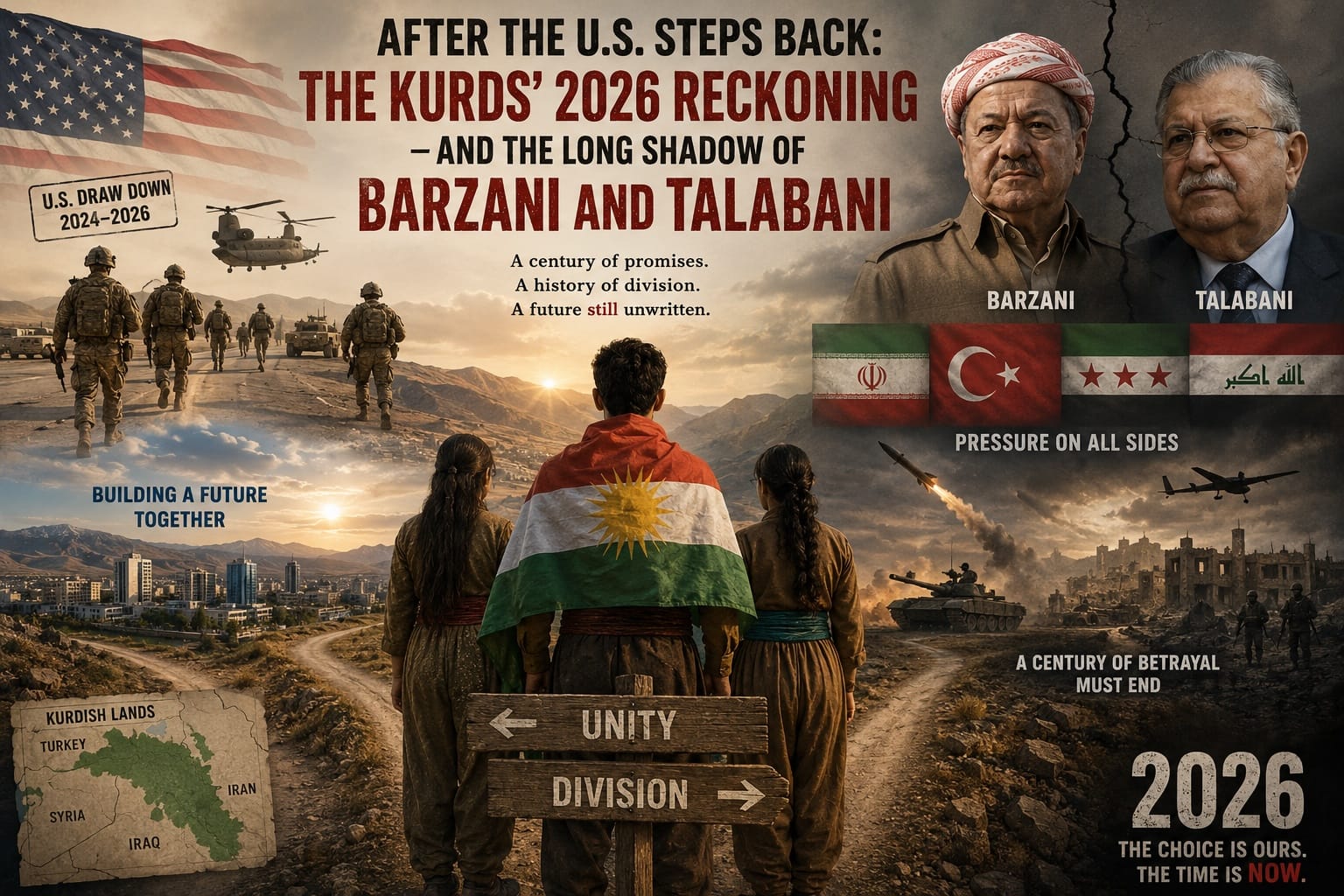
Through 2026, the security and political architecture that Iraqi and Syrian Kurds have relied on for a generation has been dismantled piece by piece. American troops have wound down their footprint in both countries, the Kurdish-led Syrian Democratic Forces (SDF) have formally dissolved into the Syrian national army, Baghdad is tightening its grip on armed factions outside state control, and the Pentagon's funding mechanism for the Peshmerga is set to lapse. Iran, Turkey, and the central governments in Damascus and Baghdad are each moving to fill the resulting space.
Some observers frame this moment as an opening: without the cushion of American backing, could Kurdish factions across Iraq and Syria finally set aside the rivalries that have divided them since the 1990s — rivalries embodied above all by the Barzani and Talabani political dynasties? Others see it simply as the latest chapter in a century-long pattern, in which external powers use the Kurds and then withdraw, and Kurdish factions turn on each other rather than uniting. Both readings have serious backers, and the historical record — recounted below — offers support for either conclusion.
Part I: The 2026 squeeze
The U.S. drawdown, in phases
Washington and Baghdad agreed in September 2024 that the U.S.-led coalition mission in Iraq would wind down in two stages: coalition forces left Iraq's federal territory (outside the Kurdistan Region) by September 2025, while a reduced American presence continued operating from Erbil and from bases in northeast Syria, with a further pullback expected around September 2026. In April 2026, U.S. forces handed over their last base in northeast Syria, the Qasrak base in Hasakah, ending a decade-plus partnership with the SDF, though limited counter-ISIS cooperation with Iraqi and Kurdish forces continues in reduced form.
Layered onto the troop drawdown is a funding dispute. The Pentagon's memorandum of understanding with the Kurdistan Regional Government (KRG) — which has underwritten Peshmerga salaries, training, and reform efforts since 2016 and was last renewed in 2022 — is due to expire on September 30, 2026, the same date coalition forces are slated to leave Iraq. U.S. officials have told the KRG they do not currently intend to renew it, and the Pentagon has proposed eliminating the roughly $61 million in annual counter-ISIS aid to the Peshmerga's 180,000-strong force in its next budget request. KRG officials have pushed back on the more alarming framing, insisting the expiration reflects the planned end of a specific counter-ISIS funding mechanism rather than a full American abandonment, and that talks on a successor framework are expected. This is unfolding against intensified Iranian missile and drone strikes on Iraqi Kurdistan — roughly 158 by late May 2026, according to one Washington think tank's count — which has sharpened Kurdish anxiety about the funding gap.
Iran's pressure campaign
Rather than direct territorial moves, Iran has relied on missile and drone pressure against Iraqi Kurdistan — intensified since U.S. Patriot batteries were drawn down from Erbil — combined with diplomatic pressure on the KRG to curb Iranian-Kurdish opposition groups that have long used the Qandil Mountains as a rear base.
Syria: an integration process, not a single event
The SDF's dissolution as an independent force predates and is only loosely tied to the U.S. base handover. It traces back to a March 2025 agreement between SDF commander Mazloum Abdi and Syria's interim president Ahmad al-Sharaa to fold northeast Syria's civil and military institutions into the Syrian state. Talks stalled repeatedly, and in January–February 2026 Damascus's forces moved militarily to impose integration on Kurdish-held areas, triggering weeks of clashes before a ceasefire and a more detailed agreement were reached, reportedly with U.S. mediation. SDF units were folded into new Syrian army divisions on a unit-by-unit basis, and al-Sharaa issued a decree granting citizenship to stateless Kurds and recognizing Kurdish as a national language — real concessions, though not yet written into Syria's constitution. Abdi announced the process fully complete on August 25, 2026. Analysts note unresolved friction, including reported reluctance to integrate the all-female YPJ units and lingering distrust after Kurdish representatives were excluded from earlier constitutional drafting.
Baghdad reasserts control
The Iraqi central government has used the coalition withdrawal deadline to press armed groups — Kurdish and otherwise — toward absorption into state institutions and to restrict weapons to official channels, part of a broader post-ISIS consolidation of Baghdad's authority that reduces the KRG's independent leverage.
Turkey's parallel track
Turkey has used the loosening of the American security umbrella to continue operations against the PKK and its affiliates in northern Iraq and Syria, while maintaining a close economic and security relationship with the KDP-led administration in Erbil — a relationship Ankara has periodically leveraged to press Erbil to act against Kurdish groups it considers hostile. A separate development, the PKK's 2025 announcement that it would disband and end its armed insurgency, has also reshaped this picture, removing a fixed variable that Ankara, the KDP, and the PUK had each maneuvered around for years.
Part II: The historical roots of Kurdish disunity
1946 — The Republic of Mahabad and the birth of the KDP
During World War II, Anglo-Soviet forces occupied Iran to secure supply lines, and the resulting power vacuum left northwestern Iran under Soviet influence. Kurdish nationalists used the opening to declare the Republic of Mahabad, with Qazi Muhammad as president. Mustafa Barzani arrived from Iraq with several thousand fighters and became the republic's military commander. The episode became one of the first major confrontations of the emerging Cold War: sustained U.S. and British diplomatic pressure, exercised through the UN Security Council and bilateral channels, contributed to a Soviet withdrawal from northern Iran in 1946. Deprived of its external protector, Mahabad was overrun within months by the Imperial Iranian Army. Qazi Muhammad was captured and executed; Barzani led his fighters on a long retreat into the Soviet Union, where he remained in exile for over a decade. That same year, Barzani founded the Kurdistan Democratic Party (KDP) to carry the movement forward — the party his son Masoud Barzani would later lead.
1975 — The Algiers Agreement
Between 1972 and 1975, the CIA, acting at the urging of the Shah of Iran and with the authorization of Henry Kissinger and Richard Nixon, funneled covert money and weapons to Mustafa Barzani's renewed insurgency against Baghdad. U.S. officials later acknowledged the aim was to tie down the Iraqi military and protect Iranian interests, not to secure Kurdish independence. That support ended abruptly when the Shah and Iraqi Vice President Saddam Hussein struck a deal at an OPEC summit in Algiers, mediated by Algerian President Houari Boumédiène: Iraq conceded shared sovereignty over the Shatt al-Arab waterway, and in exchange the Shah cut off aid to the Kurds and sealed the border. Barzani's revolt collapsed within weeks.
That same year, a faction broke away from the KDP amid recriminations over the Algiers collapse and Barzani's leadership. In 1975, Jalal Talabani founded the Patriotic Union of Kurdistan (PUK), setting up the rivalry that would define Iraqi Kurdish politics for the next half-century.
1991 — Uprising, betrayal, and Operation Provide Comfort
After the Gulf War, President George H.W. Bush publicly encouraged Iraqis to rise against Saddam Hussein. Kurds in the north and Shia in the south took up the call, believing it signaled U.S. support. A ceasefire after roughly 100 hours of ground combat, however, left Saddam's elite units intact, and with the coalition's advance halted, Saddam turned his remaining forces and helicopter gunships on the uprisings. The crackdown triggered a mass exodus: more than a million Kurds fled toward the Turkish and Iranian borders. The scale of the humanitarian crisis prompted the U.S. and its allies to launch Operation Provide Comfort, establishing a safe haven and no-fly zone in northern Iraq. Within that protected space, the KDP and PUK each carved out control of different areas — setting the stage for the next conflict.
1994–1998 — The Iraqi Kurdish Civil War
With Baghdad's authority removed from the north but revenue and power left undefined, tensions between the KDP and PUK over shared administration, customs revenue from border crossings, and smuggling routes broke into open warfare in May 1994. The conflict — known locally as Şerî birakujî, the "fratricidal war" — killed an estimated 5,000 to 8,000 fighters and civilians over four years.
Each side drew in outside patrons. Iran backed Talabani's PUK with weapons, funding, and safe haven, partly to counter Iraqi influence and to pressure Iranian-Kurdish dissident groups sheltering in northern Iraq. Turkey, focused above all on the PKK's use of northern Iraq as a staging ground, aligned primarily with Barzani's KDP and mounted repeated cross-border incursions against PKK camps. In the war's most dramatic turn, Barzani's KDP — facing defeat by the PUK in August 1996 — appealed to Saddam Hussein's regime for help. Saddam sent tens of thousands of troops and armored units into the region, seizing Erbil and pushing the PUK back toward the Iranian border, a stunning alliance between the KDP and the same Baghdad government that had gassed Kurdish civilians at Halabja less than a decade earlier.
The war ended with the U.S.-brokered Washington Agreement, signed by Barzani and Talabani on September 17, 1998. Its terms included: equitable sharing of customs revenue from border crossings, especially the lucrative Ibrahim Khalil crossing with Turkey; a framework for a unified regional government and parliament to replace the two parties' competing administrations; commitments by both sides to deny the PKK sanctuary and to work toward merging their Peshmerga forces; and a U.S. guarantee to protect the Kurdish enclave from renewed attack by Saddam's military.
In practice, unification was only ever partial. The war left Iraqi Kurdistan split into a KDP-run "Yellow Zone" centered on Erbil and Dohuk and a PUK-run "Green Zone" centered on Sulaymaniyah, each with its own administration, security apparatus, and — despite decades of Western-backed reform efforts — party-loyal Peshmerga units rather than a single unified force. Power in each zone consolidated within the founding families: the Barzanis in the KDP, holding the KRG presidency and other senior posts, and the Talabanis in the PUK. That dynastic, dual-track structure has repeatedly weakened Kurdish leverage in negotiations with Baghdad over oil revenue, budget shares, and disputed territories such as Kirkuk.
1999 — The capture of Abdullah Öcalan
The PKK's founder, Abdullah Öcalan, was seized by Turkish intelligence in Nairobi, Kenya, in February 1999 after being expelled from Syria the previous year under Turkish military pressure. The United States did not carry out the operation directly, but the Clinton administration — including Secretary of State Madeleine Albright — played a significant diplomatic and intelligence-sharing role in the lead-up, reportedly discouraging other governments from sheltering him and aiding Turkish efforts to track his movements. Öcalan's capture removed the PKK's central leader from the field for the following quarter-century of insurgency, though the organization continued fighting until its 2025 announcement that it would disband.
The pattern that persists
Across these episodes — Mahabad, the Algiers Agreement, the 1991 uprising, and the KDP-PUK civil war — a recurring structure emerges: Kurdish forces gain external backing tied to a patron's own strategic interests, that patron's interests shift, and support is withdrawn with limited notice, often leaving Kurdish communities exposed to retaliation. Layered on top of that has been persistent internal division: the KDP's enduring alignment with Turkey and the PUK's with Iran have functioned less as temporary wartime alliances than as long-term structural features of Iraqi Kurdish politics, reinforced by two ruling families whose succession has, so far, outlasted the conflicts that produced them.
Is a more unified Kurdish future possible?
Some analysts argue that the simultaneous erosion of American backing, the SDF's absorption into Damascus, and pressure on the KRG's finances could push Kurdish factions across Iraq and Syria toward closer coordination out of necessity, since none can now count on outside patronage to offset rivals. Others are skeptical, pointing out that the KDP-Turkey and PUK-Iran axes remain intact, that Damascus and Baghdad have each gained leverage over Kurdish forces rather than lost it, and that Kurdish political divisions have historically widened rather than narrowed under external pressure — including at the very moment, in 1991 and again in 1994, when a common external threat might have been expected to unite them. Whether 2026 breaks that pattern or repeats it will likely depend on choices Kurdish leaders — and their neighbors — make over the coming year, not on the withdrawal timeline alone.
Sources
- Middle East Forum, "The United States Exiting Kurdish Syria Is a Mistake" (April 2026)
- Gulf International Forum, "Redeployment or Withdrawal: Evaluating U.S. Troop Drawdown in Iraq" (2025–2026)
- Kurdistan24, Pentagon troop-reduction and Kurdistan Region reporting (2025–2026)
- Forbes / Paul Iddon, "Prospects and Risks of a U.S. Troop Withdrawal from Syria and Iraq" (Feb. 2026)
- BBC / Arab News / The National, reporting on the expiring Peshmerga MOU (Aug. 2026)
- Inkstick Media, "In Iraqi Kurdistan, Peshmerga Reform Dies on the Vine" (June 2026)
- The National, Middle East Council on Global Affairs, FDD, and SANA, reporting on the SDF–Damascus integration process (Jan.–Aug. 2026)
- Historical background on the Republic of Mahabad (1946), the Algiers Agreement (1975), the 1991 uprising and Operation Provide Comfort, the 1994–1998 Iraqi Kurdish Civil War and Washington Agreement, and the 1999 capture of Abdullah Öcalan drawn from the established historical record.
This article reflects reporting available as of late August 2026; the situation in Iraq and Syria remains fluid.