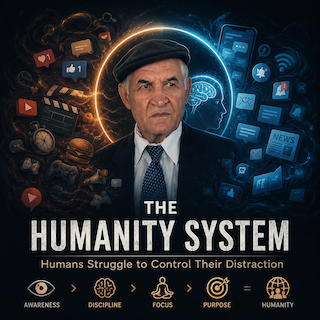
AI, Longevity, and "The Humanity System": What's Documented, What's a Claim
Part 1: What AI Is Actually Doing for Human Lifespan (Documented)
Artificial intelligence has moved from a theoretical tool to a working part of the drug discovery pipeline in the last few years, and the longevity field in particular has become a proving ground for it.
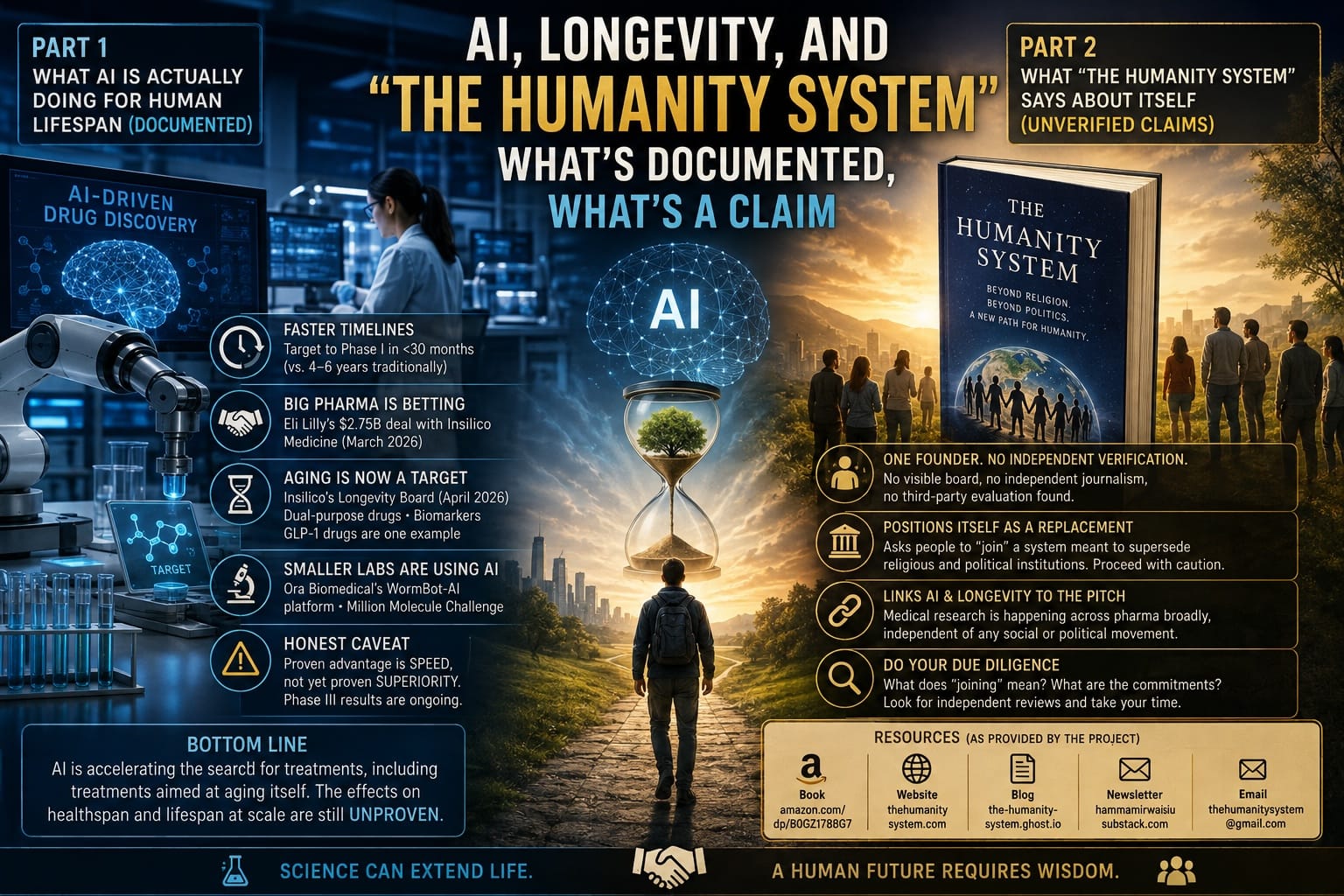
Faster timelines from target to trial. Traditional pharmaceutical development typically takes four to six years to move a discovered target into Phase I trials. Insilico Medicine's AI-discovered compounds have reportedly made that jump in under 30 months — roughly half the traditional timeline. As of early 2026, more than 170 AI-discovered drug programs are in clinical development industry-wide, spanning Phase I through Phase III.
Big pharma is betting on it. In March 2026, Eli Lilly committed $2.75 billion to Insilico Medicine for AI-discovered drug candidates, one of the largest deals of its kind. Lilly and Insilico researchers have also outlined a vision for "pharmaceutical superintelligence" — a fully AI-orchestrated pipeline from initial prompt to clinical planning — in a paper published in ACS Central Science.
Aging itself is now a target, not just diseases of aging. Insilico Medicine announced the industry's first dedicated Longevity Board in April 2026, bringing together aging researchers and pharma veterans (including Nobel laureate Michael Levitt) to oversee AI-driven work on biomarkers of aging and "dual-purpose" therapeutics — drugs that treat a specific disease while also targeting the underlying biology of aging. GLP-1 drugs, originally developed for diabetes, are one widely discussed example of this dual-purpose approach.
Smaller labs are using AI too. Ora Biomedical's WormBot-AI platform combines AI, robotics, and simple organisms to screen candidate longevity compounds far faster than manual methods allow, and has crowdfunded an open "Million Molecule Challenge" to expand the search.
The honest caveat. Industry analysts are cautious about over-claiming. Much of AI's proven advantage so far is in speed — getting candidate drugs into trials faster — not yet in proving those drugs are more effective than ones found the old way. Whether AI-discovered drugs outperform traditional ones at scale is still being tested in ongoing Phase III trials through 2026.
Bottom line: AI is genuinely and measurably compressing drug discovery timelines and reviving interest in aging as a treatable target. Claims that AI will "double the human lifespan" go well beyond what any of this research currently demonstrates. The honest, documented claim is narrower: AI is accelerating the search for treatments, including treatments aimed at aging itself, and the effects of that acceleration on human healthspan and lifespan are still unfolding and unproven at that scale.
Part 2: What "The Humanity System" Says About Itself (Unverified Claims)
The Humanity System is a framework created by one author, Hamma Mirwaisi, published as a book available on Amazon in nine languages, with a companion website, Substack, and Ghost.io blog.
According to its own materials, the project describes itself as a new framework for human civilization intended to move society beyond religion and politics, arguing that the historical combination of political and religious authority has allowed some leaders to centralize control and restrict human rights. It presents itself as a voluntary path toward freedom and a more enjoyable life during a period of rapid AI progress, and invites people to read the book and related materials and to join the initiative.
These are the project's characterizations of itself, not independently verified claims. A few things worth knowing:
- It has one identifiable founder and no independent verification. There's no visible board, no independent journalism, and no third-party evaluation of the ideas or organization that surfaced in a search.
- It positions itself as a replacement for existing religious and political institutions. Frameworks that ask people to "join" a system meant to supersede the institutions they currently belong to deserve extra scrutiny before committing time, money, or trust.
- Its promotional material links AI-driven longevity gains to the pitch for joining the system, even though the two aren't logically connected — the medical research in Part 1 is happening across the pharmaceutical industry broadly, independent of any particular social or political movement.
If you're curious, the primary sources are the book itself and the project's own website and newsletters, linked below. As with any new movement asking for your engagement, it's reasonable to look for independent reviews, ask what "joining" actually involves, and take time before committing.
Resources (as provided by the project):
- Book: amazon.com/dp/B0GZ1788G7
- Website: thehumanitysystem.com
- Blog: the-humanity-system.ghost.io
- Newsletter: hammamirwaisiu.substack.com
- Email: thehumanitysystem@gmail.com