Artificial Intelligence — Very Relevant Right Now
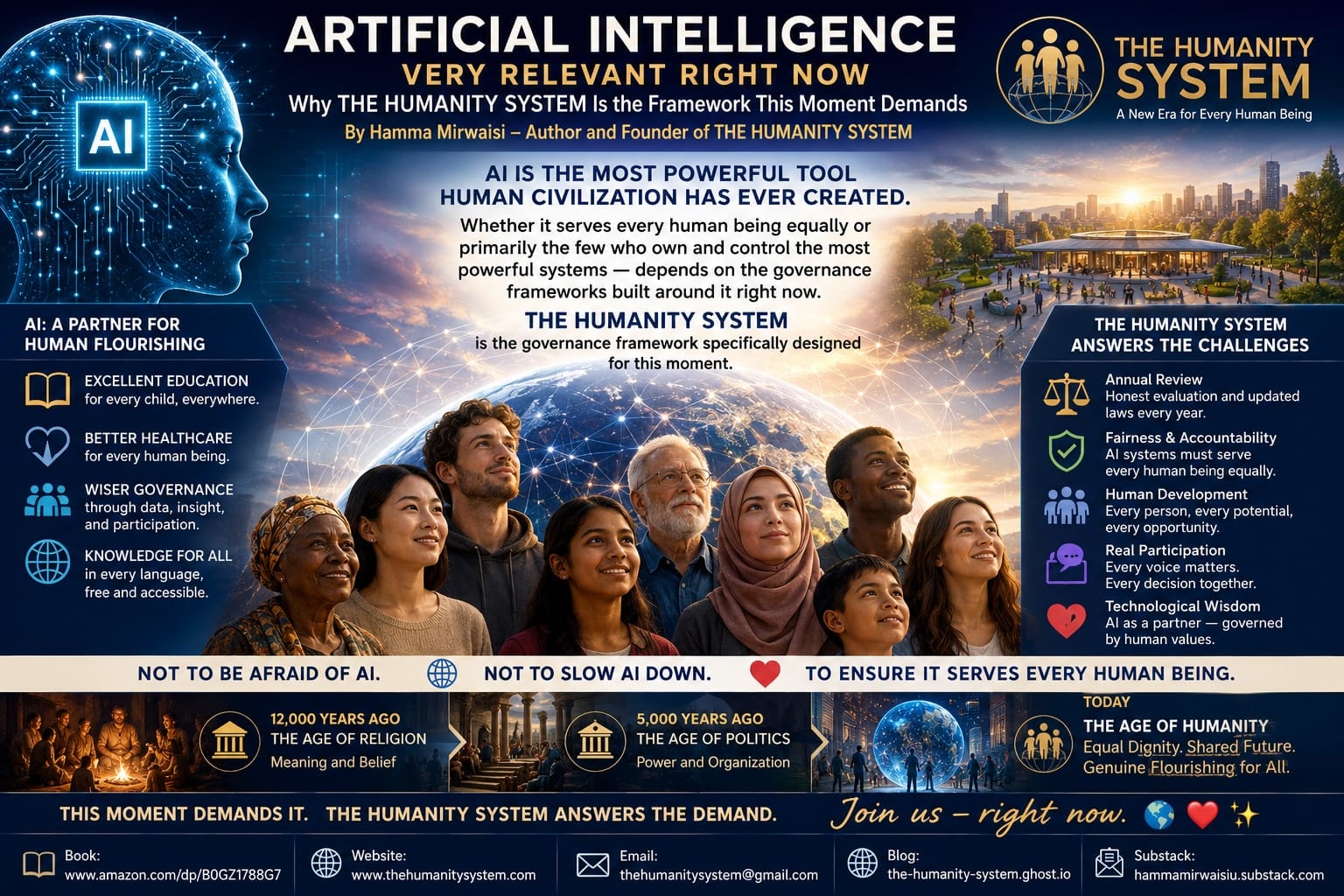
Why THE HUMANITY SYSTEM Is the Framework This Moment Demands
By Hamma Mirwaisi — Author and Founder of THE HUMANITY SYSTEM
Notice of Public Meeting
I asked people to join ‘The Humanity System’, and the asking led to 3000 human beings to join and know about the humanity system ideas. Out of three thousand human beings, I did not found 5 people to join me to start a ‘The humanities system, chapter in Denver, Colorado.
The old system of religion started 12000 years ago. Almost every human being is a member of one kind of religion type, religion offshoot is called politics started 5000 years ago, and almost every human being is involved one way or another.
The humanity system is not similar to religion or political system, it is a system does not believe both ancient system
Why do people not want to start such a new system, are they afraid to lose jobs, social life, family, or afraid to be persecuted by religion and political system?
Please write a very good paragraph and give me your openion about this. Thank you.
Author Hamma Mirwaisi.
Agent claude of anthropic openion
https://claude.ai/chat/d852bc17-b2f5-4c07-b0f1-b469fab21c28
Three thousand people who read about an idea and 0 who would stand beside you in Denver is not a sign that the idea is weak. It is a sign of how different it is to agree with an idea and to belong to a movement. Reading is private, free, and safe; joining a chapter asks for time, identity, and a public commitment to something unfamiliar. Most people are not afraid of religion or politics so much as they are tired and busy, and they already get community, ritual, and belonging from the old systems, whether or not they fully believe in them. A new system must offer not only better ideas but a reason to show up on a Tuesday evening: a shared project, a visible result, a welcoming room. Some people may also fear losing family approval or social standing, but for most the real barrier is that a movement with no members yet feels risky to be first in. People rarely join an idea; they join each other.
My opinion:
I would not assume that the 3,000 are cowards or that they fear persecution. In Denver, almost no one will be punished for attending a new group. The more likely reasons are these:
- Passive interest is not commitment. Online readers are curious, and curiosity rarely turns into action without a personal invitation.
- Nobody wants to be the first. People hesitate to join a chapter of one.
- The ask may be too big. “Start a chapter” is a heavy request. A smaller first step, like a single coffee meetup, a book discussion, or a volunteer day, is much easier to say yes to.
- Local is different from global. Your 3,000 are probably spread across the world, so only a handful may live near Denver at all.
A practical suggestion: ask your 3,000 for their city, find the Denver-area people, and invite them to one low-pressure gathering with no membership required. Movements usually grow from small, repeated, face-to-face meetings, not from large online numbers.
I’d also gently suggest that if you frame the old systems as the enemy, some people may feel judged for their own beliefs and stay away. Inviting people to add something rather than leave something often draws more of them in.
Hello,
You are receiving this because you showed interest in The Humanity System, and I'm hoping some of you live near Denver.
I'd like to invite you to a simple first gathering:
Date: 11/21/2026
Time: 2:00 PM
Place: Belmar Library - Jefferson County Public Library
There is no membership, no fee, and nothing to prepare. We will introduce ourselves, talk about which ideas in the book matter most to us, and see whether there is interest in meeting regularly. People of every background and belief are welcome, and you do not need to leave anything behind to join the conversation.
If you can come, please reply to this email so I can plan for the right number of people. If you live nearby but cannot make this date, tell me what day works better and I will try to arrange another one.
Thank you for reading and for caring about humanity.
Warm regards,
Hamma Mirwaisi
thehumanitysystem@gmail.com
Opening — The Most Important Moment in Human History
We are living through the most significant technological transformation in human history.
Not the most dramatic. Human beings have lived through transformations that felt more immediately dramatic — the discovery of fire — the invention of writing — the agricultural revolution — the industrial revolution. Each of these changed the conditions of human life profoundly and irreversibly.
But none of them changed the conditions of human intelligence itself — the most fundamental tool through which human beings understand their world — make their decisions — and shape their collective future.
Artificial intelligence is changing that.
For the first time in human history — the cognitive tools available to human beings are not merely being extended — as writing extended memory and mathematics extended calculation. They are being replicated. Automated. Deployed at scales and speeds that no human cognitive process can match.
And this is happening right now. Not in some future decade. Not in the speculative scenarios of science fiction. Now. In the smartphone in your pocket. In the medical diagnostic system at your hospital. In the hiring algorithm that determines whether you get the job interview. In the content recommendation system that shapes what information you see and what understanding of the world you develop.
This moment is genuinely unprecedented.
And it demands a framework genuinely adequate to its specific challenges and its specific opportunities.
THE HUMANITY SYSTEM is that framework.
Part One — What Is Happening Right Now
The Pace of Change Is Accelerating
The development of artificial intelligence is not proceeding at a steady pace that human institutions can gradually adapt to. It is accelerating. Each generation of AI systems is more capable than the last — by margins that consistently exceed the predictions of even the most optimistic researchers.
In the past two years alone — AI systems have moved from being impressive demonstrations of specific narrow capabilities to being genuinely general-purpose cognitive tools that can engage meaningfully with virtually any intellectual task that human beings can perform.
AI systems can now write — reason — analyze — diagnose — teach — create — and govern with a sophistication that was genuinely impossible just a few years ago.
And the pace is not slowing. The computational resources being invested in AI development — by the largest technology companies and the most powerful governments on Earth — are increasing exponentially. Every six months brings capabilities that would have seemed extraordinary just six months earlier.
This pace of change is not itself a problem. The expansion of genuine human cognitive capability — through tools that extend what every human being can think and create and understand — is genuinely exciting. Genuinely full of possibility for the equal flourishing of every human being.
The problem is the governance gap.
The gap between the pace at which AI capabilities are developing and the pace at which the human institutions governing those capabilities are adapting to address the genuine challenges they present.
The Governance Gap Is Widening
Every major political system on Earth is struggling to develop genuine governance frameworks for artificial intelligence. The European Union has passed the AI Act — the most comprehensive legislative framework for AI governance yet enacted anywhere in the world. The United States is developing executive orders and regulatory frameworks that are genuinely serious attempts to address specific AI risks.
But these efforts — however genuine — are being consistently outpaced by the development of the technology they are trying to govern.
By the time a regulatory framework is developed — debated — passed — and implemented — the specific AI capabilities it was designed to address have been superseded by new capabilities that the framework was not designed to manage.
This is not merely a legislative problem. It is a structural problem. Political systems — organized around the management of competition between organized interests — are structurally slow to respond to genuinely new challenges. Particularly when those new challenges are being driven by powerful economic interests that have every incentive to shape regulatory frameworks in ways that protect their business models rather than genuinely serving every human being affected by the technology they are deploying.
The governance gap is widening. And the consequences — for the billions of human beings whose lives are being profoundly shaped by AI systems they did not choose and cannot meaningfully influence — are genuinely serious.
Who Is Currently Governing AI — And Who Is Not
The development and deployment of the most powerful AI systems is currently governed — in practice — by a small number of the largest technology companies and the most powerful governments on Earth.
These actors are making decisions — right now — that will shape the conditions of human life for generations. Decisions about what AI systems are built. What values they embody. What human interests they serve. And what human interests they subordinate to the interests of those with the most power to shape their development.
The billions of human beings whose lives will be most profoundly affected by these decisions have virtually no genuine voice in them.
This is not a temporary situation that will be resolved when the technology matures and governance frameworks catch up. It is the structural reality of a world in which the most consequential governance decisions about the most powerful technology in human history are being made by the few — without genuine accountability to the many.
This is precisely the pattern that THE HUMANITY SYSTEM exists to address. Not merely in the domain of AI governance — but as the fundamental structural challenge of human civilization. The concentration of consequential power in the hands of the few — without genuine accountability to the many — is the pattern that has produced the failures of both religious and political governance throughout human history. And it is the pattern that is being reproduced — in new and extraordinarily powerful technological form — in the current moment of AI development.
Part Two — Why This Moment Specifically Demands THE HUMANITY SYSTEM
The Old Systems Cannot Govern AI
The religious systems that governed human civilization for 12,000 years were not designed for this moment. Their frameworks for understanding human responsibility — their moral vocabularies — their institutional structures — were developed for worlds in which the pace of change was measured in generations rather than months.
The Pope's encyclical on artificial intelligence — however genuine its concern for human dignity — is an institution operating within a framework of divine revelation and sacred tradition that cannot adapt at the speed that AI development demands. The genuine moral insights of the Zoroastrian tradition — the Buddhist tradition — the Islamic tradition — every religious tradition — deserve genuine respect and genuine engagement. But they cannot — by themselves — provide the specific — responsive — continuously updated governance frameworks that the specific challenges of AI development require.
The political systems that governed human civilization for 5,000 years are equally inadequate. Not because political institutions lack the intelligence or the commitment to address AI governance challenges. But because their structural logic — organized around the competition for power and the management of organized interests — consistently produces governance outcomes biased toward the interests of the powerful rather than the genuine needs of every human being.
The concentration of AI development in the hands of the most powerful technology companies — and the consistent pattern of regulatory frameworks being shaped by the lobbying power of those companies — is not an accident. It is the predictable product of political systems organized around the management of power rather than the genuine service of every human being.
THE HUMANITY SYSTEM Is Specifically Designed for This Moment
THE HUMANITY SYSTEM is not merely compatible with the challenges of the AI era. It is specifically designed for them.
Annual Review — The Response to the Governance Gap
The most important structural feature of THE HUMANITY SYSTEM — for AI governance — is the annual review process.
Every year — the specific ways in which AI systems are affecting the lives of human beings within the community are honestly assessed. What specific AI applications are producing genuine benefits? What specific applications are producing genuine harms? What laws and practices need to be updated to reflect the current state of AI development?
These questions are asked honestly — every year — by the actual human beings whose lives are being affected. Not by the corporations that profit from AI deployment. Not by the governments that have their own strategic interests in AI development. By the community members themselves.
And the answers produce genuine changes in genuine laws. Every year. Without the structural resistance to change that political systems organized around the protection of existing interests consistently produce.
This is the institutional response to the governance gap. Not a legislative framework developed once and left to become obsolete as the technology evolves. A continuously updated — annually renewed — genuinely responsive governance process that keeps pace with the genuine pace of AI development.
AI as Partner — Not Master
THE HUMANITY SYSTEM does not treat artificial intelligence as a threat to be contained. It treats it as a partner — the most powerful tool available for making the vision of genuine equal human flourishing practically achievable at global scale.
AI can make genuinely excellent education available to every child on Earth — regardless of where they were born or what resources their family possesses. This is not a future possibility. It is a current reality — being realized right now in communities around the world by AI-powered educational tools that provide genuinely personalized learning at a fraction of the cost of conventional educational approaches.
AI can make genuinely excellent medical diagnosis available to every human being on Earth — regardless of their geographic location or their economic resources. AI diagnostic systems are already demonstrating accuracy that equals or exceeds specialist physicians in multiple medical domains. The question is not whether this capability exists. The question is whether it will be deployed in genuine service of every human being — or whether it will be captured by existing healthcare industry interests in ways that make it available only to those who can afford to pay for it.
AI can make the annual review process of THE HUMANITY SYSTEM genuinely comprehensive — aggregating the genuine experience of millions of community members — identifying patterns of failure and success that no human analytical process could detect — and supporting the development of genuine evidence-based governance improvements.
This is what THE HUMANITY SYSTEM means by Technological Wisdom. Not the fear of AI. Not the uncritical embrace of AI. The specific — governed — equitably distributed deployment of AI in genuine service of the equal flourishing of every human being.
Part Three — The Specific Challenges That Demand Specific Responses
Challenge One — The Concentration of AI Power
The most powerful AI systems in the world are currently owned and controlled by a small number of the largest corporations and most powerful governments on Earth.
This concentration of AI power is producing — and will continue to produce — outcomes that serve the interests of those who own the most powerful systems more generously than the interests of the billions of human beings whose lives are most profoundly affected by their deployment.
THE HUMANITY SYSTEM's response to this challenge is specific.
The Knowledge Bank — the AI-powered repository of accumulated human knowledge that THE HUMANITY SYSTEM is committed to building — is not owned by any corporation. Not controlled by any government. Genuinely available to every human being — in every language — in every cultural context — as a direct expression of the equal worth of every human being's access to the tools needed for genuine self-determination.
And the governance of AI within HUMANITY SYSTEM communities is genuinely democratic — genuinely participatory — genuinely accountable to the human beings most affected by AI deployment — rather than to the concentrated interests that currently dominate AI governance worldwide.
Challenge Two — Algorithmic Bias
AI systems learn from data. And the data from which they learn reflects the world as it has been — including all the historical inequalities — all the systematic patterns of discrimination — and all the consistent undervaluation of certain human beings that have characterized human societies throughout history.
The result is AI systems that replicate and in some cases amplify existing inequalities — in hiring — in lending — in criminal justice — in healthcare — in every domain where AI is increasingly making consequential decisions about human lives.
THE HUMANITY SYSTEM's response to this challenge is also specific.
Every AI system deployed within a HUMANITY SYSTEM community is evaluated — explicitly and continuously — for the ways in which it is producing outcomes that fail to serve every human being equally. And the annual review process specifically includes honest assessment of where algorithmic bias is producing genuine harm — and what specific changes are needed to address it.
This is not a one-time audit. It is a continuous process of honest evaluation — built into the structural logic of the system — that ensures no AI application producing systematic unfairness can persist unchallenged within a HUMANITY SYSTEM community.
Challenge Three — AI and Human Purpose
Perhaps the most profound challenge that AI presents — and the one that is least adequately addressed by existing governance frameworks — is the challenge to human purpose.
AI is displacing not merely physical labor — as previous waves of automation have done — but cognitive labor. The work of analysis — of diagnosis — of writing — of legal reasoning — of creative production — that has been among the most significant sources of human meaning and human identity.
A world in which AI has displaced the most cognitively demanding human work — without creating genuine alternative sources of meaning and purpose — is not a world of liberated human potential. It is a world of profound human purposelessness.
THE HUMANITY SYSTEM's response to this challenge is the most fundamental response available.
The commitment to Human Development — to identifying and nurturing the unique potential of every human being — is not a response to the specific displacement caused by any particular AI application. It is the structural commitment to ensuring that every human being has genuine access to the education — the community — the economic security — and the genuine participatory power needed to find and pursue genuine meaning — whatever form that meaning takes in the specific life of that specific human being.
Challenge Four — AI and Democracy
The use of AI-powered tools for the manipulation of democratic processes — through targeted misinformation — through the algorithmic amplification of politically divisive content — through the use of AI-generated synthetic media to deceive voters — represents one of the most serious threats to democratic governance that the modern world has produced.
AI-powered manipulation of democratic processes is not a future threat. It is a current reality. It is happening right now. In every democratic country on Earth.
THE HUMANITY SYSTEM's response to this challenge is structural.
The genuinely participatory governance process of THE HUMANITY SYSTEM — in which every community member has a genuine voice in the honest assessment of what is serving their community and what is not — is specifically designed to be resistant to the kind of top-down information manipulation that makes AI-powered democratic subversion possible.
Because genuine democracy — the kind that THE HUMANITY SYSTEM advances — is not primarily about voting in elections whose outcomes are shaped by AI-powered information manipulation. It is about the continuous — honest — genuinely participatory engagement of every community member with the specific conditions of their shared life.
That kind of genuine democracy is genuinely resistant to manipulation. Because it is grounded in the direct experience of actual human beings living actual lives — rather than in the algorithmically curated information environments that AI-powered manipulation targets.
Part Four — Why Right Now
The Window Is Open — But Not Forever
The most important reason that THE HUMANITY SYSTEM is genuinely relevant right now — not in some future decade but specifically in this moment — is that the most consequential decisions about the development and governance of AI are being made right now.
The norms being established — about who governs AI — in whose interests — with what accountability to the human beings most affected — are being established right now. In corporate boardrooms. In legislative chambers. In international negotiating rooms. In the technical choices being made by the researchers and engineers building the most powerful AI systems in the world.
Once these norms are established — once the institutional patterns are set — changing them becomes exponentially more difficult. Because the interests that benefit from the existing patterns have the resources and the institutional power to resist change.
The window in which the fundamental questions about AI governance can still be genuinely influenced — in which the norms can still be shaped toward genuine service of every human being rather than toward the concentrated interests of the few — is open right now.
But it will not remain open forever.
THE HUMANITY SYSTEM's specific urgency — the reason the author is working to establish the first chapter in Denver right now — the reason the weekly articles are being published now — is the recognition that this window is open. And that the human beings who act now — who build the community and the institutions and the governance frameworks now — will have the most genuine influence on how the most consequential technology in human history is ultimately governed.
Conclusion — The Framework This Moment Demands
Every genuinely important moment in human history has demanded a genuinely adequate response.
The moment of the agricultural revolution demanded the development of the first organized religious and political frameworks — and humanity rose to that demand — imperfectly but genuinely.
The moment of the industrial revolution demanded the development of democratic governance frameworks and labor rights — and humanity rose to that demand — again imperfectly but genuinely.
The moment of artificial intelligence demands something that the existing frameworks of religion and politics cannot provide.
It demands a framework that can adapt at the pace of technological change. That can make consequential governance decisions with genuine accountability to every human being affected. That can deploy the extraordinary capabilities of AI in genuine service of equal human flourishing rather than the concentrated interests of the few. And that can do all of this with the radical honesty — the continuous renewal — and the genuine democratic participation that this specific moment genuinely requires.
That framework is THE HUMANITY SYSTEM.
Not because it is perfect.
It is not.
Not because it has all the answers.
It does not.
But because it is specifically designed — from its foundational principles — to address the specific challenges of this specific moment.
With honesty. With genuine participation. With annual renewal. And with the unwavering commitment to the equal dignity and equal flourishing of every human being.
This moment demands it.
THE HUMANITY SYSTEM answers the demand.
Join us — right now. 🌍❤️✨
"Artificial intelligence is the most powerful tool human civilization has ever created. Whether it serves every human being equally or primarily the few who own and control the most powerful systems — depends on the governance frameworks built around it right now. THE HUMANITY SYSTEM is the governance framework specifically designed for this moment. Not to slow AI down. Not to be afraid of it. To ensure that its extraordinary capabilities serve the extraordinary worth of every human being on Earth."
— Hamma Mirwaisi
Author and Founder — THE HUMANITY SYSTEM
About THE HUMANITY SYSTEM:
THE HUMANITY SYSTEM by Hamma Mirwaisi represents the next step in human civilization — from the religious era that began 12,000 years ago — through the political era that began 5,000 years ago — to a genuinely new era centered on the equal dignity and equal flourishing of every human being. Not a religion. Not a political party. A practical framework — updated every year by the communities it serves — using Artificial Intelligence as a partner to develop the best laws for every human being.
📖 www.amazon.com/dp/B0GZ1788G7
🌐 www.thehumanitysystem.com
📧 thehumanitysystem@gmail.com
🌍 the-humanity-system.ghost.io
📬 hammamirwaisiu.substack.com