
Beyond Shia and Sunni: The Many Faces of Islam — and What Iran and Afghanistan's Rulers Don't Want You to Know
By Hamma Mirwaisi
Author of two groundbreaking books and founder of The Humanity System — a genuinely new framework enabling human civilization to establish new centers anywhere in the world.
Most people in the West hear only two words when Islam comes up in the news: Sunni and Shia. It's treated as if the entire religion, stretching across 1.9 billion people and fourteen centuries, can be reduced to two rival teams. That picture is not just incomplete — it is precisely the kind of simplification that lets extremist regimes in Tehran and Kabul pretend they speak for "true Islam" when in reality they represent narrow, politicized minorities within a far more diverse tradition.
It's Not Just Two Branches
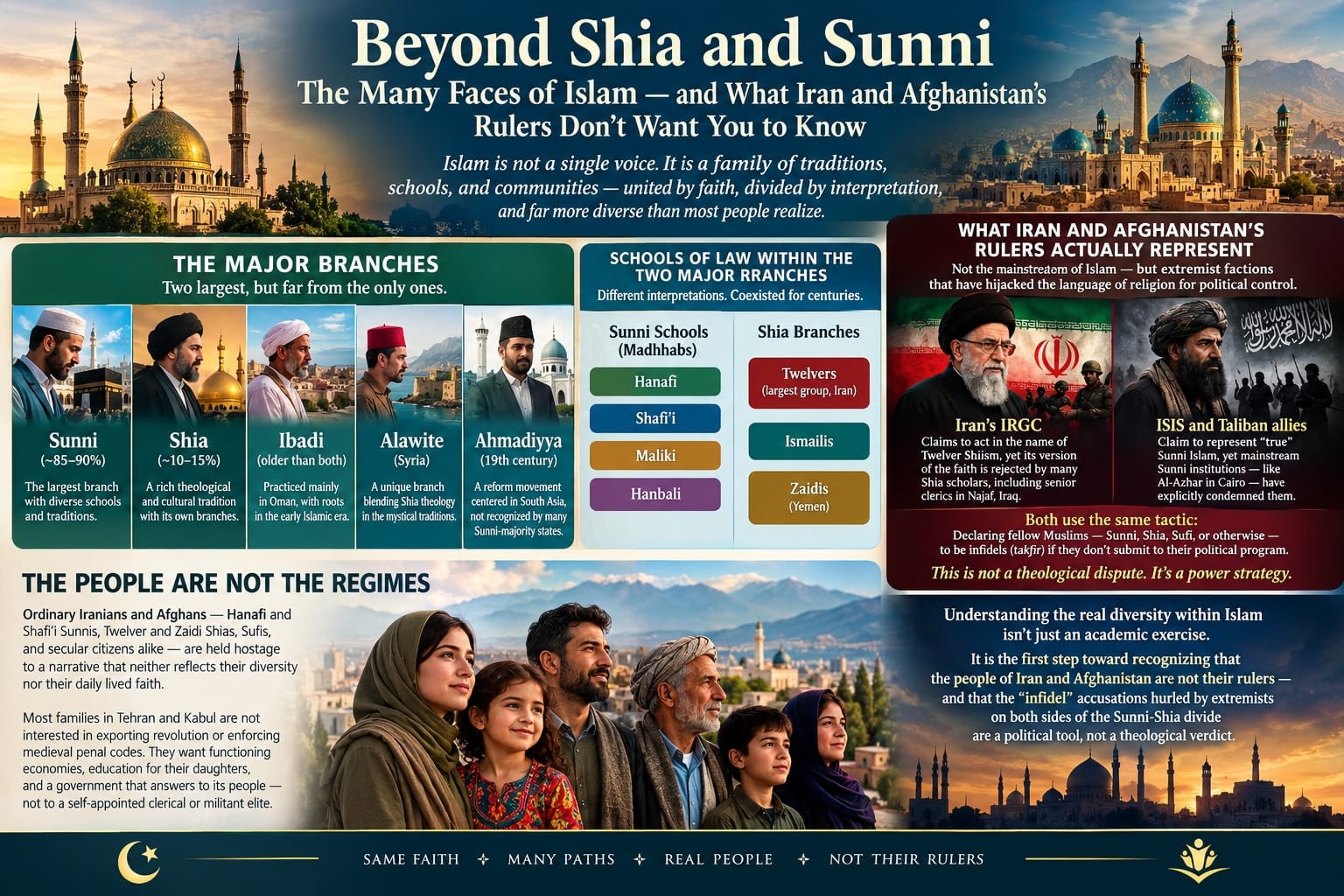
Sunni and Shia are the two largest branches, but they are far from the only ones. Smaller, historically significant branches include:
- Ibadi Islam — older than both Sunni and Shia, practiced mainly in Oman, with roots going back to the earliest years of Islamic history.
- Alawites — a branch closely associated with Syria, blending elements of Shia theology with distinct mystical traditions.
- Ahmadiyya — a nineteenth-century reform movement centered in South Asia, which many Sunni-majority states refuse to even recognize as Muslim.
None of these communities have armies of enforcers accusing the rest of the Muslim world of being infidels. That distinction matters.
Schools of Law Within the Two Major Branches
Even within Sunni and Shia Islam, there is no single, monolithic legal or theological voice:
- Sunni Islam organizes itself around four major schools of jurisprudence (madhhabs): Hanafi, Shafi'i, Maliki, and Hanbali. These schools differ on matters of ritual, family law, and interpretation, and for most of history they coexisted without treating each other as enemies.
- Shia Islam contains its own major branches, most notably the Twelvers (the largest group, dominant in Iran), the Ismailis, and the Zaidis (historically centered in Yemen).
This internal diversity is the point. Islam, like Christianity or Judaism, is not a single voice issuing single commands — it is a family of overlapping traditions, legal schools, and interpretive communities that have argued, debated, and coexisted for over a thousand years.
What Iran and Afghanistan Actually Represent
Here is the uncomfortable truth: the governments ruling Iran and Afghanistan today do not represent the mainstream of Sunni or Shia Islam — they represent extremist factions that have hijacked the language of religion to justify political control.
- Iran's Islamic Revolutionary Guard Corps (IRGC) operates in the name of Twelver Shiism, yet its politically weaponized version of the faith is rejected by many Shia scholars, including senior clerics in Najaf, Iraq, who favor a far less politically interventionist model of religious authority.
- Groups like ISIS, operating in the Sunni world including parts of Afghanistan, claim to represent "true" Sunni Islam, yet mainstream Sunni institutions — Al-Azhar in Cairo among them — have repeatedly and explicitly condemned them as a distortion of the faith, not an expression of it.
Both movements share a common tactic: declaring fellow Muslims — Sunni, Shia, Sufi, or otherwise — to be infidels (takfir) if they don't submit to their narrow political program. This is not a theological dispute. It is a strategy for consolidating power by monopolizing the definition of who counts as a "real" Muslim.
The People Are Not the Regimes
The tragedy is that ordinary Iranians and Afghans — Hanafi and Shafi'i Sunnis, Twelver and Zaidi Shias, Sufis, and secular citizens alike — are held hostage to a narrative that neither reflects their diversity nor their daily lived faith. Most families in Tehran and Kabul are not interested in exporting revolution or enforcing medieval penal codes. They want functioning economies, education for their daughters, and a government that answers to its people rather than to a self-appointed clerical or militant elite.
When the IRGC or the Taliban's allies claim to act "in the name of Islam," they are not channeling fourteen centuries of Islamic scholarship, jurisprudence, and internal pluralism. They are channeling a narrow, modern political ideology dressed in religious language — one most Muslims, across all of Islam's branches and schools, would not recognize as their own faith.
Understanding the real diversity within Islam isn't just an academic exercise. It is the first step toward recognizing that the people of Iran and Afghanistan are not their rulers — and that the "infidel" accusations hurled by extremists on both sides of the Sunni-Shia divide are a political tool, not a theological verdict.
Sources on Shia branches: Wikipedia — Zaydism