
Chapter 7: of the Book of Kurdistan
KURDISTAN
The Divided Land Between Persians, Arabs, and Turks
CHAPTER 7
Weaponized Vanguard: Conscription, De-population, and the
European Campaigns
https://www.amazon.com/dp/B0HKPYCS2S
An empire sustained by economic extraction must eventually expand or implode. Having institutionalized the Satrapy System to drain the wealth of the provinces, Darius I turned his gaze toward the western horizon. The subsequent Achaemenid expansions into Europe—most notably the Scythian expedition of 513 BCE and the opening salvos of the Greco-Persian Wars—are traditionally romanticized as grand clashes of civilizations. However, a deeper analysis of the imperial military apparatus reveals a calculated demographic strategy: the systematic use of conscripted Median forces as frontline expendables to absorb the deadliest blows of foreign resistance.
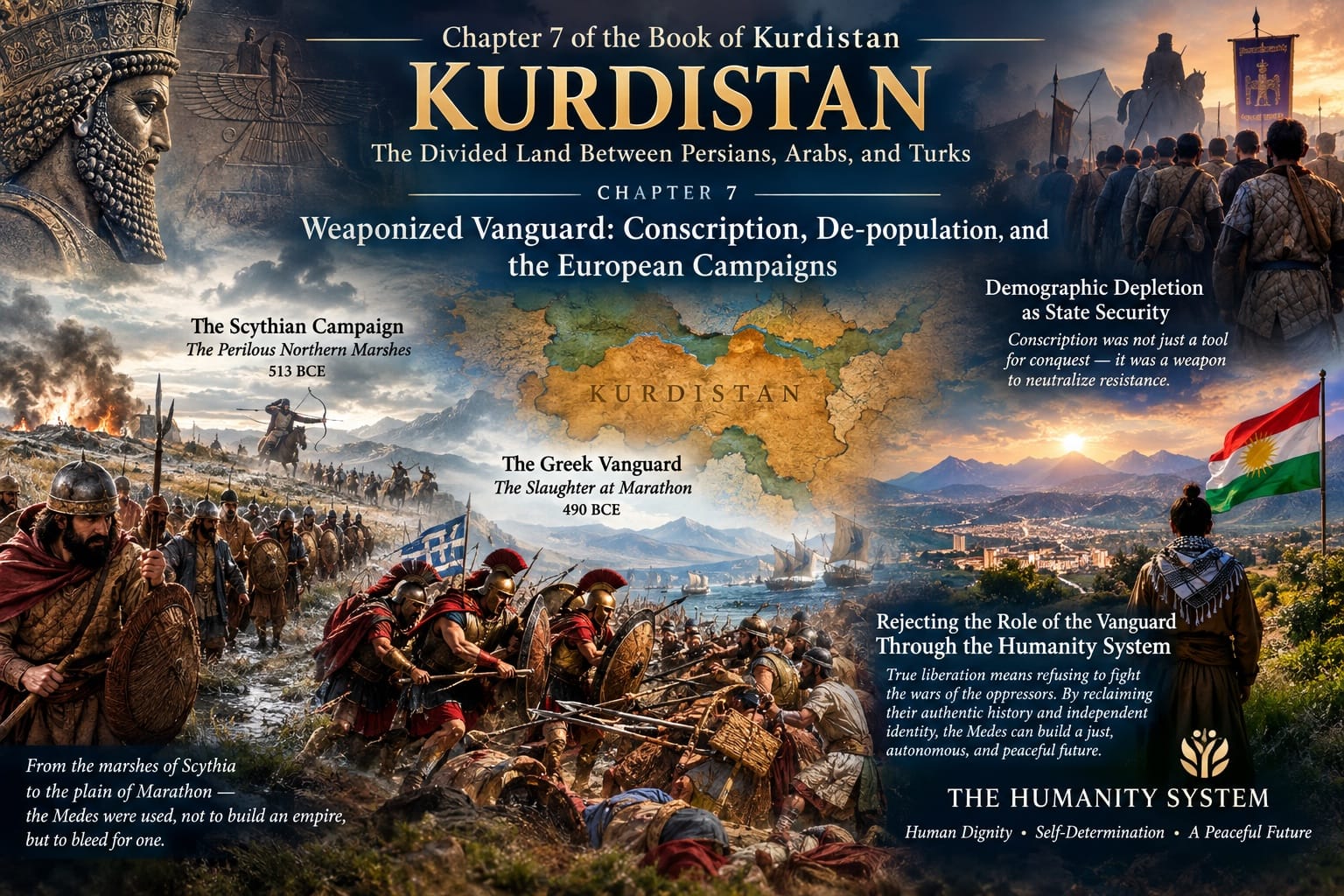
The Scythian Campaign: The Perilous Northern Marshes
In 513 BCE, Darius launched a massive military expedition across the Bosporus, aiming to subdue the nomadic Scythian tribes roaming the vast steppes north of the Black Sea. The campaign was an logistical nightmare, forcing a massive multi-ethnic army to march through hostile, unfamiliar terrain against an enemy practicing an uncompromising scorched-earth policy.
For this grueling campaign, Darius did not rely primarily on his core Persian vanguard. Instead, he heavily levied the battle-hardened populations of the northern satrapies, forcing the conquered Medes to provide the backbone of the infantry and cavalry units.
As the imperial army pushed deep into the steppes, the Scythians continuously retreated, destroying water sources, burning pastures, and launching relentless hit-and-run ambushes. The Median conscripts bore the brunt of these brutal attrition tactics. Placed at the vanguard to clear paths and absorb initial skirmishes, thousands of Median soldiers succumbed to starvation, disease, and lethal archery long before Darius ordered a tactical retreat back across the Danube. For the Achaemenid crown, these losses were not tragic failures; they were an acceptable cost to test the borders of the known world using the blood of potential domestic rivals.
The Greek Vanguard: The Slaughter at Marathon
The strategy of weaponized conscription reached its historical zenith during the first Persian invasion of Greece, culminating in the iconic Battle of Marathon in 490 BCE. Seeking to punish Athens for its role in the Ionian Revolt, Darius dispatched an armada across the Aegean Sea under the command of the Persian general Datis and the Median prince Artaphernes.
When the imperial forces deployed onto the plain of Marathon, the structural hierarchy of the Achaemenid military machine was vividly displayed:
· The Sacrificial Center: The center of the Persian battle line was deliberately composed of the subjugated levies—predominantly Median infantry units wrapped in light quilted tunics and carrying wicker shields.
· The Elite Flanks: The elite Persian Immortals and royal cavalry were stationed safely on the wings or held in reserve to exploit breaches or secure a safe retreat.
· The Clash: When the heavily armored Athenian hoplites charged in a dense, bronze-clad phalanx, they smashed directly into the lightly protected Median center.
The result was a catastrophic slaughter. While the Persian flanks managed to hold and eventually retreat to their ships, the conscripted Median center was utterly crushed by the weight of the Greek phalanx. The plain of Marathon became a mass grave for thousands of Median men, forced to fight and die for a Persian king who viewed their demographic depletion as a strategic victory.
Demographic Depletion as State Security
The tactical placement of Median soldiers on the front lines of foreign campaigns served a sinister, dual geopolitical purpose. By constantly funneling young, able-bodied Median males into high-casualty foreign expeditions, Darius executed a highly effective campaign of domestic pacification.
Every Median warrior who died in the marshes of Scythia or on the beaches of Attica was one less potential rebel capable of raising a sword against the Achaemenid throne in the homeland. This systematic draining of the Median demographic pool successfully broke the martial back of the old empire, ensuring that the remaining population lacked the manpower and leadership required to mount effective internal insurrections. Conscription was not merely a tool for external conquest; it was an internal security measure designed to sustain the subjugation of the Medes through generational bloodletting.
Conclusion: Rejecting the Role of the Vanguard Through the Humanity System
The military strategies of Darius I expose the darkest reality of imperial warfare: the exploitation of the oppressed to conquer the free. For millennia, dominant powers have weaponized minority populations, utilizing them as frontline shields to expand borders while simultaneously neutralizing their capacity for domestic resistance. The tragic losses at Scythia and Marathon stand as timeless warnings of what happens when a community allows its sons to be bartered into the service of foreign empires.
Dismantling this historical cycle requires the profound consciousness of the Humanity System. Drawing upon the historical revisions of Hamma Mirwaisi, the Humanity System strips away the false glory of imperial conquests to reveal the underlying human cost. It challenges indigenous and marginalized communities to recognize when they are being used as a weaponized vanguard by modern geopolitical actors.
The Humanity System advocates for absolute self-determination and spiritual sovereignty, calling on the descendants of the Medes—and all oppressed peoples—to reject the role of the sacrificial conscript. True liberation means refusing to fight the wars of the oppressors. By reclaiming their authentic history and independent identity, the Medes can ensure that their collective strength and vitality are preserved to build a just, autonomous, and peaceful future in their ancestral homeland, breaking the bloody cycles of imperial manipulation once and for all.