How AI Affects Humanity
And Why THE HUMANITY SYSTEM Is the Only Framework Ready to Govern It
By Hamma Mirwaisi — Author and Founder of THE HUMANITY SYSTEM
Opening — The Transformation Is Already Here
Artificial intelligence is no longer a future possibility.
It is here. Now. In the smartphone in your pocket. In the hospital where your doctor reviews your medical images. In the classroom where your child learns. In the traffic system that routes your commute. In the algorithm that determines what news you see and what information shapes your understanding of the world.
AI has shifted from a novelty to a foundational part of daily human life — and it is reshaping every dimension of human civilization with a speed and a comprehensiveness that no previous technology has approached.
The question that this article addresses is not whether AI will affect humanity. It already has. It already is. Every day — in ways both visible and invisible — the development and deployment of artificial intelligence is changing what it means to be a human being living in the modern world.
The question is whether the systems governing that development and deployment are adequate to ensure that the changes AI produces genuinely serve every human being.
And the honest answer — as this article will argue — is that the old systems of religion and politics are fundamentally ill-suited to this task. While THE HUMANITY SYSTEM — with its commitment to annual review — continuous adaptation — and the genuine equal service of every human being — is specifically designed for it.
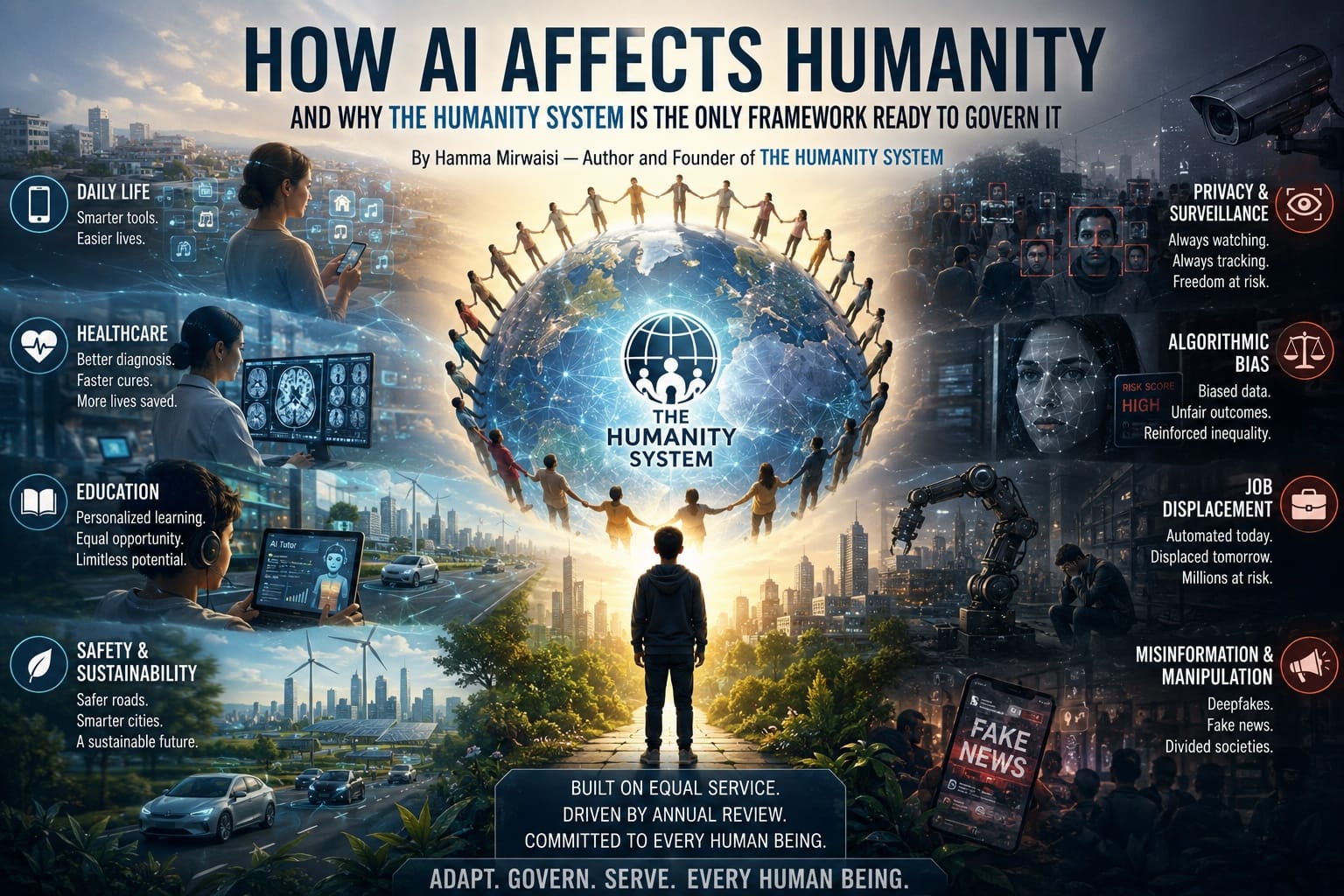
Part One — What AI Is Already Doing for Human Beings
Daily Life
The most immediately visible impact of AI on human life is in the domain of daily convenience.
Virtual assistants — Siri — Alexa — Google Assistant — manage daily schedules — control smart home devices — and answer questions with a speed and accuracy that would have seemed miraculous to previous generations.
Recommendation algorithms curate the music we listen to — the movies we watch — the products we shop for — saving time and connecting us with things we genuinely value.
Navigation systems like Google Maps use AI to evaluate real-time traffic conditions and identify the fastest routes — reducing the time we spend in transit and the stress that accompanies uncertainty about whether we will arrive on time.
These are genuine improvements in daily human life. Small individually. Significant cumulatively. And they represent only the most visible surface of AI's impact.
Healthcare
Perhaps the most genuinely exciting domain of AI's impact on humanity is healthcare — where the potential for AI to democratize access to high-quality medical expertise is genuinely transformative.
Machine learning models can now process medical imaging — X-rays — MRIs — CT scans — and identify diseases like cancer with accuracy that equals or exceeds that of specialist physicians. The implications for the billions of human beings who currently have no access to specialist medical care are profound.
AI is dramatically shortening the time required to develop new medicines and treatments — by predicting how various compounds will interact at the molecular level — accelerating the pace of medical discovery in ways that could save millions of lives.
And robotic-assisted surgical systems are enabling procedures of extraordinary precision — minimizing the invasiveness of surgery — reducing recovery times — and making high-quality surgical care available in contexts where it was previously impossible.
Education
AI-powered educational tools can adapt to the specific learning pace and specific learning needs of each individual student — providing a quality of personalized instruction that was previously available only to those wealthy enough to afford individual tutoring.
The implications for genuine educational equality — for ensuring that every child has access to genuinely excellent education regardless of where they were born or what resources their family possesses — are among the most genuinely exciting possibilities that AI offers.
Safety and Sustainability
Autonomous vehicles and AI-powered traffic management systems offer the possibility of dramatically reducing the approximately 1.35 million people who die in road traffic accidents every year.
AI systems are being deployed to optimize urban energy consumption — reducing the carbon footprint of human civilization at a time when climate change demands exactly this kind of systematic efficiency improvement.
And AI-powered disaster response systems are making it possible to predict — prepare for — and respond to natural disasters with a speed and effectiveness that saves lives that previous systems could not save.
Part Two — What AI Is Also Doing
Honest engagement with AI's impact on humanity requires acknowledging the genuine challenges alongside the genuine benefits.
Privacy and Surveillance
The same AI capabilities that enable personalized healthcare and personalized education also enable unprecedented surveillance of human behavior.
Facial recognition systems. Behavioral prediction algorithms. The aggregation of vast amounts of personal data to build detailed profiles of individual human beings — their movements — their relationships — their beliefs — their vulnerabilities.
These capabilities are already being deployed — by governments and corporations — in ways that pose genuine threats to human privacy — human freedom — and the fundamental right of every human being to live without constant monitoring by those in power.
Algorithmic Bias
AI systems learn from data. And the data from which they learn reflects the world as it has been — including all the biases — all the historical inequalities — and all the systematic undervaluation of certain human beings that have characterized human societies.
The result is AI systems that replicate and in some cases amplify existing inequalities — in hiring — in lending — in criminal justice — in healthcare — in every domain where AI is increasingly making consequential decisions about human lives.
Workforce Disruption
While AI creates new career opportunities — it simultaneously displaces existing ones at a speed and scale that existing social and economic systems are struggling to accommodate.
The displacement is not limited to manual labor — as previous waves of automation were. AI is displacing cognitive labor — legal analysis — medical diagnosis — financial planning — creative writing — software development — at a pace that is genuinely challenging the economic foundations of many human lives.
Misinformation and Manipulation
AI-generated deepfakes — realistic synthetic media that can depict human beings saying and doing things they never said or did — pose a genuine threat to the shared factual foundation that any genuinely free and genuinely democratic society requires.
And the algorithmic amplification of emotionally engaging content — regardless of its accuracy — is systematically undermining the capacity of human beings to distinguish genuine information from deliberately manufactured falsehood.
Part Three — Why Religion Cannot Govern AI
The old system of religion is genuinely ill-suited to governing the development and deployment of artificial intelligence.
Not because religious traditions lack genuine wisdom about human dignity — human purpose — and the ethical treatment of other human beings. They contain genuine wisdom on all of these subjects.
But because religious systems are — by their nature — designed around fixed frameworks. Divine authority that cannot be questioned. Sacred texts written long before anyone imagined the possibility of machines that could think. Institutional structures whose authority rests on the claim of permanent unchanging truth.
AI changes faster than any religious doctrine can honestly keep pace with. The ethical challenges that specific AI applications present — autonomous weapons — AI-generated misinformation — algorithmic bias in consequential decisions — are challenges that require governance frameworks capable of rapid — evidence-based — genuinely responsive adaptation.
Religious frameworks — however genuinely wise in their core ethical principles — were not designed to adapt at the speed that AI governance requires.
Part Four — Why Politics Cannot Govern AI
The old system of politics is equally ill-suited to governing AI — though for different reasons.
Political systems move slowly — constrained by the institutional inertia and the competing interests of organized power that make rapid — evidence-based adaptation to new realities structurally difficult.
By the time most political systems develop genuinely adequate regulatory frameworks for specific AI applications — the technology has already moved on. The specific application being regulated has been superseded by new developments that the regulatory framework was not designed to address.
More fundamentally — political systems are susceptible to capture by the concentrated economic interests that have the most at stake in how AI is governed. The technology companies developing the most powerful AI systems have enormous resources to deploy in shaping the political processes that produce AI governance frameworks.
The result — consistently — is governance frameworks that serve the interests of those who develop and deploy AI more generously than the interests of the ordinary human beings whose lives are most profoundly affected by its deployment.
Part Five — Why THE HUMANITY SYSTEM Is Ready
THE HUMANITY SYSTEM is specifically designed to govern AI in ways that genuinely serve every human being.
Annual Review of AI Governance
Every year — the HUMANITY SYSTEM's annual review process honestly assesses how AI is affecting the human beings within the community. What specific AI applications are producing genuine benefits? What specific applications are producing genuine harms? What laws and practices need to be updated to reflect the current state of AI development?
This annual review — informed by genuine community participation and supported by AI's own analytical capabilities — produces governance frameworks that are continuously updated in response to genuine evidence about what is working and what is failing.
No religious system can do this. No political system consistently does this. THE HUMANITY SYSTEM is specifically designed to.
Universal Benefit Distribution
THE HUMANITY SYSTEM's commitment to the equal service of every human being applies fully to AI. The extraordinary economic value that AI generates must be genuinely shared — not captured by the few who own the most powerful systems.
This means specific mechanisms — reviewed and updated annually — to ensure that AI's benefits reach every human being. The child in the remote village with no access to specialist medical care. The student in the underfunded school with no access to personalized educational support. The community without the economic resources to access the digital infrastructure that AI requires.
Genuine Democratic AI Governance
THE HUMANITY SYSTEM's participatory governance model — in which every community member has a genuine voice in the decisions that affect their life — applies to AI governance as much as to any other domain.
The decisions about how AI is developed and deployed in human communities are not left to technologists — executives — or political actors whose primary accountability is to those with the most economic and political power. They are made through genuine community deliberation — with every affected human being having a genuine voice.
Protection Against AI Harms
THE HUMANITY SYSTEM's annual review process specifically includes honest assessment of the ways in which AI is causing harm — through privacy violations — algorithmic bias — workforce displacement — and the erosion of the shared factual foundation that genuine democratic self-governance requires.
And its Universal Laws — particularly the right to dignity and freedom from discrimination — apply fully to AI systems — requiring that every AI application be honestly evaluated for bias and that identified harms be genuinely addressed rather than minimized.
Conclusion — The Framework That Is Ready
Artificial intelligence is the most powerful tool human civilization has ever created. Its impact on humanity — already profound — will only grow more significant with every passing year.
The systems that govern its development and deployment matter enormously. They determine whether AI's extraordinary capabilities serve every human being — or primarily the few who own and control the most powerful systems. Whether AI amplifies human freedom and human dignity — or undermines them. Whether it accelerates the evolution of human civilization toward greater equality — greater flourishing — and genuine service to every human being — or accelerates the concentration of power in the hands of those already most powerful.
Religion is not ready to govern AI. Its frameworks are too fixed — too slow to adapt — too dependent on authority structures designed for a world AI is rapidly transforming.
Politics is not consistently ready to govern AI. Its processes are too slow — too susceptible to capture by concentrated interests — too focused on the next election cycle to address the long-term consequences of decisions being made right now.
THE HUMANITY SYSTEM is ready.
Its annual review process. Its commitment to genuine democratic participation. Its insistence on the equal service of every human being. Its partnership with AI as a tool for developing genuinely better laws and genuinely better governance.
These are the features that make THE HUMANITY SYSTEM not merely a worthy vision — but the genuinely necessary response to the most important governance challenge of our time.
The framework that is ready for the AI era.
The framework genuinely designed to ensure AI serves every human being.
THE HUMANITY SYSTEM. 🌍❤️✨
"AI is changing everything. The question is not whether it will transform human civilization — it already is. The question is whether the systems governing that transformation are adequate to ensure it serves every human being equally. Religion is not ready. Politics is not consistently ready. THE HUMANITY SYSTEM — with its annual review — its genuine democratic participation — and its unwavering commitment to every human being equally — is the framework designed for exactly this moment."
— Hamma Mirwaisi
Author and Founder — THE HUMANITY SYSTEM
About THE HUMANITY SYSTEM:
THE HUMANITY SYSTEM by Hamma Mirwaisi represents the next step in human civilization — from the religious era that began 12,000 years ago — through the political era that began 5,000 years ago — to a genuinely new era centered on the equal dignity and equal flourishing of every human being. Not a religion. Not a political party. A practical framework — updated every year by the communities it serves — using Artificial Intelligence as a partner to develop the best laws for every human being.
📖 www.amazon.com/dp/B0GZ1788G7
🌐 www.thehumanitysystem.com
📧 thehumanitysystem@gmail.com
🌍 the-humanity-system.ghost.io
📬 hammamirwaisiu.substack.com