Human Dignity and Human Worth
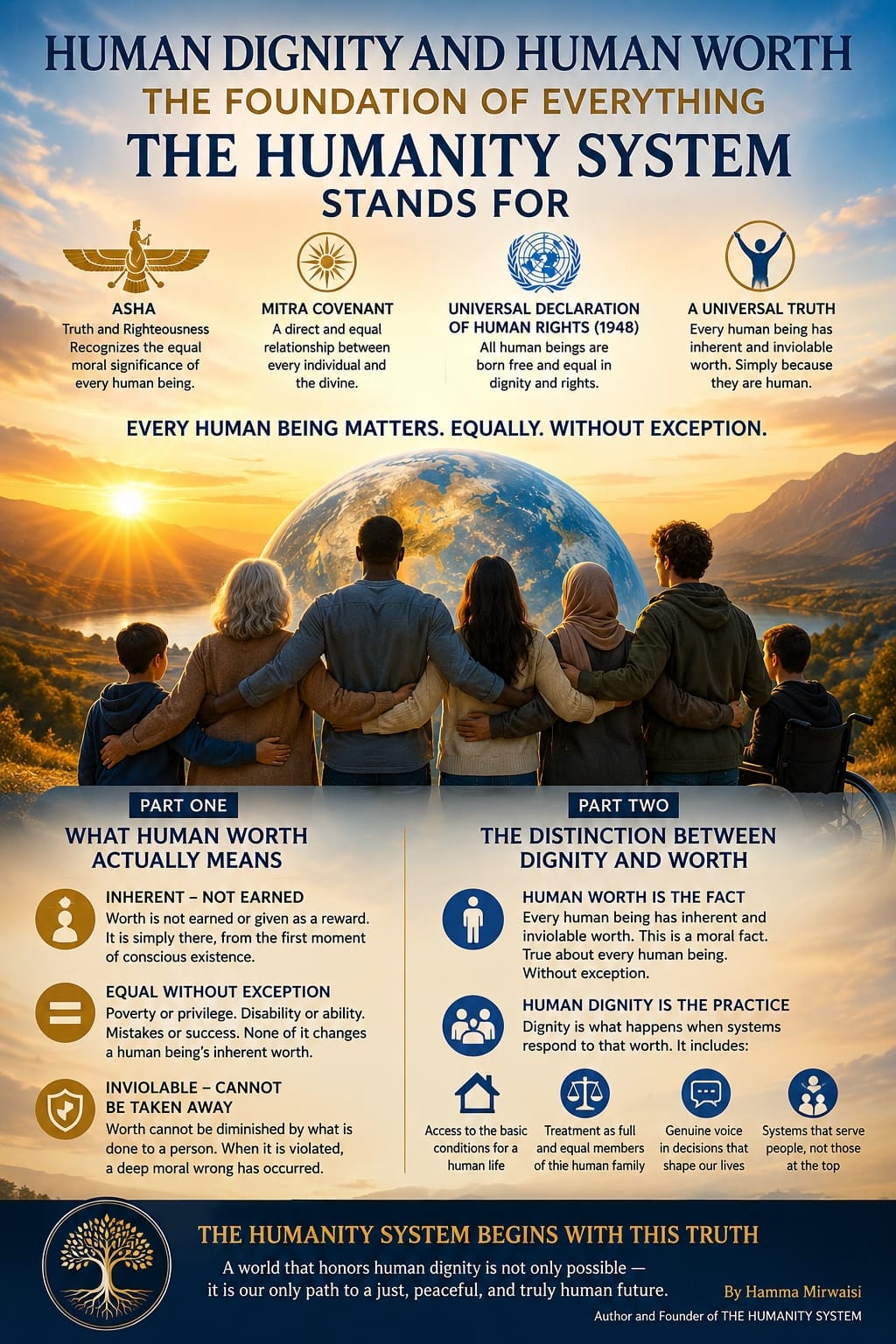
The Foundation of Everything THE HUMANITY SYSTEM Stands For
By Hamma Mirwaisi — Author and Founder of THE HUMANITY SYSTEM
Opening — The Most Important Truth
There is one truth that — if every human being genuinely understood it and genuinely acted on it — would transform human civilization more completely than any political revolution — any religious reformation — or any technological breakthrough in the history of our species.
Every human being has inherent and inviolable worth.
Not because of what they have achieved. Not because of the family they were born into. Not because of their religion — their nationality — their ethnic identity — their economic productivity — or any other characteristic that systems of power have historically used to sort human beings into those who matter and those who do not.
Simply because they are human.
This truth is not new. It has been articulated — in different ways and different languages — by the greatest moral teachers in every tradition across the full span of human history. The Zoroastrian principle of Asha — truth and righteousness — recognized the equal moral significance of every human being. The Mitra covenant — as described in the Return of the Medes — proposed a direct and equal relationship between every individual and the divine that required no intermediary and recognized no hierarchy of worth. The Universal Declaration of Human Rights — adopted by the United Nations in 1948 — declared in its very first article that all human beings are born free and equal in dignity and rights.
And yet — after thousands of years of articulating this truth — after centuries of building political and legal systems explicitly designed to protect it — the gap between the truth of universal human worth and the reality of how human beings are actually treated by the systems governing their lives remains one of the most devastating facts about the world we inhabit.
THE HUMANITY SYSTEM begins with this truth. Not as a philosophical aspiration. Not as a political slogan. As the most fundamental structural commitment of everything it does.
Every human being matters. Equally. Without exception.
Part One — What Human Worth Actually Means
The concept of human worth — inherent worth — is worth examining carefully. Because it is genuinely easy to say the words and genuinely difficult to understand what they actually require.
Inherent means not earned.
The worth of a human being is not something they produce through their achievements. Not something they earn through their productivity. Not something they receive as a reward for holding the right beliefs or belonging to the right community.
It is simply there. Present from the first moment of conscious existence. Unchanged by success or failure — wealth or poverty — social recognition or social invisibility.
A child born into extreme poverty has exactly the same inherent worth as a child born into extraordinary privilege. A human being with severe disabilities has exactly the same inherent worth as a human being of exceptional physical and intellectual capability. A person who has made terrible mistakes has exactly the same inherent worth as a person of irreproachable moral record.
This is not sentimentality. It is the most genuinely radical moral claim available. Because it means that every system — religious or political or economic — that treats the worth of human beings as variable — as dependent on their productivity — their conformity — their social usefulness — or any other characteristic — is wrong. Fundamentally. Structurally. Without qualification.
Inviolable means it cannot be taken away.
The worth of a human being cannot be diminished by what is done to them. A human being who has been enslaved — tortured — imprisoned unjustly — subjected to systematic discrimination — humiliated — exploited — or denied the basic conditions of a dignified human life — has not lost their worth. Their worth has been violated. Which is precisely why these acts are genuinely wrong — not merely inconvenient or inefficient — but genuinely wrong in the deepest moral sense.
This distinction matters enormously. Because it means that the violation of human dignity — the failure of systems to recognize and respond to the inherent worth of every human being within their reach — is not merely a policy failure. It is a moral catastrophe. A specific — identifiable — and genuinely unacceptable failure to honor the most fundamental fact about every human being.
Part Two — The Distinction Between Dignity and Worth
The philosophical tradition draws a distinction between human worth — the inherent fact of every person's moral significance — and human dignity — the practical realization of that worth in the actual conditions of human life.
This distinction is genuinely important. Because it identifies the specific gap that THE HUMANITY SYSTEM exists to close.
Human worth is the fact.
Every human being has inherent and inviolable worth. This is a moral fact — as fundamental as any fact available to honest human inquiry. It does not depend on any particular religious tradition — though many religious traditions have expressed it. It does not depend on any particular philosophical system — though many philosophical systems have argued for it. It is simply true. About every human being. Without exception.
Human dignity is the practice.
Dignity is what happens — or fails to happen — when human systems respond to that worth. Dignity is maintained when human beings have genuine access to the basic material conditions needed to live a genuinely human life. When they are treated by every institution they encounter as full and equal members of the human family. When they have genuine voice in the decisions that shape their lives. And when the systems governing their communities are honestly designed to serve their genuine interests rather than the interests of those at the top of institutional hierarchies.
Dignity is violated when human beings are objectified — treated as instruments for someone else's purposes rather than as ends in themselves. When they are discriminated against — denied opportunities or protections available to others simply because of their identity. When they are deprived of the basic material conditions — food — clean water — shelter — healthcare — education — that a genuinely human life requires. And when the systems supposedly designed to serve them are in reality designed to serve the concentrated interests of those with the most power to shape those systems.
The gap between human worth — universal and inherent — and human dignity — distributed with devastating unevenness across every human society — is the most important problem that any system of governance must address.
THE HUMANITY SYSTEM is specifically designed to close it.
Part Three — What 12,000 Years of Systems Have Done to Human Dignity
The honest historical record — examined clearly and without the distortions of ethnic or religious or political loyalty — shows that the systems governing human civilization have consistently failed to honor the inherent worth of the human beings within them.
What Religion Did to Human Dignity
The great religious traditions of the ancient and modern world have — at their best — been among the most powerful forces for the recognition of universal human worth available. The Mitra covenant's insistence on the direct and equal relationship between every individual and the divine. The Zoroastrian principle of Asha that recognized the moral significance of every human being's choices. The Golden Rule — present in virtually every major religious tradition — that demanded treating every human being as one would wish to be treated oneself.
These are genuine moral achievements. And the communities that have lived them most fully have produced genuine human dignity in ways that deserve genuine acknowledgment.
But the institutional expressions of religion — the priesthoods and the sacred texts and the systems of orthodoxy and heresy — have too often used the language of human dignity to maintain arrangements that served institutional interests at the expense of the genuine dignity of the human beings within them.
The religious frameworks that declared female subordination to be divinely ordained — that consigned millions of human beings to social hierarchies declared sacred and immutable — that treated those who questioned as spiritually dangerous rather than as human beings exercising their most fundamental cognitive freedom — these are genuine violations of human dignity. Committed in the name of systems that claimed to honor it.
What Politics Did to Human Dignity
The great political traditions of the past five thousand years have — at their best — produced genuine advances in the legal and institutional protection of human dignity. The rule of law. Constitutional limits on arbitrary power. Democratic participation. The Universal Declaration of Human Rights.
These are genuine achievements. And the human beings who fought for them — often at genuine personal cost — deserve genuine recognition.
But political systems have also — consistently — used the language of human dignity to maintain arrangements that violated it. The political frameworks that declared the dignity of citizens while enslaving others. That extended democratic rights to some while denying them to women — to minorities — to the poor — to every group whose inclusion would threaten the interests of those already within the system.
The gap between what political systems have proclaimed about human dignity and what they have actually delivered remains one of the most damning facts about the human political tradition.
Part Four — What THE HUMANITY SYSTEM Proposes
THE HUMANITY SYSTEM does not merely add another proclamation of human dignity to the long list that history has already produced.
It proposes something genuinely different. The specific — structural — institutionally enforced mechanisms through which the inherent worth of every human being is translated into the actual dignity of their daily lived experience.
The Eight Universal Laws
The Eight Universal Laws of THE HUMANITY SYSTEM are the specific institutional expression of the commitment to universal human dignity.
The Right to Life and Physical Safety — because dignity requires physical safety as its most basic precondition.
The Right to Basic Needs — because a human being who lacks food — clean water — shelter — or healthcare cannot live a genuinely dignified human life regardless of what any document proclaims about their inherent worth.
The Right to Education and Knowledge — because a human being denied genuine access to knowledge has been denied the most essential tool of their own genuine self-determination.
The Right to Dignity and Freedom from Discrimination — because every act of discrimination is a specific — identifiable — and genuinely unacceptable denial of the equal worth of a specific human being.
The Right to Freedom of Thought and Expression — because the cognitive freedom that is the most distinctively human of all human capacities — the freedom to think honestly and express that thinking without fear — is the most fundamental expression of human worth.
The Right to Participation — because genuine dignity requires genuine voice in the decisions that shape one's life. Not formal voting rights that mask genuine exclusion. Genuine participatory power.
The Right to Justice — because a system that applies its laws differently to different human beings — depending on their wealth or status or identity — has declared — in practice — that some human beings are worth more than others.
The Right to a Healthy Environment — because the physical world that sustains human life is itself a dimension of human dignity — and its destruction is a violation of the worth of every human being who depends on it.
The Annual Review
The most important structural innovation of THE HUMANITY SYSTEM — for the protection of human dignity — is the annual review process.
Because the history of human civilization demonstrates — with devastating consistency — that proclamations of human dignity are not enough. That systems genuinely committed to human dignity must be continuously and honestly evaluated against the standard of whether they are actually delivering it.
Every year — in every HUMANITY SYSTEM community — the honest question is asked.
Are the laws and practices governing this community actually serving the genuine dignity of every human being within it? Where are they failing? What needs to change?
And the answers — arrived at through genuine community participation — produce genuine changes in genuine laws.
Not eventually. Not after decades of political resistance. Every year.
AI as a Tool for Genuine Dignity
Artificial intelligence — deployed in genuine service of human dignity rather than in the service of those who own the most powerful AI systems — offers genuinely transformative possibilities for the realization of human worth in practice.
AI can make genuinely excellent medical diagnosis available to every human being regardless of where they were born. It can make genuinely personalized education available to every child regardless of their family's economic resources. It can make the genuine complexity of legal systems — designed by and for those with legal expertise — genuinely accessible to the ordinary human beings who most need their protection.
And within THE HUMANITY SYSTEM specifically — AI can make the annual review process genuinely comprehensive. Aggregating the genuine experience of every community member. Identifying where dignity is being violated. And supporting the development of genuine solutions.
Part Five — Why This Matters Right Now
The question of human dignity is not an abstract philosophical question. It is the most urgent practical question facing the human family in this moment.
Because the development of artificial intelligence — the most powerful tool human civilization has ever created — is producing a world in which the gap between what human dignity requires and what existing systems deliver could widen dramatically.
A world in which the extraordinary capabilities of AI are concentrated in the hands of a small number of the most powerful corporations and governments — while the billions of human beings whose lives are most profoundly affected by AI's development have no genuine voice in how it is governed — is a world in which the inherent worth of the many is being systematically violated by the institutional power of the few.
THE HUMANITY SYSTEM is committed to ensuring that AI serves human dignity rather than undermining it. That its benefits are genuinely available to every human being. That its governance genuinely includes the voice of every human being affected. And that the extraordinary possibilities it offers — for genuine universal access to education — healthcare — legal protection — and democratic participation — are realized in service of the equal worth of every human being.
Conclusion — The Standard That Changes Everything
Human dignity is not a philosophical nicety. It is the most fundamental standard available for evaluating every system — every law — every institution — every practice — that governs human life.
Does this system genuinely honor the inherent and inviolable worth of every human being within its reach?
Not some human beings. Not the human beings with the most power or the most resources or the most social recognition. Every human being. Equally. Without exception.
This standard — applied honestly — reveals the inadequacy of every previous system of governance. Religion — which proclaimed the worth of believers while too often denying the dignity of those outside its boundaries. Politics — which proclaimed the equality of citizens while maintaining the systematic exclusion of those whose inclusion threatened the interests of the powerful.
And it reveals what THE HUMANITY SYSTEM is committed to being.
Not a perfect system. No human creation is perfect. But a system genuinely designed — from its foundational principles — to honor the inherent worth of every human being. To close the gap between that worth and the actual dignity of every person's lived experience. And to review honestly — every year — whether it is succeeding.
Every human being has inherent and inviolable worth.
Every human being deserves the dignity that worth requires.
And THE HUMANITY SYSTEM is committed to building the systems that deliver it.
For every human being.
Equally.
Without exception.
Starting now. 🌍❤️✨
"Human dignity is not something any system grants to human beings. It is something every system is obligated to honor — because it is already there. Present in every human being from the first moment of their existence. The question that every system governing human life must honestly answer is not whether human beings have worth. They do. The question is whether the system is genuinely designed to honor it. That is the question THE HUMANITY SYSTEM asks — honestly — every year — about itself."
— Hamma Mirwaisi
Author and Founder — THE HUMANITY SYSTEM
About THE HUMANITY SYSTEM:
THE HUMANITY SYSTEM by Hamma Mirwaisi represents the next step in human civilization — from the religious era that began 12,000 years ago — through the political era that began 5,000 years ago — to a genuinely new era centered on the equal dignity and equal flourishing of every human being. Not a religion. Not a political party. A practical framework — updated every year by the communities it serves — using Artificial Intelligence as a partner to develop the best laws for every human being.
📖 www.amazon.com/dp/B0GZ1788G7
🌐 www.thehumanitysystem.com
📧 thehumanitysystem@gmail.com
🌍 the-humanity-system.ghost.io
📬 hammamirwaisiu.substack.com
I genuinely want to hear from you.
What do you think?
Do you agree?
What would you add?
Reply to this email or write to me at:
thehumanitysystem@gmail.com