Imprisonment and Power: A Divided Turkey
Hamma MirwaisiAuthor of ‘The Humanity System’ My name is Hamma Mirwaisi. I am the author of two groundbreaking books and the founder of THE HUMANITY SYSTEM — a genuinely new framework for human civilization.August 10, 2026
Power and Its Prisoners
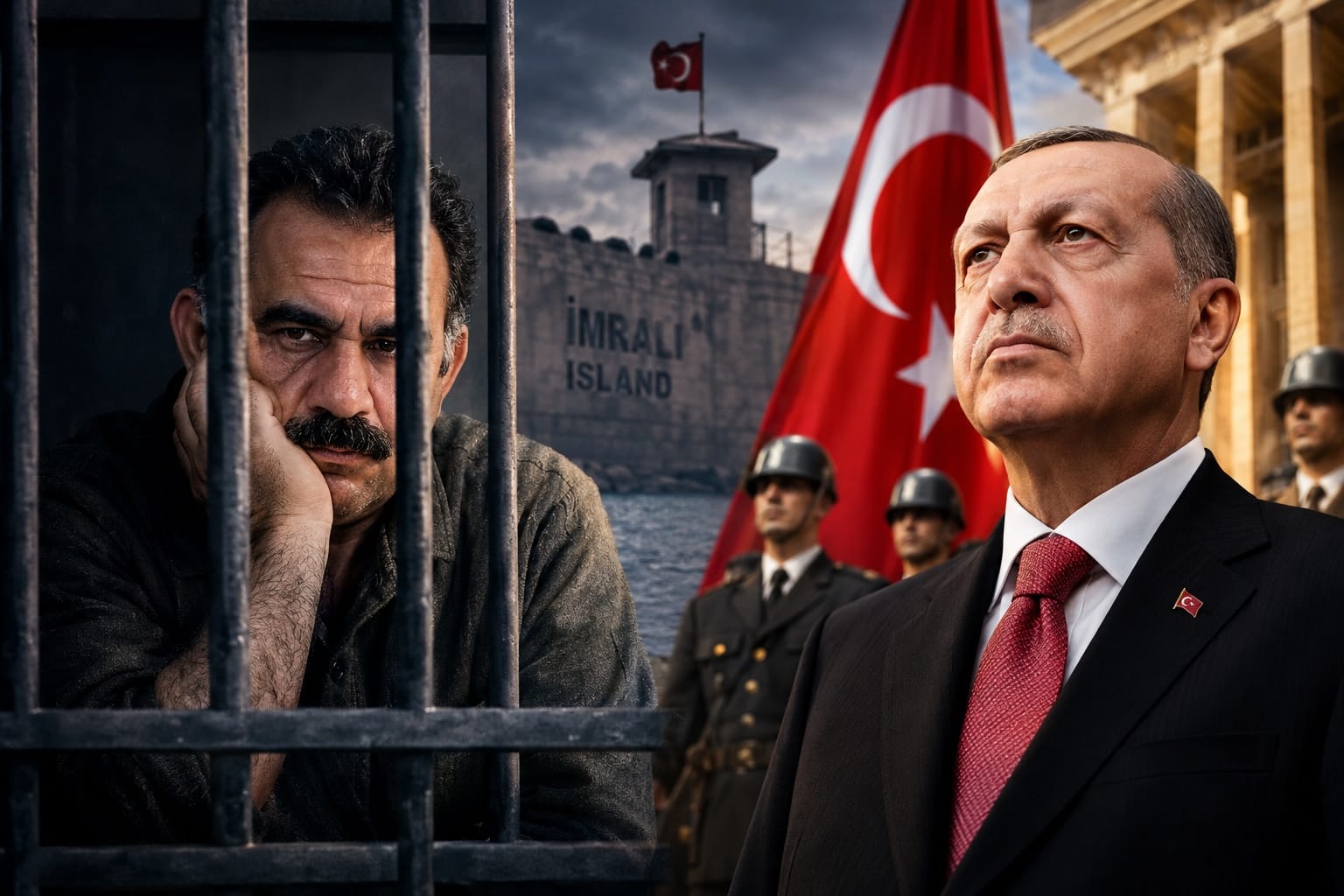
Human cruelty toward the powerless is often less about individual character than about what power itself demands of those who hold it. Abdullah Öcalan's 1999 capture — seized in Nairobi with the help of intelligence networks including the CIA, and reportedly Mossad, before being flown to Turkey — shows how state power operates: coalitions of intelligence services, working across borders, converging on a single man deemed a threat to a nation's stability.
President Erdoğan didn't orchestrate that capture — it happened under a previous administration — but his decades in power since have shaped Öcalan's continued imprisonment on İmralı Island, a case still central to Turkey's Kurdish question.
Why do leaders act this way? A few threads people point to:
- Security logic: states justify harshness as protecting the many from the few, especially against armed insurgencies (the PKK is designated a terrorist organization by Turkey, the US, and the EU).
- Power's psychology: some research suggests authority can dull empathy — the further removed someone is from another's suffering, the easier severity becomes.
- Political incentive: appearing strong against perceived threats often wins domestic support more reliably than showing mercy.
Others push back — pointing out that Kurdish rights advocates see the same events as evidence of authoritarian overreach, not necessary security, and that Erdoğan's government has in recent years also explored peace talks and a partial thaw with Kurdish political movements, including renewed contact with Öcalan himself in 2024–2025.
So the honest answer may be: it's not that powerful people are uniquely cruel — it's that power creates conditions where cruelty becomes easier to justify, and harder to see as cruelty at all.
Power and Its Prisoners: Why the Strong Are Often Hardest on the Weak
Human beings are capable of astonishing kindness and astonishing cruelty, sometimes within the same life. But there's a particular pattern worth examining: the way power itself seems to change how people treat those beneath them. Few cases illustrate this as starkly as the decades-long relationship between the Turkish state and Abdullah Öcalan, the founder of the Kurdistan Workers' Party (PKK).
A Capture That Crossed Borders
On February 16, 1999, Turkish intelligence agents seized Öcalan in Nairobi, Kenya, where he had been living after fleeing a string of countries following Syria's expulsion of him under Turkish pressure. The operation succeeded with help well beyond Turkey's own reach: American intelligence reportedly helped track his movements, and reporting has long linked elements of Israeli intelligence to the effort as well. He was flown to Turkey, tried, and sentenced to death — a sentence later commuted to life imprisonment after Turkey abolished capital punishment as part of its bid for European Union membership. He has been held on İmralı Island in the Sea of Marmara ever since, largely in isolation for much of that time.
It is a case study in how state power operates when it wants something badly enough: intelligence services across rival global powers, normally suspicious of one another, converging to remove a single man. That kind of coordinated, overwhelming force is itself a form of harshness — not born of personal hatred, but of institutional will.
Why Power Tends Toward Severity
Political scientists and psychologists have offered a few overlapping explanations for why those at the top often deal harshly with those they've subdued:
- Security logic. States justify severity as protection for the many against the few. The PKK is designated a terrorist organization by Turkey, the United States, and the European Union, and the insurgency it waged killed tens of thousands of people over four decades. From Ankara's perspective, Öcalan's imprisonment was framed as necessary, not vindictive.
- Psychological distance. Some research on power suggests that authority can blunt empathy — the further removed a decision-maker is from the person affected, the easier it becomes to authorize harsh treatment without feeling its weight.
- Political incentive. Projecting strength against a defeated enemy often plays better domestically than showing mercy, especially in nationalist politics.
None of this makes cruelty inevitable. It only explains why it's so common among the powerful — the incentives point that way, even when individual restraint is possible.
A Different Chapter, Written by the Same Men
What complicates any simple story of "powerful tyrant, captured victim" is what has happened more recently. In February 2025, Öcalan — still imprisoned, now in his late seventies — called on the PKK to lay down its weapons and dissolve entirely, urging a shift from armed struggle to democratic politics. The PKK's congress in May 2025 agreed, and by July 2025 the group held a symbolic disarmament ceremony in northern Iraq, destroying weapons on camera. President Recep Tayyip Erdoğan responded by pledging that his coalition would work alongside pro-Kurdish lawmakers to pass legislation completing the process — a striking reversal after years of treating Kurdish political parties as extensions of the PKK.
That reversal has its own harder edges. Analysts have noted that one of Erdoğan's incentives for pursuing peace is domestic and constitutional — a resolved Kurdish conflict strengthens his hand as he seeks to remain in power past 2028. Nationalist opposition parties have called the accompanying legislation a betrayal given the conflict's toll. And Öcalan himself remains behind bars; his influence flows entirely through statements smuggled out and read aloud by others, not through freedom.
So the relationship between the "kind" and the "cruel" here isn't fixed. The same leader capable of decades of hard-line imprisonment is now, for reasons that mix genuine peacemaking with self-interest, extending a hand toward reconciliation. The same captured man who spent 26 years isolated on an island is now, from that same cell, shaping the end of a war he once led.
The Real Lesson
Perhaps the honest conclusion isn't that powerful people are uniquely cruel by nature. It's that power creates conditions where severity is easy to justify, and mercy is politically costly — until, sometimes, the incentives flip, and mercy becomes the more useful currency. Öcalan and Erdoğan's story suggests that harshness toward the powerless isn't a fixed trait of the powerful, but a choice shaped by what power currently demands — which means it can, under the right pressures, be unmade.
Kurdish rights advocates and Turkish nationalists read these same events very differently — one side sees overdue justice and a path to peace, the other sees either dangerous concessions or insufficient ones. Both perspectives remain part of an unresolved and actively contested story.