MOVEMENT PROGRESS
Why Reforming Old Systems Is Not Enough — And Why THE HUMANITY SYSTEM Is Something Genuinely New
By Hamma Mirwaisi — Author and Founder of THE HUMANITY SYSTEM
Opening — The Age of Progressive Movements
Something significant is happening across the world right now.
Every major system that has governed human civilization — religious and political — is launching a progressive movement.
Progressive Judaism. Progressive Christianity. Progressive Islam. Progressive politics in the United States and across democratic societies worldwide.
The message from each of these movements is essentially the same.
We recognize that the old ways are not working. We want change. We are committed to social justice — economic equality — human dignity.
These are genuine convictions — held by genuinely good human beings who are genuinely committed to making the world better.
But there is a question that honest examination requires asking about every one of these progressive movements.
Are they building something genuinely new? Or are they repairing old machinery that — however skillfully repaired — can never do what new machinery does?
Part One — Understanding the Progressive Movement Phenomenon
The progressive movement in its various forms — religious and political — is a genuine response to a genuine crisis.
The crisis of systems that are visibly failing the human beings within them. The crisis of the gap between what religious and political institutions promise and what they actually deliver. The crisis of a world changing so rapidly that frameworks built for previous eras are increasingly inadequate to the challenges of the present.
Progressive Politics
The progressive political movement — particularly visible in the United States — emerged originally in response to the Gilded Age. A period of extraordinary economic growth accompanied by extraordinary economic inequality. A period in which corporate monopolies accumulated power that no previous generation of political institutions had been designed to manage.
Progressive politics advocated — and continues to advocate — for government intervention to correct systemic market failures. For social justice. For economic equality. For the extension of genuine democratic participation to those historically excluded from it.
These are genuine values. And the achievements of progressive political movements — Social Security — the minimum wage — civil rights legislation — environmental protection — represent genuine human progress.
Progressive Religion
Progressive religious movements — within Judaism — Christianity — Islam — and other traditions — represent the sincere effort of genuinely committed human beings to bring their religious traditions into genuine alignment with contemporary understandings of human dignity and human rights.
Progressive Judaism's commitment to gender equality and LGBTQ inclusion. Progressive Christianity's emphasis on social justice and the preferential option for the poor. Progressive Islam's engagement with democratic values and human rights frameworks.
Again — these are genuine commitments. And the human beings who hold them deserve genuine respect for the courage it often takes to challenge the orthodox positions of powerful religious institutions.
Part Two — The Fundamental Limitation
But here is what honest examination reveals about every progressive movement — religious and political — that has ever existed.
They are all attempting to reform systems that were not designed to be genuinely reformed.
Progressive politics works within political systems whose fundamental structure — organized around the competition for power among those with the resources to compete — consistently produces the same outcomes regardless of which faction momentarily controls the institutional machinery.
Progressive religion works within religious systems whose fundamental authority structure — grounded in the claim of divine revelation that cannot be honestly questioned — consistently limits how far genuine reform can go before it threatens the institutional foundations on which the religion's authority rests.
This is not a criticism of the people within these movements. It is an observation about the systems they are working within.
And it leads to the most important insight that THE HUMANITY SYSTEM offers about the current era of progressive movements worldwide.
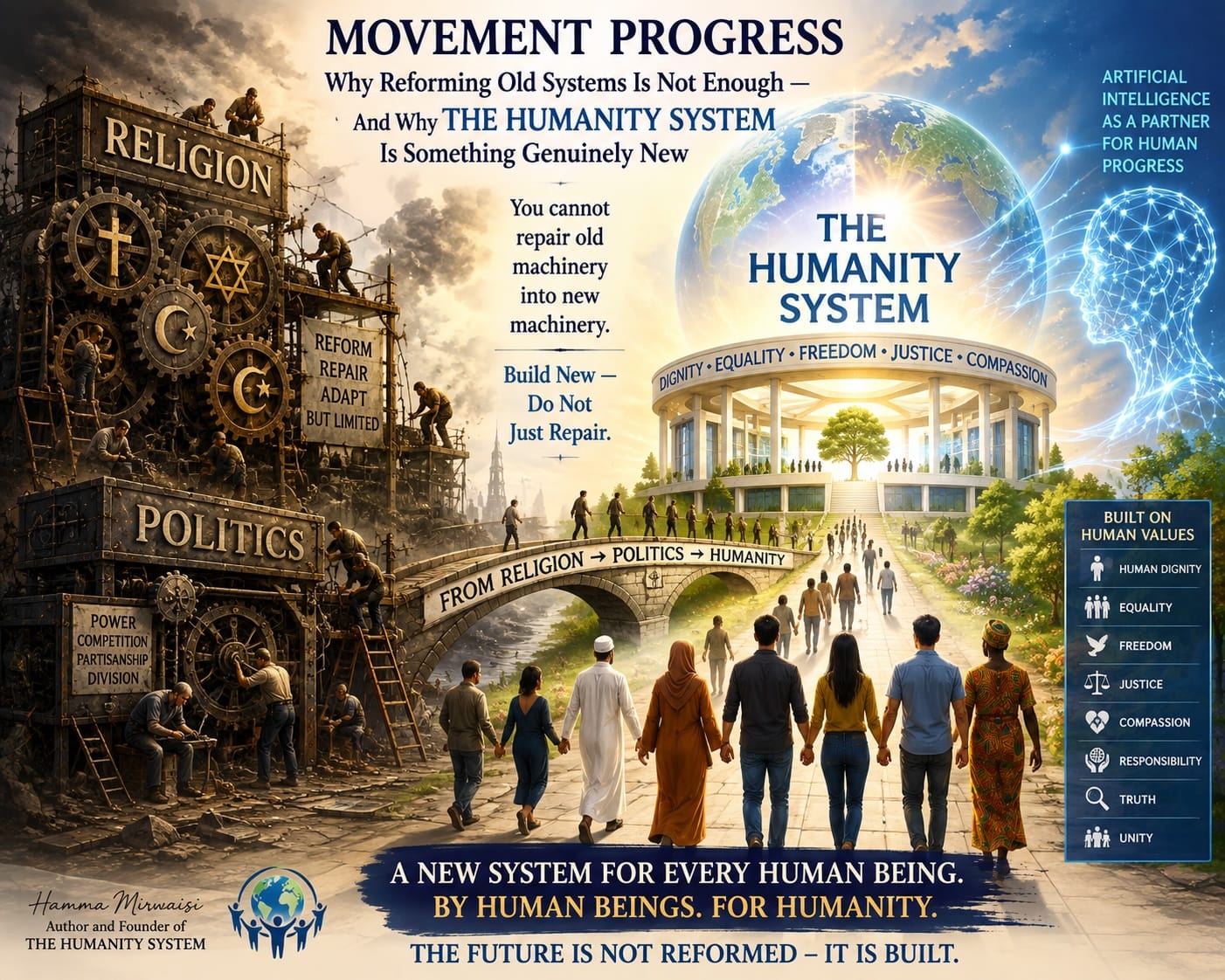
You cannot repair old machinery into new machinery.
Part Three — The Machinery Analogy
Consider what happens when you try to repair genuinely old machinery.
A skilled mechanic can extend the life of an old machine significantly. They can replace worn parts — optimize existing systems — improve performance within the design parameters of the original machine.
But there are things an old machine simply cannot do — not because the mechanic is unskilled — but because the machine was not designed to do them. Its fundamental architecture — the design decisions made when it was originally built — determine what it can and cannot achieve regardless of how skillfully it is maintained or improved.
The same is true of human systems.
Religious systems were designed — 12,000 years ago — around the concentration of spiritual authority in institutions claiming divine mandate. Progressive religious movements can improve the behavior of these institutions. They can make them more compassionate — more inclusive — more genuinely aligned with human dignity.
But they cannot change the fundamental architecture. The claim of divine authority that cannot be honestly questioned. The institutional structure that concentrates interpretive power in religious hierarchies. The tendency to define community through the boundary between those who hold the correct beliefs and those who do not.
Political systems were designed — 5,000 years ago — around the management of competition for power among organized groups with the resources to compete. Progressive political movements can improve the behavior of these systems. They can make them more responsive — more inclusive — more genuinely committed to the well-being of ordinary citizens.
But they cannot change the fundamental architecture. The concentration of power in institutional hierarchies. The susceptibility to capture by concentrated wealth. The structural bias toward the interests of the organized and the powerful at the expense of the unorganized and the marginalized.
Part Four — Why AI Is Accelerating the Need for Something Genuinely New
The development of artificial intelligence is not merely a technological development. It is a civilizational disruption that is making the fundamental limitations of existing systems — religious and political — increasingly visible and increasingly urgent.
AI is democratizing knowledge. For the first time in human history — every human being with a smartphone has access to the accumulated knowledge of human civilization. The informational monopolies on which both religious and political authority have historically rested — the claim that only specific institutions have access to the truth that ordinary human beings need to live well — are being eroded by technology that puts that truth directly in the hands of every human being.
AI is making institutional failures measurable. The gap between what systems promise and what they deliver — which was previously difficult to document and easy to obscure — is increasingly measurable by the analytical tools that AI provides. Every progressive movement in every tradition is responding — in part — to the increasing visibility of that gap.
And AI is making something genuinely new possible. The annual review process of THE HUMANITY SYSTEM — the honest continuous assessment of whether laws and practices are genuinely serving every human being — is practically achievable at scale because AI provides the analytical tools to make it real.
This is why the progressive movements emerging within existing religious and political systems — however genuine the intentions of the human beings within them — are ultimately insufficient responses to the challenge of this moment.
They are attempting to make old machinery do new things. While the technology exists to build genuinely new machinery.
Part Five — FROM RELIGION TO POLITICS TO HUMANITY as a Natural Movement
THE HUMANITY SYSTEM is not simply another progressive movement within an existing system.
It is the natural next step in the evolutionary progression that has driven human civilization for 12,000 years.
FROM RELIGION TO POLITICS TO HUMANITY describes the natural movement of human civilization toward systems of increasing inclusivity — increasing accountability — and increasing genuine commitment to the equal dignity of every human being.
Religion scaled human cooperation beyond the family group. Politics scaled human governance beyond the religious community. THE HUMANITY SYSTEM scales genuine human service to encompass every human being on Earth — regardless of their religion — their nationality — their political affiliation — or any other characteristic that previous systems have used to determine whose dignity matters most.
This is not a reform movement within an existing system. It is the emergence of a genuinely new system — as different from the political systems that preceded it as political systems were different from the purely religious systems that preceded them.
And like every previous evolutionary step in human social organization — it is being driven by genuine human need — genuine technological possibility — and the genuine recognition that the existing systems — however progressively reformed — are simply not adequate to the challenges of the world we now inhabit.
Part Six — THE HUMANITY SYSTEM MOVEMENT PROGRESS
THE HUMANITY SYSTEM is growing.
Not as quickly as the urgency of the situation demands. No genuinely new system has ever grown as quickly as its founders hoped or as the situation required. The abolition of slavery took generations. The extension of democratic rights took centuries. The recognition of universal human rights is still incomplete after decades of effort.
But growing. Genuinely. Honestly. And in ways that reflect the natural evolutionary dynamic that FROM RELIGION TO POLITICS TO HUMANITY describes.
Human beings in every culture and every language are encountering the vision of THE HUMANITY SYSTEM and recognizing in it something they have been searching for — a framework that takes seriously both the genuine achievements of religious and political civilization and the genuine inadequacy of those systems to serve every human being in the world we now inhabit.
The two books that describe this vision are reaching readers in nine languages. The website — the Ghost blog — the Substack newsletter — the LinkedIn presence — the YouTube channel — all of these are carrying the vision to human beings who are ready to hear it.
And the first HUMANITY SYSTEM Centers — the physical community spaces where the principles of the system are put into practice in the daily lives of real human beings in real communities — are beginning to take shape.
This is the movement. Not a progressive movement within an existing system. A natural evolutionary movement toward something genuinely new.
Conclusion — Build New — Do Not Just Repair
Every progressive movement in human history has faced the same fundamental choice.
Work within the existing system — accepting its fundamental architecture — and try to improve its behavior. Or recognize that the existing architecture is inadequate — and build something genuinely new.
The great moments of genuine human progress have always involved the courage to build genuinely new.
The abolitionists did not try to make slavery more humane. They worked to end it.
The suffragists did not try to make the all-male political system more responsive to women. They worked to extend genuine democratic participation to every human being.
The architects of the Universal Declaration of Human Rights did not try to make existing national legal systems more just. They worked to establish a new framework of rights that applied to every human being regardless of which nation they lived in.
THE HUMANITY SYSTEM stands in this tradition. Not a progressive movement within religion. Not a progressive movement within politics. A natural evolutionary movement toward something that has never existed before.
A system genuinely designed — from its very foundation — to serve every human being. Equally. Honestly. And without exception.
Join the movement.
Build something genuinely new.
The time has come. 🌍❤️✨
"Every great progressive movement in history eventually faced the same honest question — are we reforming the system or replacing it? The most important moments of genuine human progress came when human beings had the courage to answer honestly — and to build something genuinely new rather than repairing old machinery that could never do what new machinery does. THE HUMANITY SYSTEM is that new machinery. And FROM RELIGION TO POLITICS TO HUMANITY is the natural evolutionary path that leads to it."
— Hamma Mirwaisi
Author and Founder — THE HUMANITY SYSTEM
About THE HUMANITY SYSTEM:
THE HUMANITY SYSTEM by Hamma Mirwaisi represents the next step in human civilization — from the religious era that began 12,000 years ago — through the political era that began 5,000 years ago — to a genuinely new era centered on the equal dignity and equal flourishing of every human being. Not a religion. Not a political party. A practical framework — updated every year by the communities it serves — using Artificial Intelligence as a partner to develop the best laws for every human being.
📖 www.amazon.com/dp/B0GZ1788G7
🌐 www.thehumanitysystem.com
📧 thehumanitysystem@gmail.com
🌍 the-humanity-system.ghost.io
📬 hammamirwaisiu.substack.com