
The Crucible of History: Why a U.S. and Israeli Exit Could Trigger a Total Sunni-Shia War
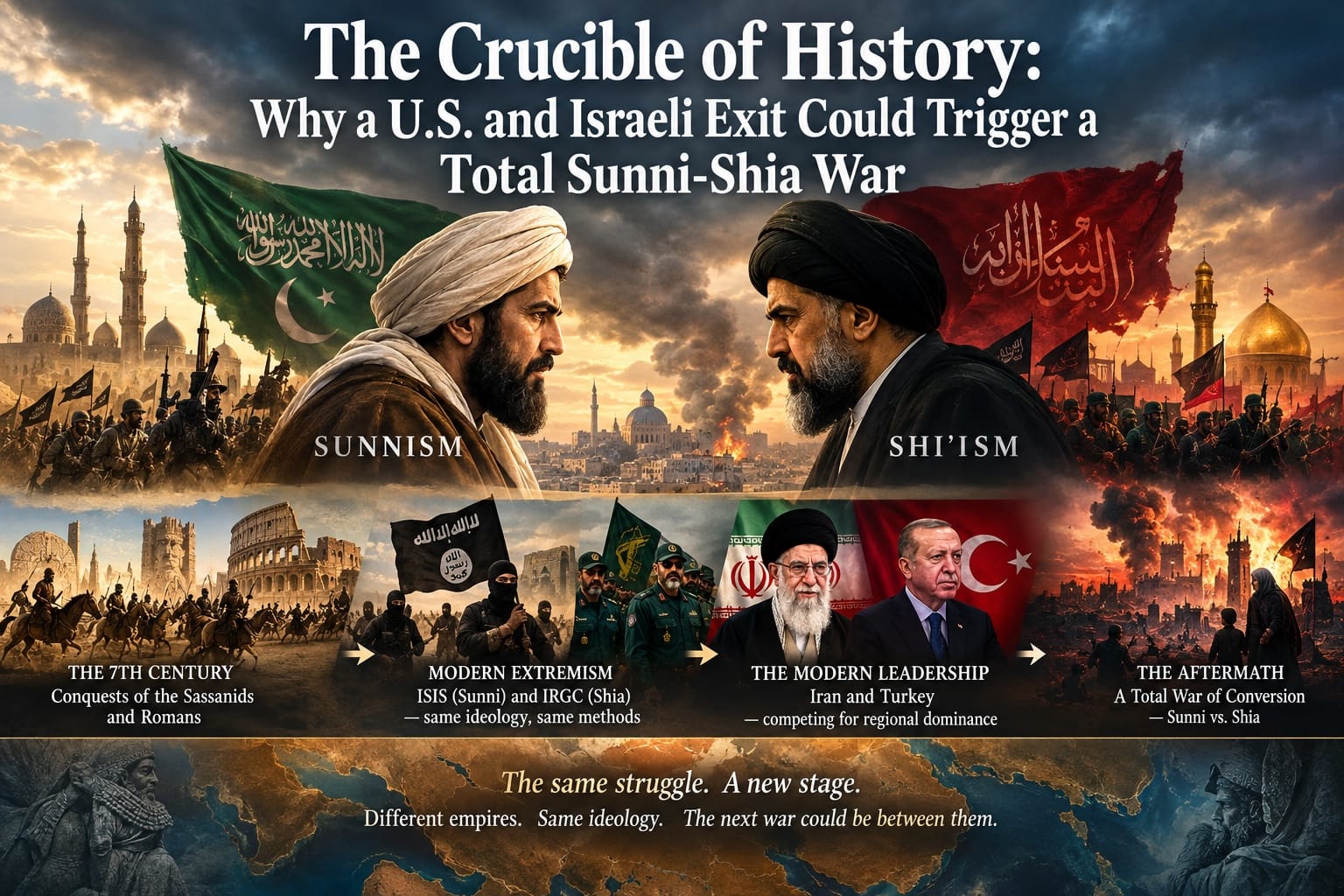
The geopolitics of the Middle East are frequently analyzed through the lens of modern alliances, but a deeper look suggests that today’s tensions are merely the continuation of a 1,400-year-old conflict. If the United States and Israel were to completely remove themselves from the region, the existing fragile balance would likely collapse, paving the way for a total war of conversion and dominance between the two major sects of Islam: Shi’ism and Sunnism.
To understand why total war would be the inevitable outcome of a Western and Israeli withdrawal, one must look directly at the bloody foundation of early Islamic expansion, the nature of modern militant leadership, and the ultimate ideological goals of these factions.
The Historical Parallel: Early Islamic Conquests and Modern Extremism
The initial rise of Islam was defined by simultaneous, aggressive military campaigns. The early Islamic Arab armies did not confine their warfare to local tribes; instead, they waged war against the Sassanid Kurdish Empire and the Roman Italian Empire at the exact same time. These historical armies utilized uncompromising violence to dismantle existing empires and enforce their rule.
In terms of ideology and tactics, this foundational era reflects the behavior of modern extremist groups. The early conquests share direct operational and ideological DNA with modern organizations:
- ISIS (Sunni Muslims): Employs brutal, uncompromising violence to establish a strict, fundamentalist Sunni order, mirroring the total warfare of early expansion.
- The IRGC (Shia Muslims): Operates the Islamic Revolutionary Guard Corps to aggressively export Shia revolutionary ideology across national borders through military force.
Both forces operate on the premise that their theological interpretation must reign supreme, using the same fierce methods as the armies of the 7th century.
The Modern Leadership: Iran and Turkey
In the current geopolitical landscape, these radical elements are not isolated; they are directed by powerful state actors seeking total regional dominance.
Today, Iran is leading both Shia and various Sunni extremist organizations, acting as a central coordinator for anti-Western and anti-Israeli militancy. By backing a network of proxy forces, Tehran has unified disparate fanatical groups under a single operational umbrella to clear the region of external resistance. Meanwhile, Turkey has assumed leadership over a separate faction of Islamic fanatics, positioning itself as a competing pole of Islamic authority.
Currently, these regional powers and their proxy armies are focused on a common goal: eliminating U.S. and Israeli influence from the Middle East.
The Aftermath: A Total War of Conversion
The presence of the U.S. and Israel currently acts as a shield and a deterrent, forcing Sunni and Shia powers to manage their rivalries through limited proxy conflicts. However, once that external presence is gone and a final victory over outside influence is achieved, the temporary alignment between these factions will disintegrate.
Without a common enemy to unite them, Shi'ism and Sunnism will turn on each other in a total war of mutual elimination.
This final conflict will not be fought over borders or resources, but for absolute theological dominance. Driven by the same zeal as the initial Islamic armies, the surviving powers will launch campaigns to forcibly convert one another. The ultimate casualty of this war will be the civilian population, who will be trapped in the crossfire and forced to accept whichever radical Islamic teaching triumphs on the battlefield.
The 1400-Year Cycle of Islamic Warfare: From the Sassanid-Roman Conquests to the Modern Dual Leadership of Iran and Turkey
To analyze the geopolitical trajectory of the Middle East without U.S. and Israeli involvement, a historian must evaluate the foundational patterns established during the initial Islamic conquests. The current proxy architectures of the region are not novel developments; they are structurally continuous with the 1,400-year history of sectarian and expansionist warfare within Islam. By examining the simultaneous 7th-century campaigns against the Sassanid and Roman Empires alongside the modern strategic doctrines of Iran and Turkey, we can map out how a total war of conversion between Sunnism and Shi'ism would unfold in the absence of external deterrents.
Part I: The Historical Blueprint — The Dual Campaigns Against the Sassanids and Romans
The foundational methodology of Islamic warfare was established in the 630s CE. Rather than consolidating power locally, the early Islamic Arab armies executed a highly aggressive, high-mobility grand strategy, launching massive military campaigns against the two superpower rival empires of the era simultaneously.
[ Early Islamic Arab Army ]
/ \
/ \
v v
[ Sassanid Empire ] [ Byzantine Roman Empire ]
(Battle of al-Qadisiyyah) (Battle of Yarmouk)
1. The Campaign Against the Sassanid Empire
The Sassanid Empire, which ruled over vast territories including modern-day Iraq and Iran, was heavily populated by various regional groups, including ancestral Kurdish populations.
- The Strategy of Total Attrition: Under the military command of generals like Khalid ibn al-Walid and Sa'd ibn Abi Waqqas, the Arab forces targeted the Sassanid western frontier.
- The Decisive Blow: Following the Battle of al-Qadisiyyah (636 CE), the Islamic forces breached the Sassanid capital of Ctesiphon. The subsequent Battle of Nihawand (642 CE) systematically dismantled the Sassanid imperial structure.
- The Ultimatum: The conquest was characterized by a strict operational formula: conversion to Islam, submission to the Jizya tax as subjugated subjects, or total warfare. This campaign permanently altered the demographic and religious landscape of the former Sassanid empire territories.
2. The Campaign Against the Roman (Byzantine) Empire
Simultaneously, the early Islamic armies pushed northwest into the Levant and North Africa, striking the eastern provinces of the Roman Empire (the Byzantine Empire based in Constantinople, possessing deep historical and political ties to the Italian Roman legacy).
- The Breakthrough: At the Battle of Yarmouk (636 CE), the Islamic forces permanently severed Rome's control over Syria and Palestine.
- The Expansion: This opened the gateway for the rapid, forceful annexation of Egypt and Mediterranean North Africa.
By fighting a multi-front war against both Rome and people of Sassanid empire, the early Islamic state established a historical precedent: utilizing absolute, uncompromising violence to dismantle existing regional powers and compel the surviving populations to accept Islamic governance and teaching. This historical template of dual-front, high-intensity expansion directly mirrors the ideological ambitions of modern extremist networks like ISIS on the Sunni side and the IRGC on the Shia side.
Part II: The Modern Operational Doctrine — The Roles of Iran and Turkey
In the contemporary landscape, the historical zeal of the initial conquests has been institutionalized by two major state powers. They have positioned themselves as the leading authorities of the respective sects, preparing their factions for regional dominance.
[ Regional Leadership Cadre ]
/ \
v v
[ Shia Axis ] [ Sunni Factions ]
Led by: IRGC (Iran) Led by: Turkey
1. Iran's Unified Command of Radical Factions
Operating through the Islamic Revolutionary Guard Corps (IRGC), Iran executes a complex, overarching strategy. While deeply rooted in Shia revolutionary theology, Tehran’s modern doctrine focuses on leading a broad coalition of fanatical organizations.
- Tactical Consolidation: Iran provides financial, logistical, and military architecture not only to Shia groups (such as Hezbollah, the Houthis, and Iraqi militias) but also to specific Sunni militant organizations.
- Strategic Intent: By acting as the operational umbrella for these diverse fanatical elements, Iran leverages them as asymmetric tools to erode Western influence and dismantle Israeli defensive capabilities, clearing the geopolitical board for a future Shia hegemony.
2. Turkey's Leadership of Sunni Fanaticism
Concurrently, Turkey has shifted its strategic posture to act as a competing pole of Islamic authority, specifically positioning itself to lead a significant portion of Sunni Islamist factions.
- Sponsorship of Non-State Actors: Ankara actively supports, funds, and shields various Sunni opposition militias, radical factions in northern Syria, and political Islamist networks throughout the region.
- Neo-Ottoman Ambitions: Turkey’s state apparatus utilizes these Sunni proxy forces to extend its geopolitical footprint, projecting power down into the traditional Arab heartlands and challenging Iranian expansionism.
Part III: The Aftermath of Western Exit — The Total War of Conversion
Currently, the military presence of the United States and Israel functions as an artificial barrier. It forces Iran and Turkey to conduct their sectarian competition through localized, controlled proxy theaters. However, a total withdrawal of U.S. and Israeli forces would fundamentally alter this dynamic, shifting the region from cold proxy conflicts to a total conventional war.
[ U.S. & Israeli Withdrawal ]
│
▼
[ Disintegration of Alliance ] ──► [ Direct Clash: Iran vs. Turkey ]
│
▼
[ Total Sectarian War ]
• Forcible theological conversion
• Subjugation of populations
Once the common external adversaries are removed and a final victory over outside influence is achieved, the temporary alignment between these radical factions will instantly disintegrate. The historical animosity between Sunnism and Shi'ism will reassume its position as the primary driver of regional geopolitics.
- The Direct Clash of Empires: Without an external deterrent, the IRGC-led Shia axis and the Turkish-led Sunni factions will engage in direct, unrestricted state-on-state warfare.
- Warfare of Absolute Conversion: Mirroring the 7th-century campaigns against Rome and the Sassanids, this conflict will be fought for total theological monopoly. The objective will not be a diplomatic truce or border adjustments, but the total elimination of the opposing sect's religious authority.
- Subjugation of the Population: As both sides deploy extreme violence to achieve victory, the civilian populations trapped within disputed territories will face the exact same conditions as those during the initial Islamic conquests. The victorious armies will use systemic, forced assimilation, compelling the population to accept their specific radical Islamic teaching under penalty of death.
The Comprehensive Geopolitical Assessment: Sectoral Total War and the Historical Continuum of Islam
To fully construct this historical overview of a potential post-U.S. and post-Israeli Middle East, we must anchor the analysis in three critical historical frameworks: the recurring pattern of Ottoman-Safavid sectarian warfare, a chronological timeline tracking the evolution of Islamic military expansionism, and the precise geographical fault lines where the contemporary forces of Turkey and Iran are destined to clash.
Part I: The Ottoman-Safavid Wars — Historical Precedents of Total Sectarian War
When evaluating how a modern conflict between Turkish-led Sunni forces and Iranian-led Shia forces would manifest, a historian must look to the Ottoman-Safavid Wars (16th–18th centuries). This era serves as the definitive historical precedent for total, state-level sectarian warfare within Islam.
- The Battle of Chaldiran (1514)
- The Sectarian Flashpoint: Under Sultan Selim I, the Sunni Ottoman Empire declared the Shia Safavid Empire, founded by Shah Ismail I, to be heretics. Religious edicts (fatwas) were issued legitimizing the total extermination of the opposing sect.
- The Military Engagement: At Chaldiran, the Ottomans utilized superior gunpowder technology and artillery to shatter the Safavid cavalry.
- The Outcome: The battle established a blood-soaked precedent: the conflict was not merely over territory, but over the absolute right to define Islamic orthodoxy. The Ottomans executed widespread purges of Shia sympathizers across Anatolia, while the Safavids responded with forced conversions of Sunnis in today Iran.
2. The Treaty of Amasya (1555) and Treaty of Zuhab (1639)
- The Division of the Lands: After decades of scorched-earth campaigns—where armies systematically burned crops, poisoned wells, and forcibly displaced entire ethnic and religious populations—the two empires drew bloodlines across the Middle East.
- The Historical Lesson: The Treaty of Zuhab (1639) established borders that roughly mirror the modern frontiers between Turkey, Iraq, and Iran. This history demonstrates that without external balancing forces, the default geopolitical state between dominant Sunni and Shia powers in this geography is total, existential war, which is only halted when both sides reach absolute physical exhaustion.
Part II: The 1,400-Year Comparative Timeline
The progression from early Islamic conquests to modern state-sponsored proxy networks demonstrates a structural continuum. The operational methods used by early armies have been digitized, institutionalized, and scaled by modern state actors.
|
Era / Date |
Historical Islamic Milestone (Sunni / Shia Foundations) |
Modern Parallel / Strategic Equivalent |
|
632–640s CE |
Simultaneous Multi-Front Expansion: Early Arab armies attack and dismantle the Sassanid (Kurdish) and Byzantine Roman Empires at Yarmouk and al-Qadisiyyah. |
Multi-Front Regional Destabilization: Modern radical organizations (ISIS on the Sunni side; IRGC proxies on the Shia side) conduct simultaneous asymmetric campaigns across Iraq, Syria, and Yemen. |
|
1514 CE |
The Battle of Chaldiran: Sunni Ottomans and Shia Safavids engage in conventional warfare driven by heretical declarations, resulting in mass sectarian purges. |
The Proxy Shatterbelts: The direct, bitter operational competition between Turkish-backed militias and Iran's IRGC branches in the Syrian and Iraqi theaters. |
|
1639 CE |
Treaty of Zuhab: The creation of rigid geographic and theological borders between Sunni-governed and Shia-governed spaces following centuries of scorched-earth total war. |
The Modern Geopolitical Balance: The fragile status quo maintained strictly by the presence of U.S. military deterrents and Israeli defensive strategies. |
|
Post-U.S. / Israel Exit |
Historical Vacuum Period: The erasure of an outside arbiter, historically leading to immediate tribal and sectarian land grabs. |
Total War of Mutual Elimination: The inevitable conventional clash between the Turkish-led Sunni factions and the Iranian IRGC axis for absolute theological monopoly. |
Part III: The Modern Collisional Geography — Where Turkey and Iran Will Clash
In the event of a total U.S. and Israeli withdrawal, the geographic boundaries where the Turkish and Iranian spheres of influence collide will transform into active conventional frontlines. Three specific territorial choke points will define this total war.
[ TURKEY (Sunni Core) ]
│
▼
[ Northern Syria / Aleppo Shatterbelt ]
▲
│
[ IRGC / IRAN (Shia Core) ]
Fault Line 1: The Northern Syria / Aleppo Shatterbelt
- The Geopolitical Context: Northern Syria is the primary zone where Turkey's neo-Ottoman ambitions directly overlap with Iran’s land bridge to the Mediterranean.
- The Clash Point: Turkey currently secures and funds Sunni rebel factions in Idlib and parts of northern Aleppo. Iran’s IRGC commands a dense network of Shia militias directly adjacent to these zones to protect the Assad regime in the past. Without a U.S. presence to police boundaries, this line will erupt into a massive, conventional armored war for control of the Levant.
Fault Line 2: The Mosul-Kirkuk Corridor (Northern Iraq)
- The Geopolitical Context: Iraq acts as the traditional geographic buffer between Iran-Iraq Shia authority and the Sunni Arab/Turkish world.
- The Clash Point: Turkey maintains military bases in northern Iraq to combat Kurdish factions and protect Turkmen interests, positioning itself as a protector of Sunni populations. Iran controls Iraq's political and military state apparatus through the Popular Mobilization Forces (PMF), which are tied directly to the IRGC. This corridor will become a primary battleground as Turkey pushes south to protect Sunni enclaves and Iran pushes north to secure its western logistical pathways.
Fault Line 3: The Bab-el-Mandeb and Red Sea Maritime Choke Point
- The Geopolitical Context: Total war requires cutting off the adversary's economic lifeblood.
- The Clash Point: Iran utilizes the Houthi movement in Yemen to control access to the Red Sea. Turkey maintains significant military facilities and geopolitical alliances across the water in the Horn of Africa (Somalia). A total sectarian war will expand from a land clash into a fierce maritime conflict, with Turkish-aligned naval forces attempting to break the IRGC's stranglehold over regional shipping lanes.
Historical Synthesis
A objective examination of the last 1,400 years reveals a cyclical pattern. When external empires or balancing powers withdraw from the Middle East, the deep-seated theological and structural divergence between Sunnism and Shi'ism returns to the forefront. Armed with the historical memory of the early conquests against Rome and the Sassanids, and driven by the institutional power of the IRGC and the Turkish state, the removal of U.S. and Israeli involvement would strip away the final layer of deterrence. The result would be a total, conventional war of conversion and regional dominance, forcing the civilian population to submit to the theological dictate of the ultimate victor.