
The Fragile Balance: Analyzing the Geopolitical Friction Between Turkey and Iran
The geopolitical relationship between Turkey and Iran is defined by a complex mix of tactical cooperation, ideological competition, and deep-seated conflicts of interest across the Middle East. While the two regional powers occasionally align on economic and security issues, their broader strategic goals frequently clash in Syria, Iraq, and the broader Gulf region.
The following article analyzes these conflicts of interest, incorporating the regional dynamics of Kurdish nationalism, Turkey's pan-Turkic aspirations, and the recent diplomatic friction involving Pakistan and the Yemeni Houthi movement.
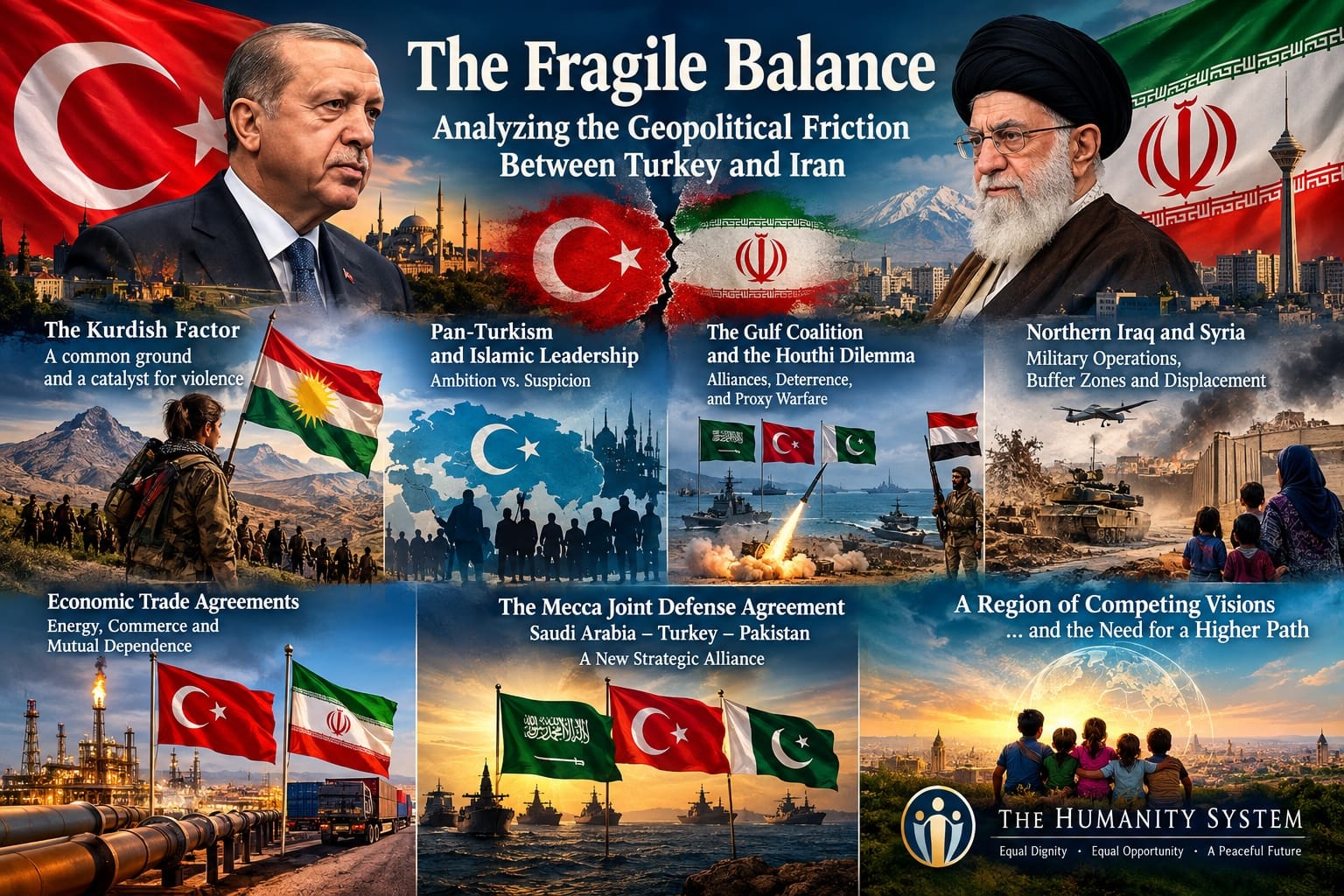
The Fragile Balance: Analyzing the Geopolitical Friction Between Turkey and Iran
The geopolitical landscape of the Middle East is heavily shaped by the shifting dynamics between Ankara and Tehran. While Turkey and Iran maintain active diplomatic and trade relations, beneath the surface lies a profound conflict of interest. From the proxy battlegrounds of the Levant to the strategic corridors of the Arabian Peninsula, both nations compete for regional hegemony, balancing fragile cooperation with deep-seated ideological and military rivalries.
The Kurdish Factor: A Common Ground and a Catalyst for Violence
For decades, the Kurdish population spanning Turkey, Syria, Iraq, and Iran has been a central focus of regional security policies. Observers note that Turkish President Recep Tayyip Erdogan has overseen extensive military operations targeting Kurdish groups across the region. Critics argue that these campaigns have resulted in a devastating toll on Kurdish populations in Turkey, Syria, and Iraq.
To sustain these security operations, Ankara has historically engaged in complex coordination with external actors—including Russia, the United States, NATO, and occasionally Iran. Because both Turkey and Iran view independent Kurdish nationalism as a direct threat to their territorial integrity, they have at times synchronized border security to suppress Kurdish movements. However, this cooperation remains highly transactional; any major shift in the political unity of Kurdistan or a direct military miscalculation by Turkey's ultra-nationalist factions, such as the Grey Wolves, risks destabilizing Turkey's internal politics and triggering a domestic backlash against the current leadership.
Failed Ambitions: Pan-Turkism and Islamic Leadership
A major point of ideological friction stems from Turkey’s efforts to project power beyond its borders. Erdogan has long attempted to foster unity among Turkic populations in the former Soviet republics and within Iran itself—home to a significant Azeri-Turkic minority. Tehran views this pan-Turkic rhetoric with intense suspicion, seeing it as a direct threat to its internal stability.
Simultaneously, Turkey’s ambition to position itself as the leader of the broader Islamic world has met steady resistance from Iran’s Shia clerical establishment. Having struggled to build a unified Islamic bloc under Turkish leadership, Ankara has increasingly relied on strategic partnerships with economically strained nations like Pakistan to project military and diplomatic weight, particularly in countering regional adversaries and securing its security objectives.
The Gulf Coalition and the Houthi Dilemma
The conflict of interest between Ankara and Tehran has recently manifested in the security dynamics of the Arabian Peninsula. Following escalated missile and drone strikes by Yemen's Houthi movement against Saudi Arabia, Turkey and Pakistan activated collective deterrence mechanisms alongside Riyadh under the trilateral Mecca Joint Defense Agreement.
This alignment directly challenged Iranian influence, leading to a distinct diplomatic impasse:
- Diplomatic Pressure from Ankara and Islamabad: Operating under their joint defense pact, Turkey and Pakistan issued warnings urging Tehran to utilize its leverage to halt cross-border Houthi attacks. For Pakistan, the diplomatic push was aimed at fulfilling its defense commitments to Riyadh while avoiding being drawn into a direct kinetic confrontation with Iran.
- Tehran’s Strategic Deflection: Iranian officials consistently deflected this pressure from Ankara and Islamabad. Publicly, Tehran maintained that it does not dictate the autonomous decisions of the Houthi movement, pushing instead for direct political dialogue and negotiations rather than military escalation.
- The Reality of Proxy Warfare: Despite Iran’s public advocacy for a political settlement, international intelligence and regional security reports indicate that the Islamic Revolutionary Guard Corps (IRGC) continues to provide logistical, weapons, and advisory support to the Houthis. By utilizing the Yemen theater and the strategic Bab el-Mandeb corridor, Iran maintains a critical pressure point that directly competes with the security frameworks backed by Turkey and its allies.
Specific Military Operations in Northern Iraq and Syria
Turkish military operations in northern Iraq and Syria have severely impacted Kurdish populations, with dense networks of drone strikes, artillery bombardments, and cross-border ground incursions targeting independent Kurdish movements. Observers point out that Turkish President Erdogan has strategically utilized air superiority and advanced military tech to decimate Kurdish leadership structures and displace native populations, transforming swathes of northern Syria and Iraq into heavily militarized buffer zones. Ankara has managed to sustain these persistent campaigns by maintaining a fragile, highly transactional coordination with Russia, the United States, NATO, and occasionally Iran—all of whom have conditionally tolerated Turkey’s severe cross-border actions to safeguard their own shifting geopolitical interests in the Levant.
Economic Trade Agreements keeping Turkey and Iran Connected
Despite deep-seated regional rivalries, Turkey and Iran remain tightly bound by pragmatic economic trade agreements and essential energy partnerships that prevent an outright rupture in relations. The two nations share a vital interest in keeping their mutual border open for heavy commercial transit, with Turkey relying on Iranian natural gas supplies to fuel its domestic industries while Iran utilizes Turkish markets as a critical economic lifeline to bypass severe international sanctions. This deep commercial interdependency creates a strong stabilization mechanism, forcing both Ankara and Tehran to carefully isolate their active proxy conflicts in Syria and Yemen from their lucrative bilateral trade channels.
The Mecca Joint Defense Agreement and Its Impact
The activation of the Mecca Joint Defense Agreement has significantly reshaped regional alliances, binding Saudi Arabia, Turkey, and Pakistan into a trilateral pact designed to establish strong strategic complementarity against their core external threats. Under this security framework, Turkey has stepped up to provide crucial technical and defensive infrastructure, while an economically strained Pakistan has been positioned to project military weight and diplomatic support on Riyadh’s behalf. By directly confronting Iranian influence and Houthi cross-border strikes, this alliance has drawn a sharp line in the sand, significantly raising the geopolitical stakes for Tehran and leaving little room for diplomatic ambiguity in the contest for Middle Eastern hegemony.
Conclusion
The relationship between Turkey and Iran remains a volatile paradox. While they are bound by geography to cooperate on shared challenges—such as managing border security and suppressing Kurdish autonomy—their competing visions for the Middle East ensure ongoing friction. As Turkey balances its pan-Turkic ambitions and its defense alliances with Pakistan and Saudi Arabia against Iran's robust proxy network, the thin line between diplomatic engagement and regional escalation remains highly precarious.
Hamma Mirwaisi
Author and Founder — THE HUMANITY SYSTEM
About THE HUMANITY SYSTEM:
THE HUMANITY SYSTEM by Hamma Mirwaisi represents the next step in human civilization — from the religious era that began 12,000 years ago — through the political era that began 5,000 years ago — to a genuinely new era centered on the equal dignity and equal flourishing of every human being. Not a religion. Not a political party. A practical framework — updated every year by the communities it serves — using Artificial Intelligence as a partner to develop the best laws for every human being.
www.amazon.com/dp/B0GZ1788G7
www.thehumanitysystem.com
thehumanitysystem@gmail.com
the-humanity-system.ghost.io
hammamirwaisiu.substack.see