The Gap Between Us: Why Wealth and Poverty Are a Human Problem, Not Just an Economic One
Walk down almost any street in the world and you'll see it: the invisible line that separates those who worry about rent from those who don't. Economists measure this gap in Gini coefficients and income percentiles. Politicians measure it in votes. But underneath the numbers is something simpler and harder to fix — a difference in how people are taught to see themselves, each other, and the world.
Two Different Educations
Rich and poor children rarely sit in the same classroom, but the deeper divide isn't about which building they learn in. It's about what they're taught to expect from life.
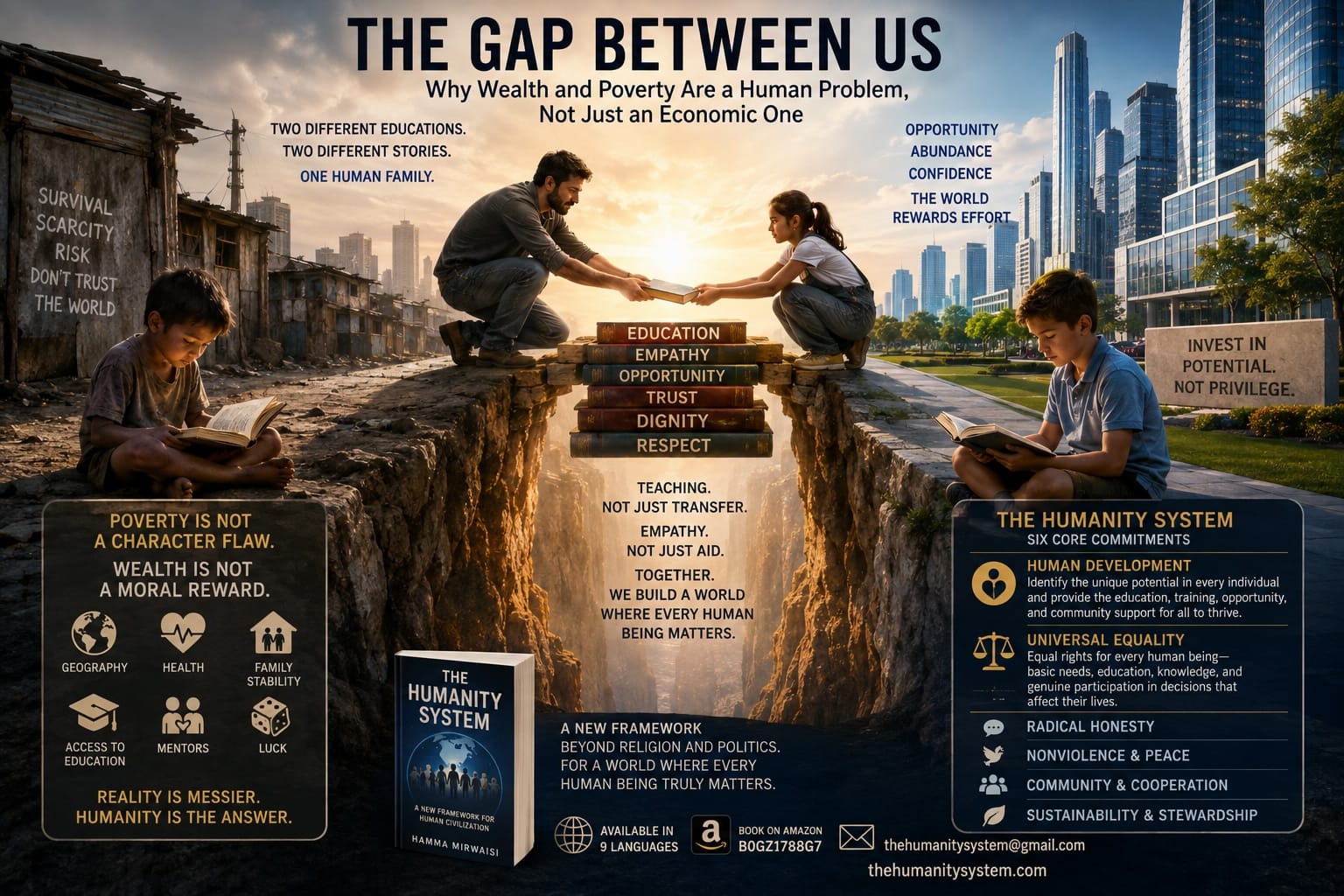
A child raised in scarcity often learns, without anyone saying it out loud, that resources are finite, that trust is risky, and that survival comes before generosity. A child raised in abundance often learns the opposite — that opportunity is abundant, that risk-taking is safe, and that the world rewards confidence. Neither lesson is wrong for the world each child actually lives in. But both are incomplete pictures of what it means to be human, and both get passed down, generation after generation, hardening into culture.
This is why wealth gaps are so stubborn. You can redistribute money, but if you don't also redistribute the mindset that turns money into opportunity — and the empathy that keeps opportunity from curdling into indifference — the gap reopens within a generation.
Poverty Is Not a Character Flaw. Wealth Is Not a Moral Reward.
One of the most damaging ideas in any society is the quiet assumption that the poor are poor because they didn't try hard enough, or that the rich are rich purely because they earned it through virtue. Reality is messier: geography, health, historical accident, family stability, access to mentors, and plain luck all weigh as heavily as effort. Recognizing this isn't about assigning blame — it's about refusing to let either group be reduced to a stereotype.
Where the Real Solution Lives
Aid programs, minimum wage laws, and tax policy all have a role to play — but they treat symptoms. They can move money across a line without changing what happens on either side of it. The deeper work is teaching people, early and often, to see the person on the other side of the wealth gap not as a competitor but as a fellow human being whose potential deserves the same investment as anyone else's.
This is the space The Humanity System, founded by author Hamma Mirwaisi, is built for. The book positions itself as a genuinely new framework for human civilization — one that moves beyond religion and politics toward a world where every human being truly matters — and it's now available in nine languages. Its central argument is that religion and politics were the two great systems that historically governed civilization, one promising meaning and the other promising justice, but that neither can keep pace with how fast the modern world is changing, leaving a widening gap between the world as it is and the world people deserve.
Rather than proposing another ideology to compete with existing ones, the framework is explicit that it is not a new religion — it asks for no belief in a god or doctrine — and not a political party seeking power or votes. Instead, it's organized around six core commitments. The one most directly relevant to closing the rich–poor gap is what the book calls Human Development: a commitment to identifying the unique talents and potential of every individual, and to providing the education, training, opportunity, and community support needed for every person — not just the talented few or the privileged many, but everyone — to develop that potential and contribute it back to the human family.
That commitment sits alongside a companion principle, Universal Equality — a set of core rights meant to apply to every human being equally, including the right to basic needs, to education and knowledge, and to genuine participation in the decisions that affect one's own life. Together, the two ideas describe a rich–poor solution that isn't primarily about moving money across the line, but about making sure the teaching that turns opportunity into mobility — and the empathy that turns privilege into stewardship — reaches everyone, not just the fortunate few who were already positioned to receive it.
Why Teaching, Not Just Transfer, Matters
Money given without understanding is often money lost. Wealth held without empathy is often wealth wasted. The most durable change happens when both sides of the gap are equipped — not just supplied. The Humanity System frames this as a matter of honesty about what previous systems have failed to deliver, paired with a commitment to being continuously revised as new challenges emerge, rather than treated as a fixed, finished doctrine.
The rich and the poor are not different species solving different problems. They're the same species, taught two different stories about what's possible. A framework built around teaching — rather than doctrine or politics — is one attempt to change that story for everyone.
Learn more: thehumanitysystem.com · Book on Amazon (B0GZ1788G7) · thehumanitysystem@gmail.com