
The Mecca Pact and the Echoes of Karbala!
The Modern Mobilization in a 1,400-Year Sectarian Divide
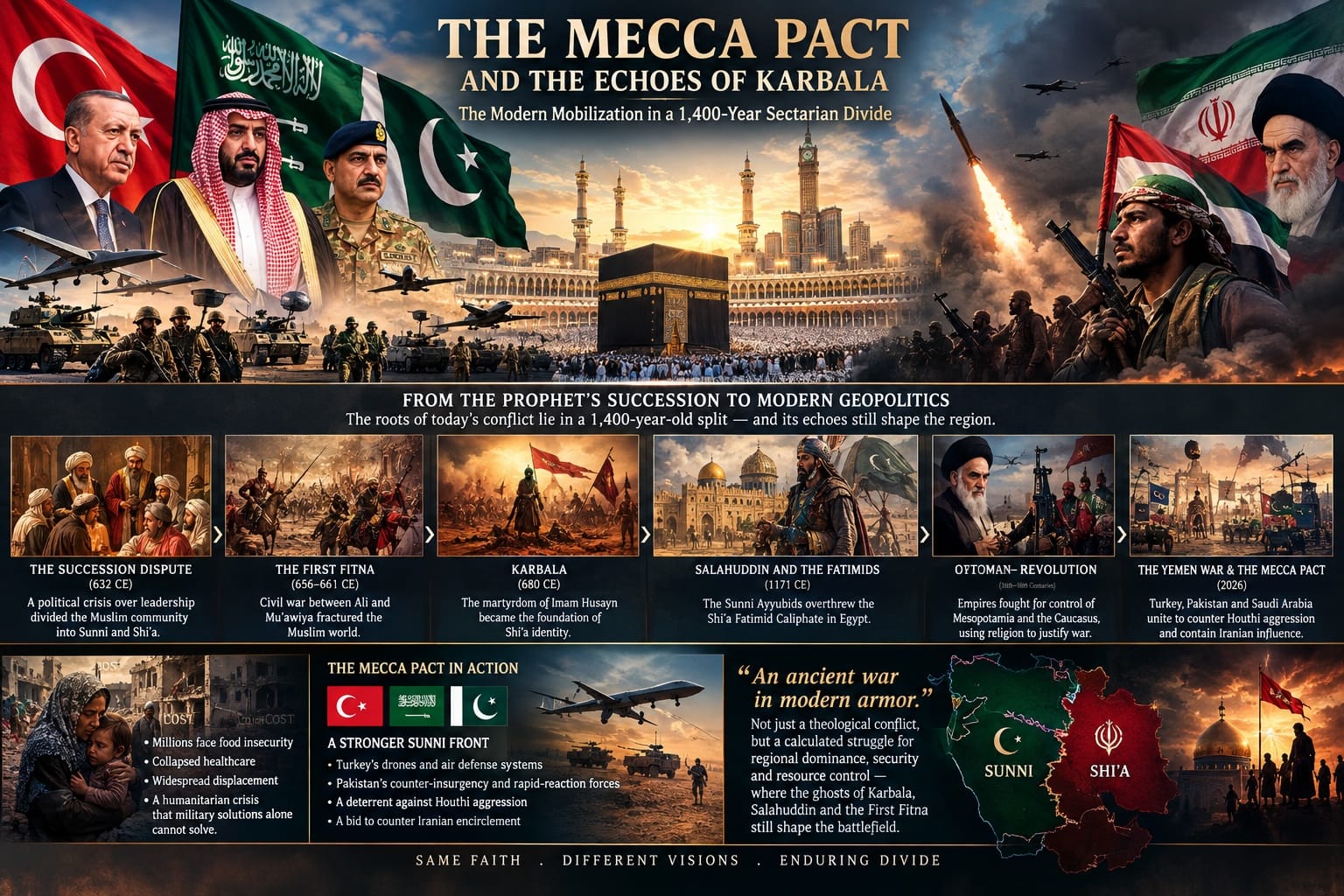
The October 2026 announcement that Turkey and Pakistan will deploy rapid-reaction military forces to Saudi Arabia under the Mecca Joint Defence Agreement marks a profound shift in Middle Eastern geopolitics. Spurred by escalating Houthi missile and drone strikes against Saudi infrastructure and holy sites, this trilateral pact unites major Sunni-led military powers in a collective defense framework.
While modern states operate on strategic interests, resource control, and geopolitical hegemony, the framing of this conflict is deeply intertwined with the oldest and most enduring schism in Islamic history: the division between Sunni and Shi'a Islam.
1. The Ancient Schism: The Succession Dispute and the First Fitna
The roots of the animosity between the two primary branches of Islam do not stem from fundamental differences in the core tenets of the faith, but from a political crisis over legitimate leadership following the death of the Prophet Muhammad in 632 CE.
- The Core Dispute: One faction of the early Muslim community believed that leadership should be decided by community consensus, leading to the selection of Abu Bakr as the first caliph. This majoritarian path formed the basis of Sunni Islam. Another faction, the Shi'atu Ali (Partisans of Ali), maintained that leadership was a divine right belonging strictly to the Prophet’s bloodline, starting with his cousin and son-in-law, Ali ibn Abi Talib.
- The First Fitna (656–661 CE): Open civil war erupted when Ali became the fourth caliph. His legitimacy was fiercely contested by Mu'awiya ibn Abi Sufyan, the governor of Syria and cousin of the assassinated third caliph, Uthman. This first major Islamic civil war fractured the political unity of the Muslim world permanently.
- The Tragedy of Karbala (680 CE): The political split transformed into a permanent spiritual and theological trauma during the Battle of Karbala in modern-day Iraq. Imam Husayn ibn Ali, the grandson of the Prophet Muhammad, refused to pledge allegiance to the Umayyad Caliph Yazid I. Husayn and his small band of family and followers were massacred by Umayyad forces. Husayn’s martyrdom became the foundational pillar of Shi'a identity, symbolizing an eternal struggle against tyranny and Sunni-dominated persecution.
2. Medieval and Imperial Clashes: From Salahuddin to the Ottoman-Safavid Wars
Throughout the centuries, this religious divide continued to dictate the rise and fall of empires, leaving a legacy of historical grievances that modern actors still reference today.
- The Overthrow of the Fatimids (1171 CE): A primary historical parallel to today's pan-Sunni alliances occurred with the rise of Salahuddin Al-Ayyubi (Saladin). At the time, Egypt and parts of the Levant were ruled by the Fatimid Caliphate, a powerful Shi'a empire. Salahuddin, a brilliant Kurdish military commander loyal to the Sunni Abbasid Caliphate, successfully overthrew the Fatimid dynasty, dismantled its institutions, and restored Sunni Islamic governance.
- The Ottoman-Safavid Rivalry (16th–18th Centuries): The historical animosity reached its imperial peak during the brutal centuries-long conflict between the Sunni Ottoman Empire (centered in modern-day Turkey) and the Shi'a Safavid Dynasty (centered in modern-day Iran). When the Safavids declared Twelver Shi'ism as their state religion, it drew a hard, permanent geopolitical border through the Muslim world. The two empires fought a series of devastating wars over control of Mesopotamia (Iraq) and the Caucasus, using religious decrees to legitimize total warfare against each other. This rivalry permanently shaped the modern borders and sectarian demographics of the Middle East.
3. The Modern Catalysts: 1979 and the Proxy Era
Historians emphasize that while ancient theological grievances provide the emotional vocabulary for today's wars, the contemporary conflict is fueled entirely by modern statecraft and regional power struggles.
- The 1979 Iranian Revolution: The true turning point for modern sectarian warfare was the birth of the Islamic Republic of Iran under Ayatollah Khomeini. By establishing an overtly Shi'a, revolutionary state committed to exporting its Islamic governance model, Iran directly challenged the regional hegemony and religious authority of Saudi Arabia, the custodian of Islam's holiest sites.
- The Riyadh-Tehran Cold War: For nearly half a century, Saudi Arabia and Iran have engaged in a bitter proxy cold war across the Middle East. Rather than fighting directly, both nations have funded, trained, and armed opposing factions in Lebanon, Syria, Iraq, and most destructively, Yemen.
4. The Yemen War: Houthis, Saudis, and the Mecca Pact
The current crisis in Yemen is the culmination of this historical friction meets modern proxy warfare.
- Who are the Houthis? The Houthis are an armed movement belonging to the Zaydi branch of Shi'a Islam, an offshoot unique to northern Yemen. While distinct from the Twelver Shi'ism practiced in Iran, their shared religious alignment and opposition to Western and Saudi influence drew them into Tehran’s orbit. Iran has provided the Houthis with advanced drone, cruise missile, and ballistic technology.
- The Sunni Mobilization: For Saudi Arabia, a hostile, Iran-backed Shi'a militant group sitting directly on its southern border represents an existential threat to national security and domestic stability.
- The Significance of the 2026 Mecca Pact: By invoking the Mecca Joint Defence Agreement, Saudi Arabia is actively bridging regional divisions to form a formidable Sunni front. By drawing in Turkey (a major NATO military power) and Pakistan (a nuclear-armed state with deep military ties to Riyadh), the alliance seeks to deter Houthi aggression and contain Iranian encirclement.
5. Strategic Capabilities and the Humanitarian Reality
The operational rollout of the Mecca Pact injects immense military power into the conflict, but it does so against a backdrop of deep regional suffering.
- Deploying Advanced Military Power: The alliance directly answers the Houthi aerial threat by leveraging Turkey's cutting-edge drone technology and air defense systems, combined with Pakistan's specialized counter-insurgency troops and elite rapid-reaction forces. This formidable combination aims to create a highly sophisticated defensive shield over Saudi infrastructure and holy sites.
- The Escalating Humanitarian Crisis: This heavy military mobilization lands on a region already devastated by over a decade of warfare. Yemen remains one of the world's worst humanitarian disasters, where years of blockades and fighting have left millions facing severe food insecurity, a collapsed healthcare infrastructure, and widespread displacement—complexities that a purely military solution cannot easily resolve.
Conclusion: An Ancient War in Modern Armor
The unfolding military escalation in Saudi Arabia is not an uninterrupted, 1,400-year theological war. It is a highly calculated, modern geopolitical struggle for regional dominance, security, and resource control.
However, by operating under defense pacts named after Islam's holiest city to fight a Shi'a-aligned insurgency, the actors involved ensure that the ghosts of the First Fitna, Salahuddin’s campaigns, and the tragedy of Karbala remain as potent and weaponized as the modern missiles flying across the Arabian Peninsula.