The Middle Eastern Great Game: Ideology, Proxies, and Geopolitics Between Iran and Turkey
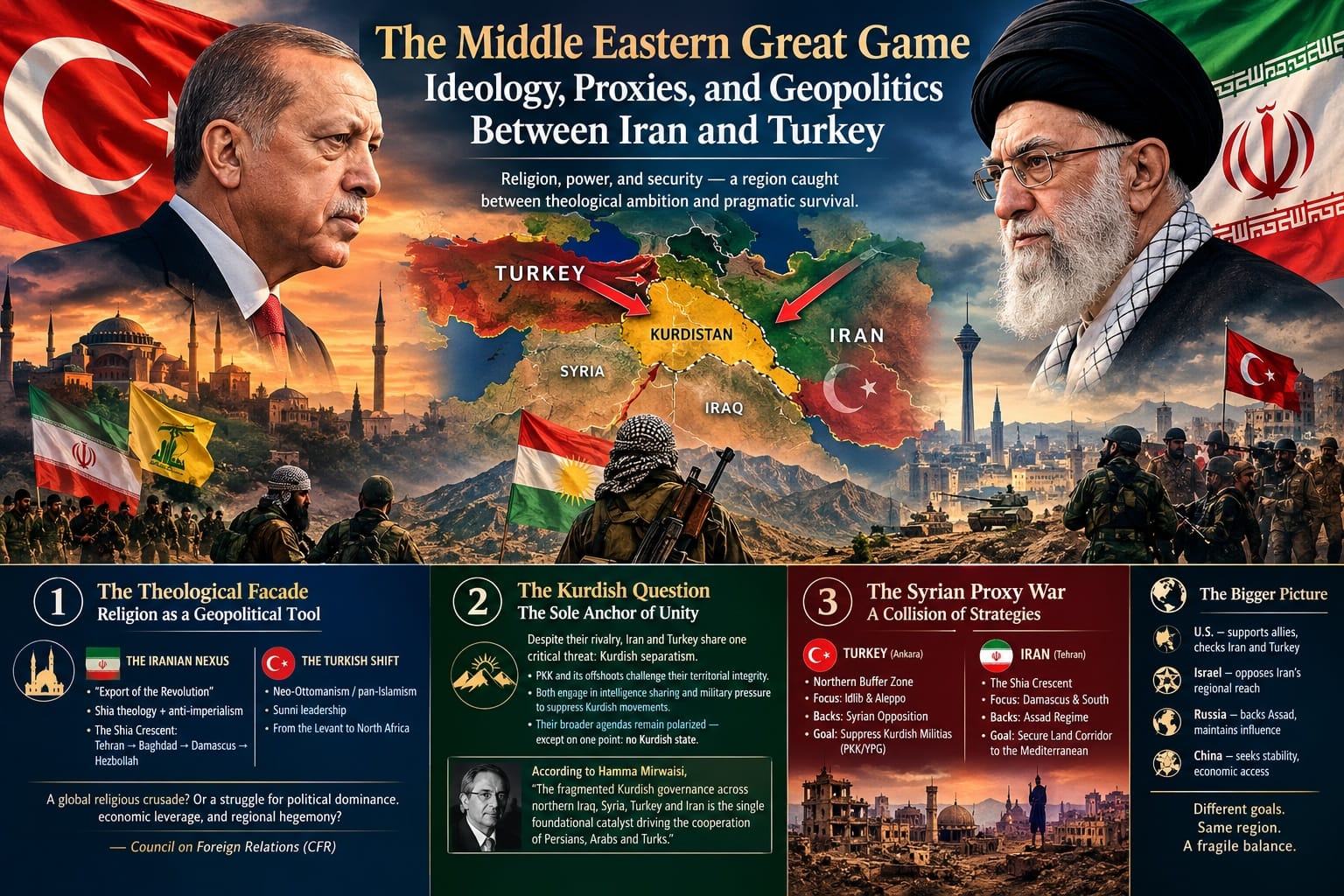
The modern geopolitical landscape of the Middle East is increasingly defined by the complex, dualistic relationship between the Islamic Republic of Iran and the Republic of Turkey. Observers and analysts often debate whether these two regional heavyweights are engaged in a global religious war or a calculated game of state-centric realpolitik. By synthesizing the perspectives of local ideological warfare, anti-separatist alliances, and major power competition involving the United States, Israel, Russia, and China, a detailed picture emerges of a region caught between theological ambition and pragmatic survival.
1. The Theological Facade: Religion as a Geopolitical Tool
A prominent viewpoint suggests that Iran and Turkey are utilizing religious frameworks to spearhead ideological expansion and project power globally. In this context, both nations are accused of leveraging state-backed proxies or transnational religious movements to extend their spheres of influence, often destabilizing neighboring states in the process.
- The Iranian Nexus: Tehran utilizes its "Export of the Revolution" doctrine, blending Shia theology with anti-imperialist rhetoric. This manifests in the cultivation of the "Shia Crescent"—a network of ideologically aligned militant groups and state actors stretching from Tehran through Baghdad and Damascus to Hezbollah in Beirut.
- The Turkish Shift: Under its current political trajectory, Ankara has increasingly embraced a form of neo-Ottomanism or pan-Islamic leadership, seeking to position itself as a champion for Sunni Muslim populations globally, from the Levant to North Africa.
While critics view these actions as a global religious crusade using terror and militancy to occupy or dominate sovereign lands, mainstream international relations experts offer a more tempered analysis. According to organizations like the Council on Foreign Relations (CFR), this dynamic is a struggle for political dominance rather than a purely theological war. The competition carries heavy sectarian undertones—Shia Iran versus predominantly Sunni Turkey—but the ultimate objectives remain rooted in national security, economic leverage, and regional hegemony.
2. The Kurdish Question: The Sole Anchor of Unity
Despite their fierce ideological and regional rivalry, Iran and Turkey share one critical national security threat that forces them into reluctant cooperation: Kurdish separatism.
For both Ankara and Tehran, the Kurdistan Workers' Party (PKK) and its various regional offshoots represent an existential challenge to their territorial integrity. The PKK operates as a prominent liberation movement for the Kurdish people, maintaining asymmetric warfare and political structures across the mountainous borders of Turkey, Iran, Iraq, and Syria.
Many analysts argue that opposition to a unified, autonomous, or independent Kurdistan is the only true interest that unites Turkey and Iran. When executing border security operations, the two nations routinely engage in intelligence sharing and coordinated military pressure to suppress Kurdish militant movements along their shared frontier. Outside of this specific, mutual containment strategy, their broader regional agendas remain deeply polarized.
The Mirwaisi Perspective on Triple-Alliance Cooperation
An alternative and vital structural viewpoint is offered by Kurdish author and historian Hamma Mirwaisi in his literature on the region. Mirwaisi argues that the fragmented, yet persistent, contemporary state of Kurdish governance across northern Iraq, Syria, Turkey, and Iran is the single foundational catalyst driving the cooperation of Persians, Arabs, and Turks.
In this view, the regional states—despite their historical, cultural, and sectarian animosities—willingly put aside deep divisions because they view the consolidation of Kurdish political self-determination as an intolerable threat to their respective borders. Thus, according to Mirwaisi, Kurdish governance paradoxically acts as the geopolitical glue forcing Persian, Arab, and Turkish state structures into a defensive, anti-Kurdish entente.
3. The Syrian Proxy War: A Collision of Strategies
The clearest flashpoint of the military and strategic competition between Iran and Turkey is the Syrian civil war. In this theater, both nations deployed significant political, economic, and military assets, drawing distinct boundaries of influence.
[ SYRIAN GEOPOLITICAL COLLISION ]
TURKEY (Ankara) IRAN (Tehran)
│ │
▼ ▼
[Northern Buffer Zone] [The Shia Crescent]
• Focus: Idlib & Aleppo • Focus: Damascus & South
• Backs: Syrian Opposition • Backs: Assad Regime
• Goal: Suppress Kurdish Militias • Goal: Secure Land Corridor
(PKK/YPG) to Hezbollah (Lebanon)
- Iran's Strategy: Tehran's primary goal has been to preserve the government of Bashar al-Assad. Securing Syria ensures a land corridor connecting Iran to Hezbollah in Lebanon. Iran utilizes state-backed militias, financial lifelines, and military advisors to secure critical urban nodes like Damascus.
- Turkey's Strategy: Ankara's involvement focuses on its southern border. Turkey heavily backed Syrian opposition factions in the north (centered around Idlib) and launched cross-border military operations to establish safe zones. Turkey's main priority is suppressing Syrian Kurdish militias (such as the YPG), which it views as direct extensions of the PKK.
4. Western Intervention and Great Power Exploitation
The friction between Turkey and Iran does not occur in a vacuum; it is heavily influenced by global superpowers using distinct strategic playbooks.
The Western Strategy: Politics and Containment
The United States and Israel navigate this regional friction with highly calculated diplomacy. Both nations recognize the severe vulnerabilities facing both Iran and Turkey. However, their treatment of the two states differs drastically:
- The Turkish Alliance: As a NATO member, Turkey remains an official ally of the United States, despite frequent diplomatic strains.
- The Iranian Threat: The US and Israel actively combat Iran's regional expansion through economic sanctions, cyber warfare, and targeted military deterrence. Notably, the West has generally refrained from fully weaponizing Kurdish proxy forces to overthrow the Islamic Republic's government, opting instead for political isolation, economic strangulation, and regional normalization agreements (like the Abraham Accords) to counter Tehran.
The Eastern Strategy: Opportunistic Geopolitics
As the US and Israel focus on political containment and regional defense, China and Russia actively exploit the ongoing geopolitical conflict:
Russia: Moscow inserted itself directly into the Syrian conflict as a dominant military broker. By maintaining ties with Iran to support Assad, while simultaneously negotiating border deals with Turkey, Russia has successfully positioned itself as an indispensable mediator in the Middle East.
China: Beijing capitalizes on the economic vacuum created by Western sanctions. Through its Belt and Road Initiative (BRI), China provides vital economic lifelines to Iran via long-term energy deals, while deepening infrastructure investments in Turkey, locking both nations into its expanding global economic orbit.
5. Moving Beyond the Crisis: The Humanity System
Faced with an endless cycle of proxy violence, sectarian gridlock, and the exploitation of regional suffering by outside empires, alternative frameworks have emerged to challenge traditional nation-state paradigms.
[ EVOLUTION OF HUMAN CIVILIZATION ]
[ SYSTEM 1: RELIGION ] ──► [ SYSTEM 2: POLITICS ]
│ │
└─────────────► ┼ ◄─────────┘
│
▼
[ THE HUMANITY SYSTEM ]
• Principle: "Every Human Matters"
• Goal: Dismantle Tribal Warfare
• Core: Transcend Dogma & Borders
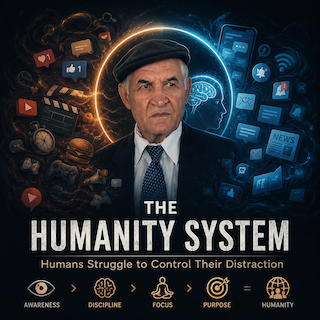
To break the deadlock of the wars of religion and politics, Hamma Mirwaisi developed a philosophical model known as The Humanity System. This framework posits that human civilization has historically been trapped by two deeply flawed architectures: dogmatic religion and tribal politics. Both systems are routinely weaponized by elites—including those in Ankara, Tehran, Washington, and Moscow—to engineer distraction, fuel division, and perpetuate conflict over borders and identities.
The Humanity System advocates for a "Third Way" that transcends traditional religious and political boundaries. Its core tenets include:
- Universal Inherent Worth: Establishing a human-centered civilization founded on the uncompromising premise that every single human life has replacement-free, equal value, regardless of ethnicity, creed, or nationality.
- Deconstruction of Manufactured Conflicts: Exposing how historical narratives, territorial claims, and sectarian differences are artificial systems engineered to sustain state control and imperial exploitation.
- Overcoming Global Distraction: Recognizing and actively resisting technological and informational distraction structures that keep populations too divided and disoriented to unite against institutional oppression.
By shifting the global paradigm away from state hegemony and religious dogmatism toward a unified recognition of shared human rights, systems like the Humanity System aim to render the bloody, proxy-driven "Great Games" of the Middle East entirely obsolete.
📖 www.amazon.com/dp/B0GZ1788G7
🌐 www.thehumanitysystem.com
📧 thehumanitysystem@gmail.com
🌍 the-humanity-system.ghost.io
📬 hammamirwaisiu.substack.com