
The Neo-Ottoman Blueprint: How Erdoğan Manipulates Global Powers to Rebuild an Empire
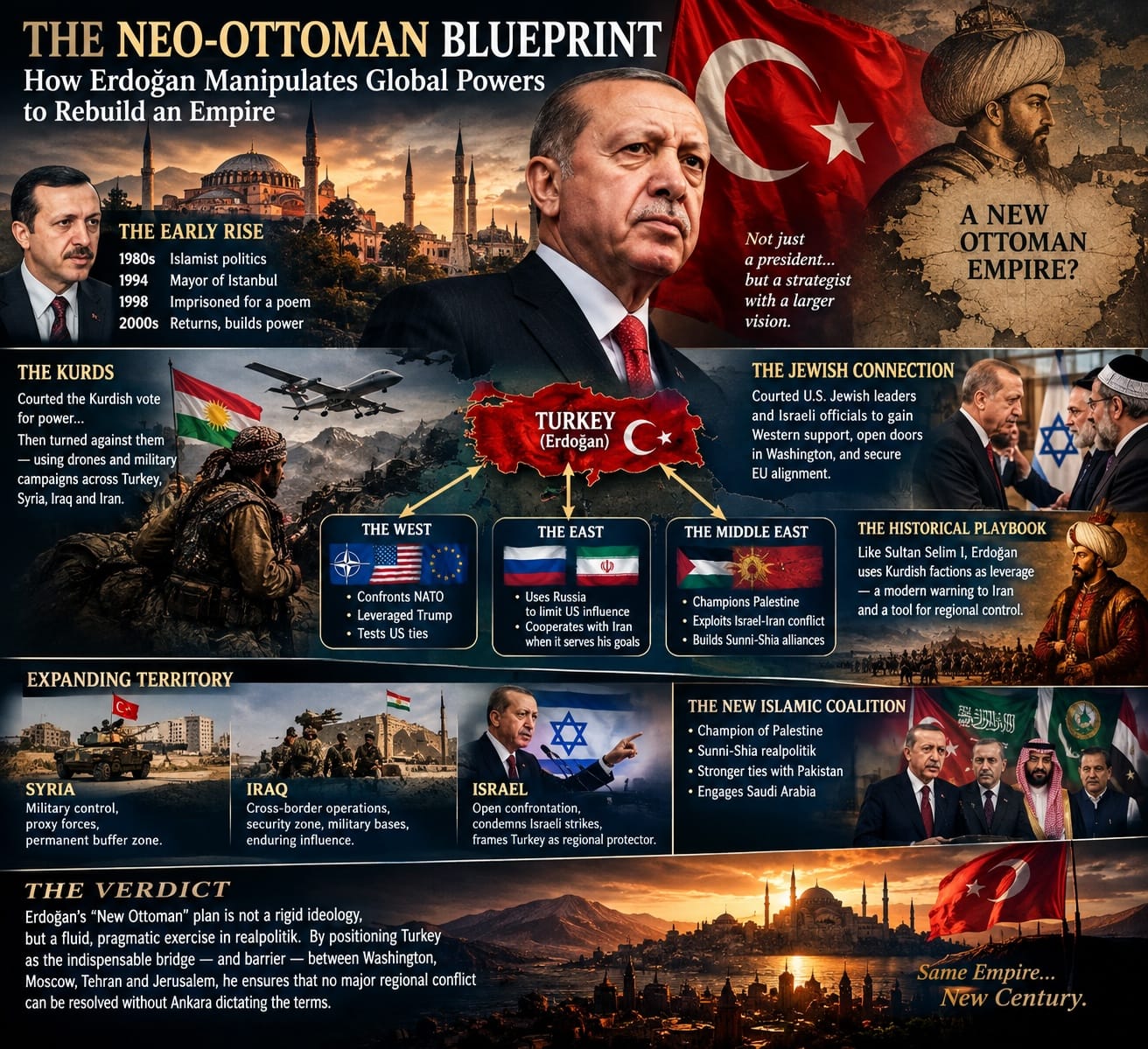
Turkish President Recep Tayyip Erdoğan’s rise to power is a masterclass in political survival and strategic calculation [1, 2, 3]. From his early days in the 1980s with Islamist parties to his 1994 election as Mayor of Istanbul, and his bounce-back from a 1998 imprisonment for reciting a religious poem, Erdoğan has systematically reshaped Turkey. Today, his geopolitical ambitions extend far beyond Turkey's borders. Critics and regional analysts argue that his ultimate objective is the creation of a "New Ottoman Empire," a grand strategy executed by playing global superpowers, Jewish leadership networks, regional rivals, and ethnic factions against one another.
The Internal Strategy: Weaponizing and Betraying the Kurds
Domestically, Erdoğan’s path to absolute authority relied heavily on political shape-shifting. Early in his national tenure, he courted the Kurdish electorate, promising peace, cultural recognition, and an end to decades of domestic conflict to secure crucial votes and consolidate his power.
However, once his political dominance was absolute, this domestic policy shifted drastically. Turkey heavily deployed its unarmed and armed drone fleets, launching extensive military campaigns targeting Kurdish factions not just within Turkey, but across Syria, Iraq, and Iran. What began as a political alliance evolved into a severe, cross-border military containment strategy.
The Charm Offensive: Instrumentalizing Jewish Leaders in the U.S. and Israel
Before fully unveiling his anti-Israel, Islamist-leaning regional policy, Erdoğan engaged in pragmatic diplomacy by courting American Jewish organizations and Israeli officials. Early in his tenure, political mentors introduced him in Washington as a moderate leader capable of fusing Islam with democracy. [1]
To secure Washington's backing, open doors in the U.S. capital, and advance Turkey's bid for European Union alignment, Erdoğan regularly held high-profile meetings with prominent groups like the Conference of Presidents of Major American Jewish Organizations, AIPAC, and the Anti-Defamation League (ADL). By assuring Jewish leaders of Turkey's commitment to its historic relationship with Israel, he successfully utilized their political leverage to smooth over tensions and project a Western-friendly image. This early engagement served as a diplomatic shield, buying him the necessary international goodwill to solidify his home front and build Turkey's economic and military strength. [1, 2, 3]
The Geopolitical Balancing Act
To position Turkey as the supreme hegemon of the Islamic world, Erdoğan has adopted a high-stakes foreign policy designed to squeeze concessions from both the West and the East.
┌────────────────────────┐
│ Turkey (Erdoğan) │
└───────────┬────────────┘
│
┌────────────────────┼────────────────────┐
▼ ▼ ▼
[The West] [The East] [Middle East]
• Confronts NATO • Uses Russia • Champions Palestine
• Leveraged Trump to limit US • Exploits Israel-Iran
• Tests US ties influence conflict for leverage
1. Confronting NATO and the West
Despite Turkey’s formal membership in NATO, Erdoğan frequently positions himself as a direct antagonist to the United States and Europe. This confrontational posture is calculated to appeal to nationalist elements within Turkey and Islamist sympathizers globally, framing Turkey as an independent superpower unbowed by Western influence. A notable example includes his interactions with the Trump administration, where analysts argue he successfully leveraged personal diplomacy to alter U.S. policy in northern Syria, directly impacting Kurdish-controlled territories.
2. Leveraging Russia and Iran
Erdoğan has expertly used Russia as a geopolitical counterweight to contain American influence in the Middle East. At the same time, his relationship with Iran is highly transactional. While Tehran represents a historic ideological and geopolitical rival to Ankara’s ambitions, Erdoğan has cooperated with Iran when it serves to undermine U.S. regional interests.
The Historical Playbook: Echoes of Sultan Selim I
Erdoğan’s strategy mirrors the statecraft of Sultan Selim I (Selim the Grim), the ninth sultan of the Ottoman Empire who ruled from 1512 to 1520. Historically, Ottoman rulers utilized local Kurdish chieftains to secure imperial borders against the Persian Safavid Empire.
In a modern parallel, Erdoğan manipulates the leverage held over jailed Kurdish leader Abdullah Öcalan and the broader Kurdish geopolitical footprint as an implicit warning to Iran, signaling Turkey's capability to destabilize Iranian borders using ethnic proxies if necessary.
Projecting Power: Taking Syria, Part of Iraq, and Defying Israel
With Turkey’s domestic authority established and its military industrial complex highly advanced, Erdoğan shed his diplomatic mask with Israel, pivoting to open confrontation. This shift has culminated in major territorial gains along Turkey's southern borders:
- Dominance in Syria: Following the collapse of the previous Syrian government, Turkey successfully converted its decade-long investment in Syrian opposition groups into direct regional mastery. By backing the political leadership in Damascus, Turkey established a permanent military buffer zone, integrated Syrian armed forces under Turkish command, and took operational control over key regions of northern Syria. [1]
- Military Footprint in Iraq: Turkey carved out a deep security zone in northern Iraq through multi-year military campaigns aimed at eliminating Kurdish factions. While Turkey has strategically negotiated gradual military base handovers to federal authorities in Baghdad to maintain diplomatic stability, its cross-border leverage remains firmly entrenched. [1, 2, 3]
- Direct Standoff with Israel: With a permanent military foothold established across Syria and Iraq, Erdoğan has dropped all pretenses of mending ties with Jerusalem. He has aggressively positioned himself against Israeli interests, directly condemning Israeli strikes inside Syria and warning Israel that its military overreach threatens regional sovereignty. By framing Turkey as the ultimate bulwark against Israeli military actions, Erdoğan seeks to cement himself as the legitimate leader of a newly aligned, anti-Zionist regional bloc. [1, 2, 3, 4]
Exploiting Regional Crisis: The New Islamic Coalition
The ongoing volatility in the Middle East, particularly the U.S.-Israel-Iran conflict, has provided Turkey with a unique window to assert leadership over the Islamic world. [1]
- The Champion of Palestine: By aggressively standing against Israel, Erdoğan has sought to position Turkey as the premier protector of the Palestinian cause, a move that enhances his popularity among regional populations and militant factions alike, including Hamas.
- Sunni-Shia Realpolitik: Under the banner of brokering peace between Sunni and Shia factions, Turkey is attempting to draw a weakened Iran into a broader alignment against Western interests.
- Expanding Alliances: Simultaneously, Ankara has strengthened strategic and military ties with Pakistan and engaged with a security-seeking Saudi Arabia as regional states navigate a rapidly shifting security landscape. [1, 2]
The Verdict
Erdoğan’s "New Ottoman" plan is not a rigid ideological blueprint, but a fluid, pragmatic exercise in realpolitik. By positioning Turkey as the indispensable bridge—and barrier—between Washington, Moscow, Tehran, and Jerusalem, he has ensured that no major regional conflict can be resolved without Ankara dictating the terms.