
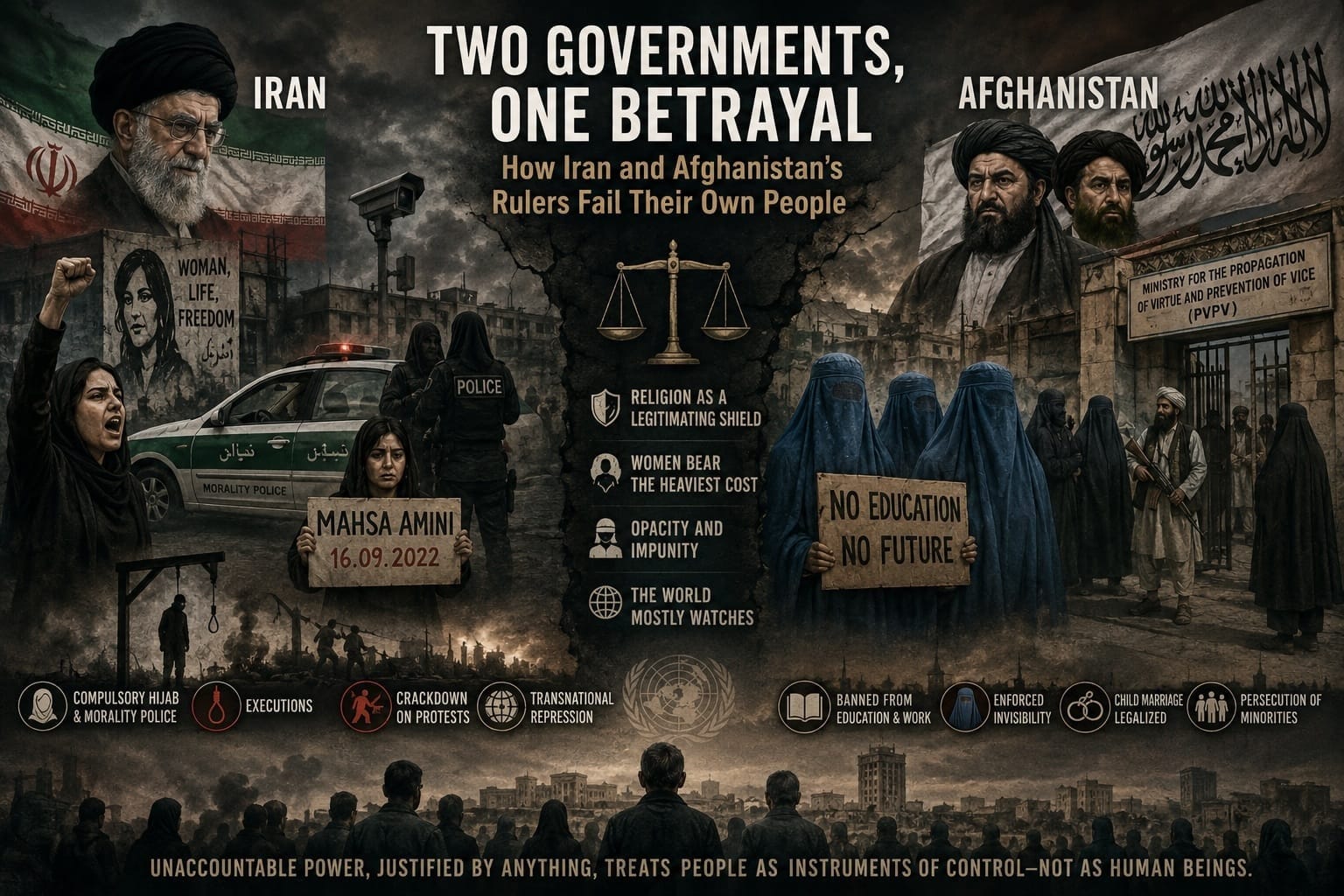
Two Governments, One Betrayal: How Iran and Afghanistan's Rulers Fail Their Own People
A note on framing
Before getting into it, one clarification worth making: this isn't really a question of whether "Shia law" is harsher than "Sunni law" as legal traditions. Both branches of Islamic jurisprudence contain centuries of diverse scholarship, and the vast majority of Sunni- and Shia-majority countries — from Indonesia to Morocco to Lebanon to Iraq — do not resemble Iran or Afghanistan under the Taliban. What we're really talking about is two specific governments — the Islamic Republic of Iran (which follows Twelver Shia jurisprudence) and the Taliban's Islamic Emirate of Afghanistan (which follows a hardline reading of Hanafi Sunni jurisprudence) — that have each built authoritarian rule on top of religious legitimacy claims. The comparison worth making is between two regimes and their treatment of citizens, not between two branches of a faith practiced by nearly two billion people worldwide.
With that said, the record of both governments is worth laying out plainly, because both are, in different ways, brutal to the people they claim to represent.
Iran: a legal system that criminalizes ordinary life, especially for women
Iran's post-1979 legal order enforces a specific interpretation of Shia jurisprudence through state institutions — morality police, Revolutionary Courts, and a judiciary widely criticized as lacking independence. In practice, this has meant:
- Compulsory hijab enforcement. The 2022 death of Mahsa Amini in morality police custody, after her arrest for "improper" hijab, triggered nationwide protests. Rather than reform, authorities have cycled between suspending and reviving morality police patrols, and have pursued even harsher "Hijab and Chastity" legislation, alongside surveillance tools like traffic cameras to identify unveiled women.
- Structural legal discrimination against women. Iranian family and civil law give women fewer rights than men in marriage, divorce, inheritance, and child custody, and permit girls to marry in their early teens with parental or judicial approval — a framework human rights monitors describe as enabling child marriage.
- Escalating executions. Iran already has one of the highest execution rates in the world, with over half tied to drug offenses that international law does not recognize as capital crimes. Reporting into 2026 documents executions tied to political dissent, including men executed in connection with the 2022 "Woman, Life, Freedom" protests, and a rising number of women executed under a sustained penal policy.
- Lethal repression of protest. A new wave of unrest in January 2026 was met with severe force; rights monitors have documented well over 200 women killed in the crackdown, alongside beatings and, in some cases, sexual violence used against detained protesters.
- Transnational repression. Iranian authorities have extended intimidation beyond their borders, targeting journalists and dissidents abroad and their family members still inside the country.
Afghanistan: governance rebuilt around the erasure of women
Since retaking power in August 2021, the Taliban has governed Afghanistan almost entirely by decree, issued by the Amir and published through the Ministry of Justice, bypassing any codified constitution or independent courts. As of mid-2026, the Taliban has issued over 260 such decrees affecting human rights — more than 160 of them specifically targeting women and girls. The effect has been described by the International Criminal Court, which issued arrest warrants in 2025 for two senior Taliban leaders, as gender persecution amounting to a crime against humanity. Key elements include:
- Total exclusion from education and work. Girls remain barred from secondary and higher education, and women have been pushed out of nearly all professions and public decision-making roles.
- Enforced invisibility in public life. The Ministry for the Propagation of Virtue and Prevention of Vice (PVPV), formalized in an August 2024 law, has sweeping authority to police women's dress, movement, and speech, including bans on women traveling without a male guardian beyond a set distance, and, more recently, barring women — including UN staff — from entering UN premises at all.
- Legalized loss of autonomy in marriage. A 2026 "Code on Judicial Separation of Spouses" upholds marriages arranged in childhood and sharply limits women's ability to leave or challenge them, effectively removing any requirement of consent.
- Persecution beyond gender. Human Rights Watch has documented beatings, sexual violence, and arbitrary detention targeting LGBT Afghans, alongside continued targeting of the Hazara ethnic and religious minority.
Where the two converge
Despite different legal traditions, the two governments converge in ways that matter more than their doctrinal differences:
- Religion as a legitimating shield. Both regimes invoke religious law to justify policies that religious scholars across both traditions frequently contest, using "Islamic law" as a rhetorical shield against accountability rather than a genuine, contested legal-theological project.
- Women bear the heaviest cost. In both countries, the most severe and most systematically expanding restrictions fall on women — control over dress, movement, marriage, and public presence functions as a core mechanism of state control, not a side effect of it.
- Opacity and impunity. Neither government operates courts with meaningful independence. Decrees and morality enforcement in both cases bypass due process, and international bodies in both cases have described the results as potential crimes against humanity.
- The world mostly watches. This is perhaps the harder truth. Despite documentation from the UN, Amnesty International, Human Rights Watch, and the ICC, foreign governments continue engaging both regimes when it serves trade, security, or migration interests — the EU inviting Taliban representatives to Brussels for migration talks in 2026 is one recent example. Sanctions, statements of concern, and resolutions have not meaningfully altered either government's trajectory, because strategic and economic interests have consistently outweighed sustained pressure on human rights.
The point worth making
It's tempting to ask "which is worse" — Iran or Afghanistan, Shia governance or Sunni governance. But that question risks missing the more important one: both systems demonstrate that when unchecked state power fuses with a monopoly on religious interpretation, the first casualties are usually women, dissidents, and minorities — regardless of which branch of a shared faith the rulers claim to represent. And both cases show something broader and more uncomfortable: that the international system, for all its human rights language, has repeatedly chosen continued diplomatic and economic engagement over consistent pressure, when the two have come into conflict.
The lesson isn't about which sect governs more harshly. It's that unaccountable power — anywhere, justified by anything — tends to treat human beings as instruments of control rather than people whose dignity is the actual point of governance.
Sources: Human Rights Watch World Report 2026 (Iran and Afghanistan chapters); Amnesty International; OHCHR press releases (2026); Georgetown Institute for Women, Peace and Security; Princeton School of Public and International Affairs; Iran Human Rights Monitor; EUAA Country Guidance on Afghanistan; contemporaneous reporting from Reuters, TIME, and RFE/RL.