What a Genuinely Human World Looks Like in Practice
THE HUMANITY SYSTEM — The Vision
By Hamma Mirwaisi — Author and Founder of THE HUMANITY SYSTEM
Opening — From Vision to Reality
It is easy to say that every human being matters.
It is easy to write those words — to publish them — to share them across every platform available — and to receive the genuine agreement of millions of human beings who feel — deeply and honestly — that yes — every human being does matter — and that the world would be genuinely better if it were organized around that recognition.
What is harder — genuinely harder — is answering the question that follows immediately from that agreement.
What does it actually look like?
Not in abstract philosophical terms. Not in the language of rights declarations and policy frameworks and institutional design. But in the actual daily lived experience of actual human beings living actual lives in actual communities.
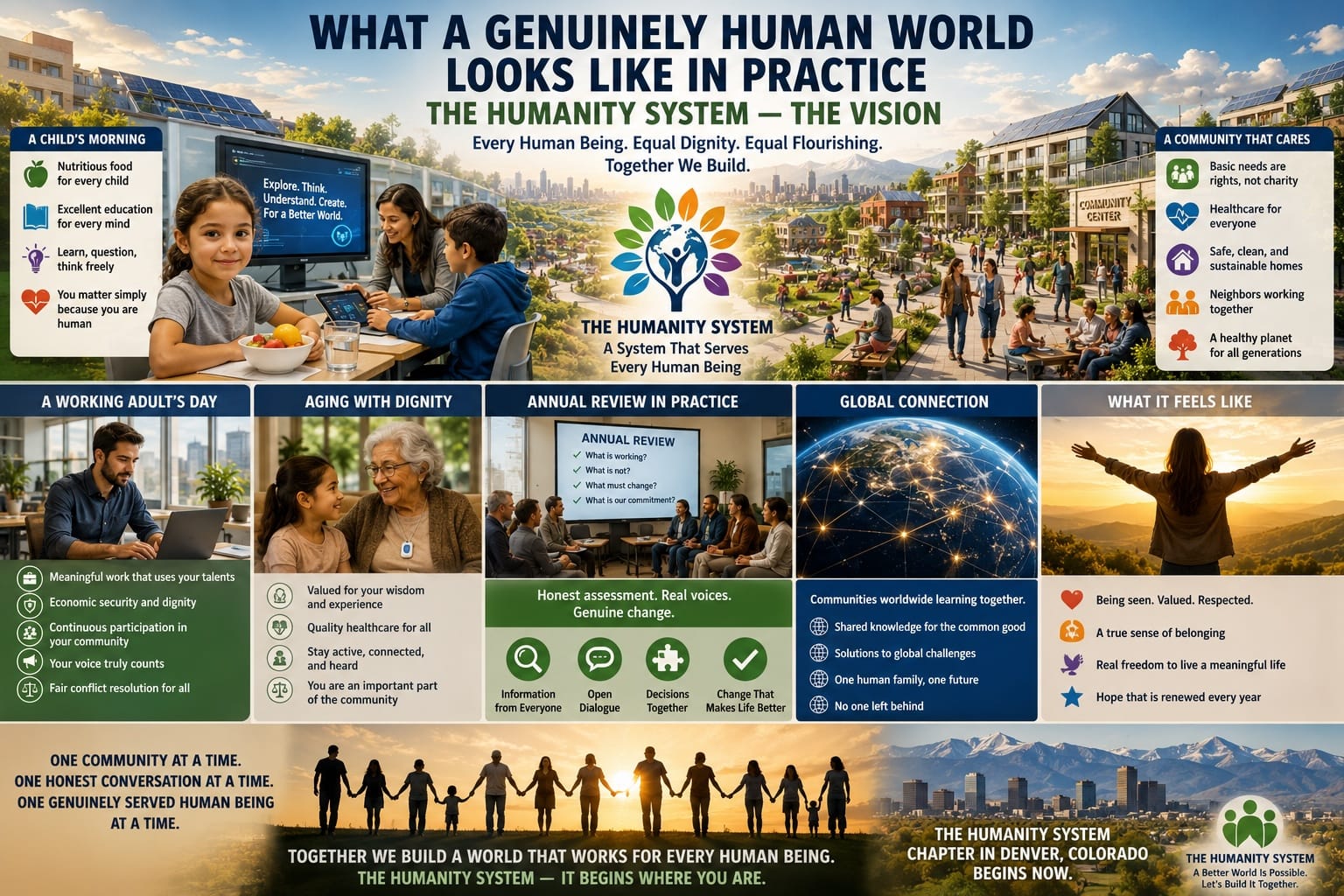
What does a child's morning look like in a world genuinely organized around the equal dignity and equal flourishing of every human being?
What does a working parent's day look like? What does an elderly person's life look like? What does a community's governance look like? What does the relationship between neighbors — between communities — between nations — look like when the systems governing those relationships are genuinely designed to serve every human being rather than the interests of those at the top?
This article answers those questions. Practically. Specifically. And with the genuine honesty that THE HUMANITY SYSTEM places at the center of everything it does.
Because a vision that cannot be made concrete — that cannot be translated from aspiration into the specific details of lived human experience — is not yet a genuine vision. It is a hope. And however important hope is — THE HUMANITY SYSTEM is committed to something more than hope.
It is committed to building.
Part One — What a Child's Life Looks Like
Morning in a Humanity System Community
A child wakes up in a HUMANITY SYSTEM community.
She is seven years old. Her family lives in modest but genuine comfort — not because they are wealthy but because the community's commitment to the Right to Basic Needs means that every family has genuine access to food — clean water — shelter — and healthcare as a matter of right rather than charity.
She eats breakfast. Real food. Nutritious food. Not because her family can afford it — though the community's economic framework ensures they can — but because the community's annual review process identified child nutrition as a genuine priority and built the specific programs needed to ensure that no child in the community goes to school hungry.
She goes to school. And here is where the difference from the world as it currently exists becomes most immediately visible.
Her school is genuinely excellent. Not because her family lives in a wealthy neighborhood — the quality of education in THE HUMANITY SYSTEM does not depend on property values or parental income. But because the community has committed — as a genuine non-negotiable priority — to providing every child with genuinely excellent education.
Her teacher knows her specifically. Knows her learning style — her particular strengths — her specific areas where she needs more support. Because AI-powered educational tools — deployed in genuine service of every child's learning — allow teachers to provide the kind of genuinely personalized attention that was previously available only to those whose families could afford individual tutors.
She learns to think honestly. To ask genuine questions. To examine evidence carefully and reach her own conclusions. Not to memorize the answers that authority figures have declared correct — but to develop the genuine cognitive independence that is every human being's most fundamental capacity and most fundamental right.
She learns about the history of human civilization — honestly. Including the genuine achievements of the religious and political systems that preceded THE HUMANITY SYSTEM. And including their genuine failures — examined clearly and without the distortions that institutional self-interest has historically introduced into every official account of the past.
She learns about the annual review process — how the laws governing her community are honestly examined every year — how community members of every age have a genuine voice in that process — and how the system is designed to change whatever is not genuinely serving every human being within it.
She learns — from the earliest age — that she matters. Not because she is talented or productive or well-behaved. But simply because she is a human being. With inherent and inviolable worth. Whose genuine flourishing is the genuine purpose of every institution in her community.
Part Two — What a Working Adult's Life Looks Like
Economic Life in a Humanity System Community
A man in his thirties wakes up in the same community.
He works. Genuinely meaningful work — because THE HUMANITY SYSTEM's commitment to Human Development means that the community invests specifically in identifying each person's unique talents and creating the conditions for those talents to be genuinely expressed.
He is not trapped in work that exhausts and diminishes him simply because it pays enough to survive. The community's economic framework — built around the Right to Basic Needs and the Right to Participation — ensures that the minimum conditions of genuine human dignity are met for every community member. Which means he works from a foundation of genuine security rather than from the desperation of someone who must accept whatever work is available simply to avoid destitution.
He participates in his community's governance. Not once every few years in an election whose outcome is shaped by concentrated money and partisan manipulation — but continuously — through the genuine participatory processes that THE HUMANITY SYSTEM builds into every community's governance structure.
When the annual review comes — he participates honestly. He shares what is working in his life and what is not. He contributes his specific experience — the experience of a working adult in this specific community — to the honest assessment of whether the laws and practices governing community life are genuinely serving every human being within it.
His voice genuinely counts. Not because he has money or connections or institutional power. But because THE HUMANITY SYSTEM is structurally designed to ensure that every human being's genuine experience of the community's laws and practices is genuinely included in the assessment of whether those laws and practices are working.
He experiences conflict — as every human being does. Disagreements with neighbors. Frustrations with community decisions. Moments when the gap between the vision of THE HUMANITY SYSTEM and the imperfect reality of its implementation is genuinely visible and genuinely frustrating.
And when those conflicts arise — there are genuine mechanisms for addressing them. Not the adversarial legal system that advantages those with the most resources. Not the informal power dynamics that advantage those with the most social influence. Genuine community-based dispute resolution — honestly administered — committed to outcomes that serve every party's genuine interests rather than simply producing a winner and a loser.
Part Three — What an Elderly Person's Life Looks Like
Aging With Dignity in a Humanity System Community
An elderly woman in her eighties lives in the same community.
She has lived long enough to remember the world before THE HUMANITY SYSTEM. To remember what it felt like to grow old in systems not designed for the genuine flourishing of elderly human beings. The anxiety about healthcare costs. The isolation of a culture that valued youth and productivity and had little genuine place for those who were no longer economically active. The fear of becoming a burden — of losing independence — of being warehoused in institutions that provided physical care without genuine human dignity.
In a HUMANITY SYSTEM community — her experience is genuinely different.
She is genuinely valued. Not as a consumer or a voter or an economic unit — but as a human being. As a member of the community whose experience — whose knowledge — whose specific perspective on what human life is actually like across its full span — is genuinely needed by the community she belongs to.
She participates in the annual review. And her perspective — the perspective of someone who has lived long enough to see what genuinely matters and what does not — is specifically sought and specifically honored. Because THE HUMANITY SYSTEM recognizes that genuine community wisdom requires the voices of every generation — not merely the young and the productive.
Her healthcare is genuinely accessible. Not because she is wealthy — but because the community's commitment to the Right to Basic Needs includes genuine healthcare access for every community member as a non-negotiable commitment rather than a means-tested benefit.
AI-powered diagnostic tools — deployed in genuine service of her health rather than in the service of healthcare industry profits — give her access to the kind of sophisticated medical monitoring and early detection that was previously available only to the wealthy. The small device she carries allows her to share health data with her medical team continuously — catching potential problems before they become crises — and giving her genuine agency over her own healthcare rather than passive dependence on whatever the system provides.
She is not isolated. The HUMANITY SYSTEM community center — open to every community member regardless of age — provides genuine space for genuine human connection across every generational line. She knows the seven-year-old girl from Part One. She participates in the dialogue circles that the center hosts. She contributes her experience to the community's understanding of itself.
She is — in the most genuine and most practical sense — genuinely part of something. Not despite her age. Because of it.
Part Four — What Community Governance Looks Like
The Annual Review in Practice
Once a year — the community gathers for its Annual Review.
Not a political election — with candidates competing for power and money flowing to shape the outcome. A genuine community process — in which every member of the community participates in the honest assessment of whether the laws and practices governing community life are genuinely serving every human being within it.
The process begins months before the formal gathering. AI systems — deployed in genuine service of the community's honest self-assessment — aggregate the genuine experience of community members throughout the year. Where are the laws working? Where are they failing? What are the specific ways in which specific community members are being genuinely served — and what are the specific ways in which specific community members are being genuinely failed?
This data — presented honestly and completely — forms the foundation of the Annual Review discussions. Not the self-serving accounts of those who benefit from existing arrangements. The genuine experience of every community member — aggregated honestly and presented transparently.
The discussions are genuine. Difficult sometimes. Honest about failures as well as successes. Including the voices of those whose experience has most consistently been overlooked — the poor — the elderly — the young — the members of minority communities whose specific needs have historically been least visible to those with the most power to shape the system's responses.
And the outcomes are genuine. Laws that the evidence shows are failing human beings are changed. Programs that are not delivering their promised benefits are reformed or replaced. Gaps that honest assessment reveals — places where community members are falling through the cracks of existing support structures — are addressed with specific new commitments.
Not eventually. Not after decades of political resistance from those who benefit from existing arrangements. In the year following the Annual Review. Because the system is specifically designed — structurally — to make genuine change possible when genuine evidence demands it.
Part Five — What the World Between Communities Looks Like
Global Connection in the Humanity System Era
Communities do not exist in isolation. They exist within regions — within nations — within a global human family whose challenges and whose opportunities are genuinely shared.
THE HUMANITY SYSTEM's vision of what the world looks like in practice includes — necessarily — a vision of how communities relate to one another. How the genuine insights and genuine achievements of one HUMANITY SYSTEM community are shared with others. How the global challenges that no single community can address alone — climate change — the governance of artificial intelligence — the elimination of extreme poverty — are approached through genuine global cooperation rather than the competition between nation-states that has historically produced so much human suffering.
The Knowledge Bank — the AI-powered repository of accumulated human knowledge about what genuinely works in serving human beings — ensures that every HUMANITY SYSTEM community — wherever in the world it is located — has genuine access to the best available understanding of how to address the specific challenges it faces. The community in Denver — Colorado — has access to the same repository of human wisdom as the community in Kurdistan — or in Uzbekistan — or in rural India — or in urban China.
And the Annual Review process — practiced simultaneously in communities across the world — produces a continuously updated understanding of what is genuinely working and what is genuinely failing — across every cultural context — every economic situation — every political environment. This global learning — shared honestly and completely through the Knowledge Bank — means that every community benefits from the experience of every other community. That no community has to rediscover — painfully and at the cost of genuine human suffering — what another community has already learned.
This is the vision of global human solidarity that THE HUMANITY SYSTEM advances. Not the solidarity of shared ethnicity or shared religion or shared political ideology. The solidarity of shared commitment to the equal dignity and equal flourishing of every human being — expressed through specific institutional mechanisms that make genuine global learning and genuine global cooperation practically possible.
Part Six — What It Feels Like
The Human Experience of a Genuinely Human World
All of the above describes structures and mechanisms and processes. But a genuine vision of what a genuinely human world looks like in practice must also describe what it feels like.
What is the actual human experience of living within a system genuinely designed for your equal dignity and your equal flourishing?
It feels — the author believes — like being genuinely seen.
Not seen as a category. Not seen as a voter or a consumer or a taxpayer or a believer or a member of any group. Seen as a specific — particular — irreplaceable human being. With specific needs and specific gifts and specific experiences of the world that are genuinely yours and genuinely matter to the community you belong to.
It feels like genuine belonging. Not the conditional belonging of religious community — available only to those who hold the right beliefs. Not the formal belonging of citizenship — which too often masks genuine exclusion. Genuine belonging — to a community that knows you specifically and values you specifically and is genuinely committed to your genuine flourishing.
It feels like genuine freedom. Not the formal freedom of political rights declarations — which too often masks the genuine unfreedom of economic desperation and social exclusion. The genuine freedom of a human being who has what they need to live a genuinely human life — and who is genuinely free to use that life in pursuit of whatever they find most genuinely meaningful.
And it feels — perhaps most importantly — like genuine hope.
Not the hope that things might improve if the right people get elected or if the right policies are adopted or if the right religious revival occurs. But the specific — institutional — annually renewed hope of a human being who lives within a system specifically designed to honestly examine whether it is serving them — and to genuinely change whatever is not.
Conclusion — Building It Together
The world described in this article does not yet exist in the form here described.
The author is honest about this. THE HUMANITY SYSTEM is at its beginning. The first communities are forming. The first chapters — including the one the author hopes to build right here in Denver — Colorado — are just starting to take shape.
The distance between the vision and the current reality is real. And honest.
But every genuinely important human achievement began as a vision that seemed impossibly distant from the reality of its time.
The abolition of slavery seemed impossibly distant from the reality of a world in which slavery was the economic foundation of the most powerful civilizations on Earth.
Universal democratic participation seemed impossibly distant from the reality of a world in which the right to vote was the exclusive privilege of a tiny minority of wealthy men.
Universal human rights seemed impossibly distant from the reality of a world that had just produced the most devastating war in human history.
And yet — each of these visions was realized. Not perfectly. Not without the loss of enormous human potential along the way. But genuinely — in ways that changed the actual daily lived experience of actual human beings in ways that those human beings themselves could feel.
THE HUMANITY SYSTEM is the next vision. The vision of a world that genuinely serves every human being — in the specific practical details of every child's morning — every adult's working day — every elderly person's final years — every community's annual honest reckoning with whether it is living up to its own most fundamental commitment.
It is not yet fully real.
But it is genuinely possible.
And every human being who joins — in Denver or anywhere else in the world — makes it more possible.
One community at a time.
One honest conversation at a time.
One genuinely served human being at a time.
That is what a genuinely human world looks like in practice.
And it begins wherever you are.
Right now. 🌍❤️✨
"The question is not whether a world genuinely organized around the equal dignity and equal flourishing of every human being is possible. It is possible. The question is whether enough human beings are willing to do the specific — practical — sometimes difficult — always genuinely worthwhile work of building it. THE HUMANITY SYSTEM is the answer to that question. And every human being who joins it — anywhere in the world — is proof that the answer is yes."
— Hamma Mirwaisi
Author and Founder — THE HUMANITY SYSTEM
About THE HUMANITY SYSTEM:
THE HUMANITY SYSTEM by Hamma Mirwaisi represents the next step in human civilization — from the religious era that began 12,000 years ago — through the political era that began 5,000 years ago — to a genuinely new era centered on the equal dignity and equal flourishing of every human being. Not a religion. Not a political party. A practical framework — updated every year by the communities it serves — using Artificial Intelligence as a partner to develop the best laws for every human being.
📖 www.amazon.com/dp/B0GZ1788G7
🌐 www.thehumanitysystem.com
📧 thehumanitysystem@gmail.com
🌍 the-humanity-system.ghost.io
📬 hammamirwaisiu.substack.see