What Did Politics Give Humanity?
THE HUMANITY SYSTEM Politics History What Politics Gave Humanity Rule of Law Democratic Participation Political Failure Capitalism Socialism Human Rights Hamma Mirwaisi Every Human Being Matters New Framework Annual Review Genuine Accountability Beyond Politics Human Flourishing
An Honest Assessment of 5,000 Years of Political Systems
By Hamma Mirwaisi — Author and Founder of THE HUMANITY SYSTEM
Opening — The Most Personal Political Question
Before examining what politics gave humanity — every honest human being must first ask themselves the most personal and most important political question available.
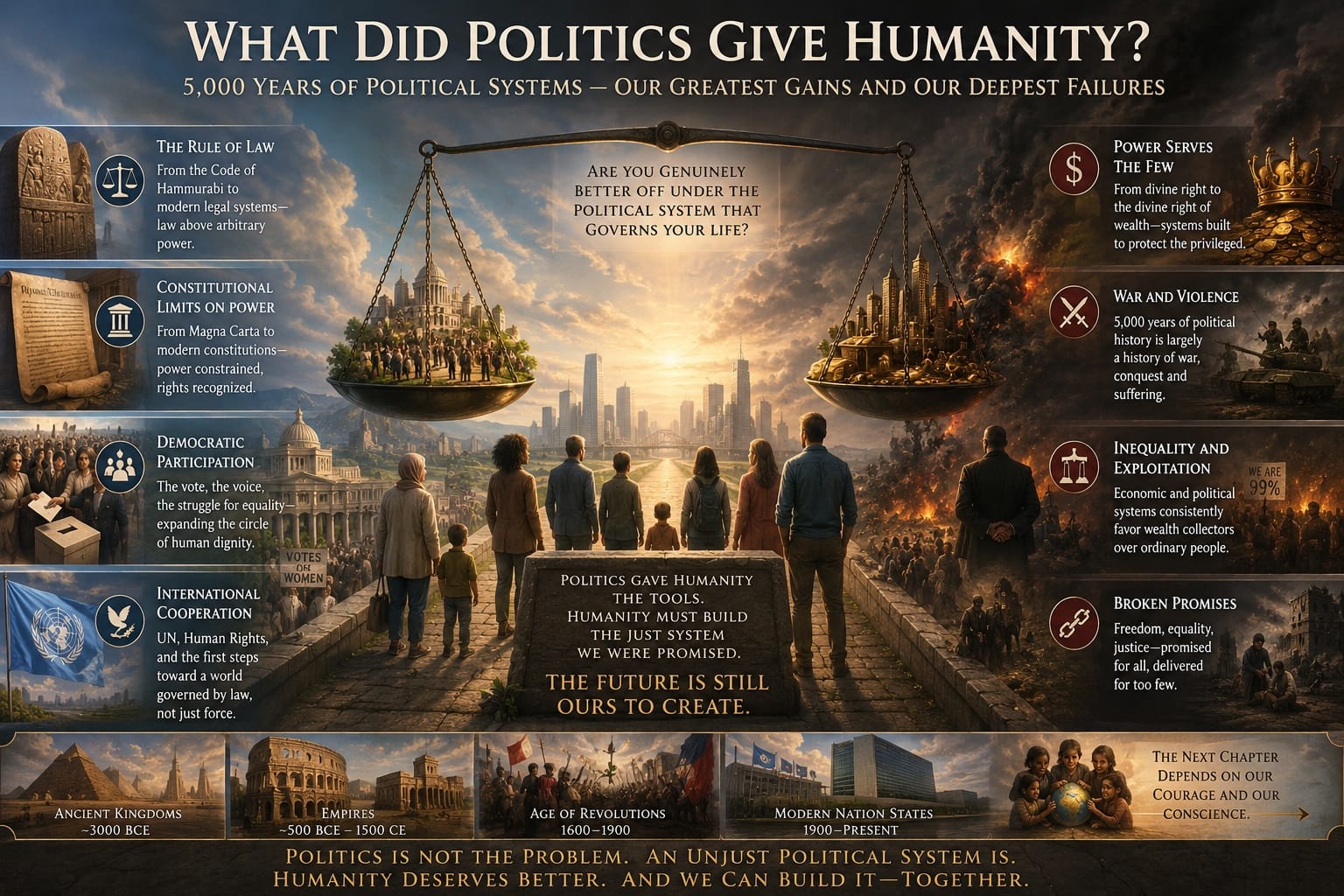
Are you genuinely better off under the political system that governs your life than you would have been under the purely religious systems that preceded it?
Not in the abstract. Not statistically. But genuinely — in the actual daily conditions of your actual life.
Do you feel genuinely secure? Genuinely free? Genuinely represented by the systems that make decisions affecting your life? Genuinely protected by the laws that govern your community?
For most human beings — in most parts of the world — the honest answer to most of these questions is no.
And understanding why requires an honest examination of what politics actually gave humanity — alongside what it promised but consistently failed to deliver.
Part One — What Politics Genuinely Gave
Google's answer to the question of what politics gave humanity is not wrong. It is incomplete. But the genuine achievements it identifies are real — and honest examination requires acknowledging them.
The Rule of Law
The transition from pure force — from the world in which the strongest simply took what they wanted — to a world governed by codified laws that applied to everyone was genuine moral progress.
The Code of Hammurabi — written approximately 3,800 years ago in ancient Babylon — was genuinely revolutionary. For the first time — the rules governing human conduct were written down — publicly available — and theoretically binding on everyone within the society. The powerful could no longer simply do whatever they wished without any framework of accountability.
This was a genuine achievement. Imperfect — deeply biased toward the powerful — and inconsistently enforced. But genuine.
Constitutional Limits on Power
The development of constitutions — documents that formally limited the power of rulers and established rights for citizens — represented another genuine step forward.
The Magna Carta of 1215. The constitutional frameworks of the American and French revolutions. The post-World War II constitutions of Germany and Japan. Each of these represented genuine recognition that political power must be constrained — that even the most powerful rulers are subject to law — and that citizens have rights that the state cannot legitimately violate.
Again — imperfect in practice. Consistently violated. But genuine in principle and genuinely important.
Democratic Participation
The extension of genuine democratic participation — the right of ordinary human beings to have a genuine voice in the governance of their own lives — from the small experiments of ancient Athens to the modern universal suffrage movements — represented genuine moral progress.
The abolition of slavery. The extension of voting rights to women. The dismantling of colonial systems. These achievements — won through genuine human courage and genuine political struggle — are real. And they deserve honest acknowledgment.
International Cooperation
The development of international institutions — the United Nations — the Universal Declaration of Human Rights — the international legal frameworks that established — however imperfectly — the principle that even sovereign states are accountable to international standards of human rights — represented humanity's first serious attempt to govern the relations between nations through law rather than pure force.
Part Two — What Google's Answer Omits
But here is what Google's carefully compiled answer does not tell you.
The Genuine Cost
The 5,000-year history of political systems is not primarily a history of the Rule of Law and democratic participation. It is primarily a history of war — of exploitation — of the systematic use of political power to serve the interests of the few at the expense of the many.
The political systems of the ancient world were systems of organized extraction — taking resources from the many to support the luxury and the power of the few — justified initially by religious authority and later by increasingly sophisticated ideological frameworks that served the same basic function.
The Divine Right Transferred to Wealth
One of the most important and most consistently overlooked developments in political history is what happened to divine authority as religious systems gradually lost their monopoly on political legitimacy.
In the religious era — power was justified by divine mandate. The king ruled because God had chosen him. The priest governed because he had special access to divine truth.
As political systems became more secular — this divine justification did not disappear. It transferred.
The divine right of kings became the divine right of property. The sacred authority of religious institutions became the sacred authority of economic ones. The laws that had once protected the power of religious elites began protecting the power of economic ones.
The result — which the history of both capitalist and socialist political systems confirms — is a world in which political laws consistently serve the interests of wealth collectors more generously than the interests of ordinary human beings.
The Failure of Both Great Political Experiments
The 20th century offered humanity two great political experiments — capitalism and socialism — each claiming to have solved the fundamental problem of political organization.
Neither did.
Capitalism — in its unregulated form — produced levels of economic inequality that undermined the genuine democratic participation it claimed to support. The formal equality of the voting booth coexisted with the profound practical inequality of economic systems in which the political influence of concentrated wealth consistently outweighed the political voice of ordinary citizens.
Socialism — in its implemented forms — produced systems of political control that violated the fundamental freedoms it claimed to protect. The concentration of economic power in the state produced concentrations of political power that proved at least as capable of serving the interests of the few at the expense of the many as the systems they replaced.
The Intensification of Competition
Google's answer describes international cooperation as one of politics' great achievements. And the institutions it mentions — the United Nations — the World Trade Organization — are genuine achievements.
But alongside these institutions of cooperation — political systems produced an intensification of national competition that has been one of the most consistent drivers of human suffering throughout recorded history.
Two World Wars. The Cold War. The countless regional conflicts and proxy wars that continue to claim human lives. The arms races — the nuclear arsenals — the military-industrial complexes that consume resources that could address genuine human needs.
These are not accidents. They are structural consequences of political systems organized around competition between nations — in which the interests of specific national populations are consistently prioritized over the interests of the broader human family.
Part Three — The Fundamental Failure
Beneath all of the specific failures that five thousand years of political history demonstrates — there is a single fundamental failure that explains them all.
Political systems were never genuinely designed to serve every human being equally.
They were designed to manage the competition for power among those who had the resources and the organization to participate in that competition. And the laws they produced — however much they may have proclaimed the equal rights of all citizens — consistently reflected the interests of those who had the most influence over the processes through which those laws were made.
This is not a criticism of individual politicians — many of whom have been genuinely committed to serving the public good. It is a structural observation about systems that were designed around the management of power rather than the genuine equal service of every human being.
Part Four — What THE HUMANITY SYSTEM Proposes
THE HUMANITY SYSTEM builds upon the genuine achievements of political civilization — the rule of law — constitutional limits on power — democratic participation — international cooperation — while addressing the structural failures that have prevented political systems from genuinely serving every human being.
Laws That Genuinely Change
Unlike political systems — in which laws change only when the organized interests of those who benefit from existing arrangements are overcome — THE HUMANITY SYSTEM's annual review process ensures that laws are continuously evaluated against the standard of whether they are genuinely serving every human being.
Not the wealthiest. Not the most organized. Every human being. And any law that is not meeting that standard is replaced.
Genuine Accountability Without Power Competition
THE HUMANITY SYSTEM does not seek political power. It does not organize competition between factions for control of institutions. It organizes community members around the single question that political systems have consistently avoided asking honestly.
Are the laws governing our community genuinely serving every human being within it?
Serving People — Not Wealth
The divine right of kings transferred to the protection of wealth under political systems. THE HUMANITY SYSTEM transfers it to neither.
The standard of THE HUMANITY SYSTEM is not divine authority. It is not economic power. It is the genuine well-being of every specific — particular — irreplaceable human being — measured honestly — annually — and with genuine willingness to change whatever is not meeting that standard.
Conclusion — The Honest Assessment
Five thousand years of political systems gave humanity genuine achievements. The rule of law. Constitutional limits on power. Democratic participation. International cooperation. These are real. They matter. And THE HUMANITY SYSTEM builds upon them.
But five thousand years of political systems also gave humanity two World Wars — the Holocaust — the Gulag — the intensification of national competition — the consistent prioritization of the interests of the powerful over the genuine needs of ordinary human beings — and the transfer of divine authority from religious elites to economic ones.
The honest question — the question that every human being deserves to ask — is not whether political systems gave humanity something.
They did.
The honest question is whether what they gave is adequate — genuinely adequate — to the extraordinary challenges that humanity faces now.
And the honest answer is no.
THE HUMANITY SYSTEM exists because that honest answer demands something better.
Something genuinely designed — from its very foundation — to serve every human being.
Not the powerful. Not the wealthy. Not the organized.
Every human being. Equally. Honestly. And without exception. 🌍❤️✨
"Five thousand years of political systems gave humanity the rule of law — but not justice for all. Democratic participation — but not genuine equality of voice. International cooperation — but not genuine human solidarity. The divine right of kings was abolished — but the divine right of wealth took its place. THE HUMANITY SYSTEM exists to end both — and to build something genuinely worthy of every human being who has ever lived under systems not designed for their genuine flourishing."
— Hamma Mirwaisi
Author and Founder — THE HUMANITY SYSTEM
About THE HUMANITY SYSTEM:
THE HUMANITY SYSTEM by Hamma Mirwaisi
represents the next step in human
Civilization — from the religious era
that began 12,000 years ago — through
The political era that began 5,000
years ago — to a genuinely new era
centered on the equal dignity and
equal flourishing of every human being.
Not a religion. Not a political party.
A practical framework — updated every
year by the communities it serves —
using Artificial Intelligence as a
partner to develop the best laws for
every human being.
Read the books — join the community —
and help build a world where every
human being truly matters.
📖 www.amazon.com/dp/B0GZ1788G7
🌐 www.thehumanitysystem.com
📧 thehumanitysystem@gmail.com
SEO Keywords
what politics gave humanity
5000 years of politics
political systems failure
THE HUMANITY SYSTEM
Hamma Mirwaisi
capitalism socialism failure
politics and human rights
rule of law history
democratic participation
political power wealth
new system beyond politics
every human being matters
annual review laws
genuine human flourishing
politics honest examination
📖 https://www.amazon.com/dp/B0GZ1788G7
🌐 www.thehumanitysystem.com
📧 thehumanitysystem@gmail.com
🌍 the-humanity-system.ghost.io
📬 hammamirwaisiu.substack.com
Share this article with every human being who has ever wondered whether the political systems governing their life are genuinely serving them — and who is ready to consider a genuinely better alternative. 🌍❤️✨