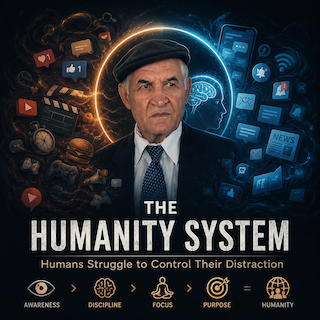
What Did Religion Give Humanity?
An Alternative Historical Perspective
By Hamma Mirwaisi — Author and Founder of THE HUMANITY SYSTEM
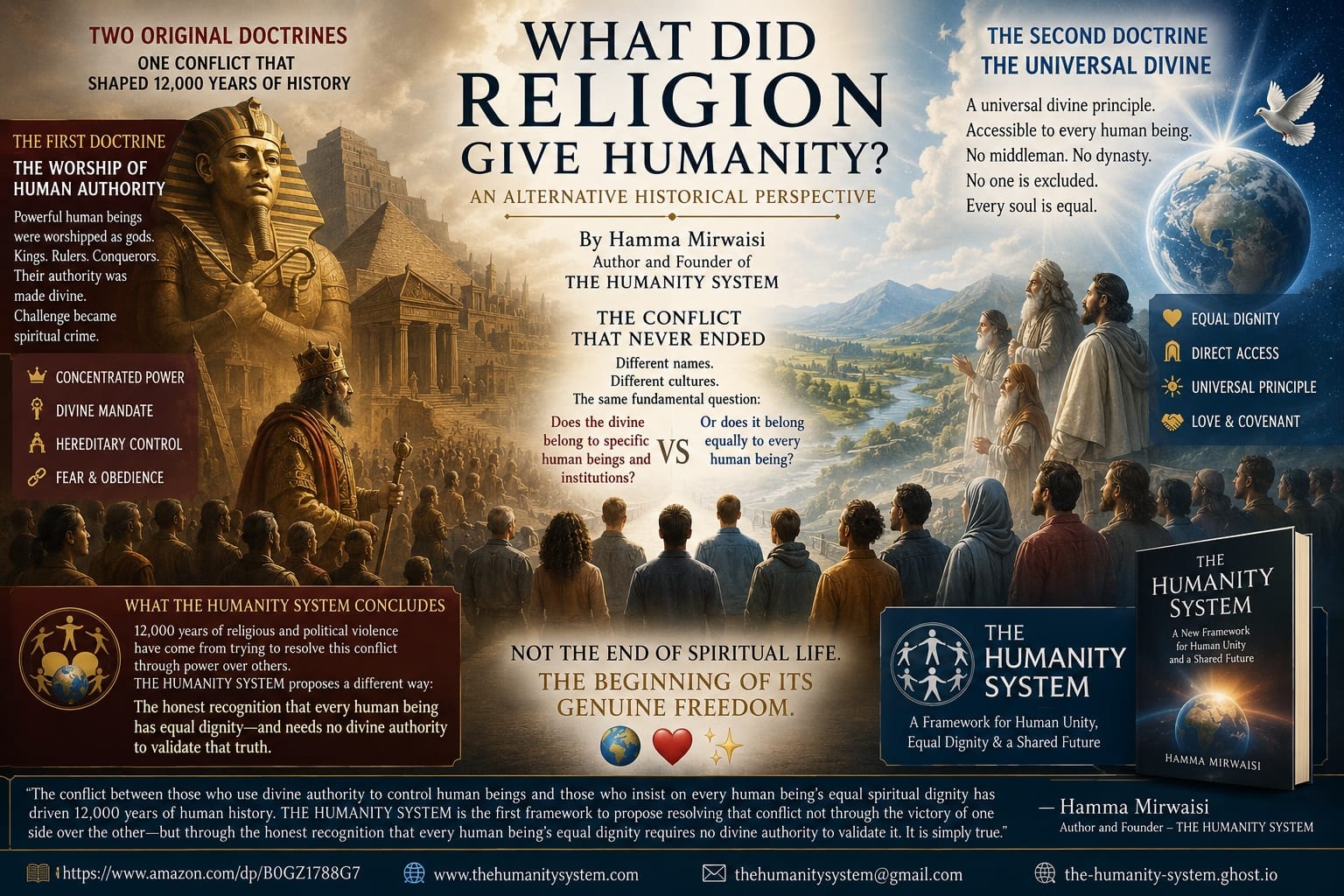
Religion honest examination, THE HUMANITY SYSTEM, Hamma Mirwaisi
When did religion start, Religion failed humanity
Opening — The Question Google Cannot Fully Answer
When you search Google for the question — what did religion give humanity — you receive a carefully compiled answer listing the major world religions and their contributions to human civilization.
The answer is not wrong. But it is incomplete.
It ignores something that the author of THE HUMANITY SYSTEM — drawing on decades of research into ancient religious history — believes is the most important truth about the origin of human religious systems.
All organized religion — in its deepest historical roots — emerges from one fundamental conflict.
The conflict between those who worshipped human beings as gods — and those who rejected the worship of human beings in favor of a universal divine principle.
Part One — What Google's Answer Ignores
The standard historical account of world religions begins approximately 5,000 to 6,000 years ago — with Hinduism — Zoroastrianism — and the early forms of what would become Judaism.
But human beings have been organizing their spiritual and social lives around religious frameworks for at least 12,000 years. And the 6,000 to 7,000 years of religious history that precedes the traditions Google lists is not merely a blank period of primitive animism.
It is the period in which the foundational conflict that has driven religious history — and through religious history — political history — was first established.
Part Two — The Two Original Doctrines
The research of Hamma Mirwaisi — developed across two books and decades of historical investigation — identifies two foundational religious doctrines that underlie virtually all subsequent religious development.
The First Doctrine — The Worship of Human Authority
The earliest organized religious systems — associated with figures like Lord Deva in the ancient Near East — were built around the worship of powerful human beings. Kings — rulers — and military leaders who — through their success in battle and their accumulation of power — came to be regarded as divine.
The Egyptian pharaohs — who ruled as supreme monarchs and chief priests simultaneously — are the most historically documented expression of this doctrine. But the pattern appears across ancient civilizations — from Mesopotamia to the Indus Valley — wherever powerful human beings used religious authority to legitimize their political dominance.
This doctrine served a specific social function. It concentrated power in the hands of specific human beings and their descendants — giving that concentration of power the weight of divine authority — and making challenge to it not merely politically dangerous but spiritually catastrophic.
The Second Doctrine — The Universal Divine
In response to the abuses of the first doctrine — a different religious vision emerged. Associated with the Mitra tradition — this vision rejected the worship of specific human beings in favor of a universal divine principle — accessible to every human being equally — and not the exclusive property of any dynasty or institution.
The Mitra tradition — whose name means covenant or contract — proposed a direct relationship between each individual human being and the divine. Not mediated by a king or a priest. Not dependent on birth into the right family or loyalty to the right ruler.
This was a genuinely revolutionary idea. And the conflict it produced — between those who benefited from the first doctrine and those who were drawn to the second — has driven religious and political history ever since.
Part Three — The Conflict That Never Ended
The war between these two foundational doctrines — the worship of human authority and the vision of universal divine access — did not end with the ancient world.
It continued — under different names — in different cultural contexts — through every subsequent era of human religious history.
The conflict between Mithraism and the traditions that grew from the Lord Deva doctrine. The conflict between early monotheism and the polytheistic traditions that preceded it. The conflicts within Christianity — between those who concentrated spiritual authority in institutions and those who insisted on direct individual access to the divine. The conflicts within Islam — between those who used religious authority to concentrate political power and those who insisted on the equal spiritual dignity of every believer.
These are — at their deepest level — the same conflict. Different names. Different cultural expressions. The same fundamental question.
Does the divine belong to specific human beings and institutions? Or does it belong equally to every human being?
Part Four — What THE HUMANITY SYSTEM Concludes
THE HUMANITY SYSTEM draws from this historical analysis a conclusion that is both honest and genuinely important.
The conflict between these two foundational doctrines has produced 12,000 years of religious and political violence — because both sides have consistently sought to resolve it through the accumulation of power over others rather than through the honest recognition of every human being's equal dignity.
The followers of the first doctrine sought to resolve it by maintaining and extending the authority of those who claimed divine mandate. The followers of the second doctrine too often resolved it by establishing new institutions — new priesthoods — new concentrations of authority — that replicated the very structures they originally opposed.
THE HUMANITY SYSTEM proposes a genuinely different resolution.
Not the victory of one doctrine over the other. Not the establishment of yet another institution claiming divine authority. But the honest recognition that the deepest insight of the second doctrine — that every human being has equal dignity and equal access to whatever is most sacred in human experience — requires not a religious institution to protect it but a genuinely human institution committed to the equal dignity of every specific human being.
That institution is THE HUMANITY SYSTEM.
Not the end of spiritual life.
The beginning of its genuine freedom. 🌍❤️✨
"The conflict between those who use divine authority to control human beings and those who insist on every human being's equal spiritual dignity has driven 12,000 years of human history. THE HUMANITY SYSTEM is the first framework to propose resolving that conflict not through the victory of one side over the other — but through the honest recognition that every human being's equal dignity requires no divine authority to validate it. It is simply true."
— Hamma Mirwaisi
Author and Founder — THE HUMANITY SYSTEM
📖 https://www.amazon.com/dp/B0GZ1788G7
🌐 www.thehumanitysystem.com
📧 thehumanitysystem@gmail.com
🌍 the-humanity-system.ghost.io
About THE HUMANITY SYSTEM:
THE HUMANITY SYSTEM by Hamma Mirwaisi
represents the next step in human Civilization — from the religious era
that began 12,000 years ago — through. The political era that began 5,000
years ago — to a genuinely new era centered on the equal dignity and
equal flourishing of every human being.
Not a religion. Not a political party.
A practical framework — updated every
year by the communities it serves —
using Artificial Intelligence as a
partner to develop the best laws for
every human being.
Read the books — join the community —
and help build a world where every
human being truly matters.
📖 www.amazon.com/dp/B0GZ1788G7
🌐 www.thehumanitysystem.com
📧 thehumanitysystem@gmail.com
Primary Keywords
Religion honest examination, History of religion, When did religion start
Religion and control, Religion failed humanity, THE HUMANITY SYSTEM
Hamma Mirwaisi, Beyond religion, New system for humanity