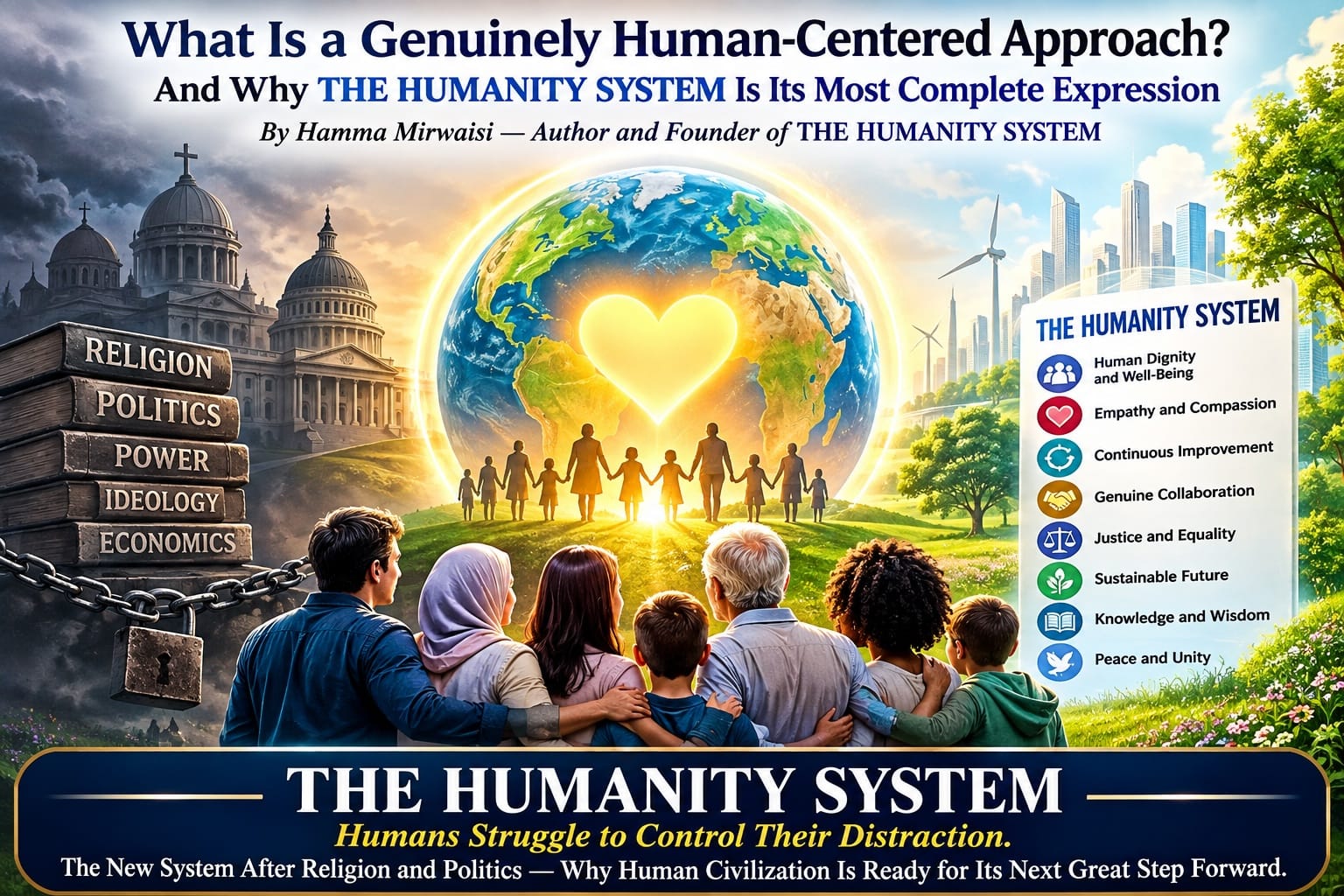
What Is a Genuinely Human-Centered Approach?
And Why THE HUMANITY SYSTEM Is Its Most Complete Expression
By Hamma Mirwaisi — Author and Founder of THE HUMANITY SYSTEM
Opening — The Question That Changes Everything
There is a simple but genuinely revolutionary question that — when asked honestly — transforms how we think about every system that governs human life.
Is this system genuinely centered on human beings?
Not on divine authority. Not on institutional power. Not on economic metrics or political ideologies or the self-perpetuating interests of organizations that have mistaken their own survival for their actual purpose.
On human beings. Specific. Particular. Feeling. Thinking. Struggling. Hoping. Genuinely irreplaceable human beings — with real needs — real experiences — and real lives that are either genuinely served or genuinely failed by the systems that govern them.
This question — simple as it sounds — is one that religion and politics have consistently struggled to answer honestly. And it is the question that THE HUMANITY SYSTEM places at the absolute center of everything it does.
Part One — What Genuinely Human-Centered Means
A genuinely human-centered approach is not a design methodology. It is not a management philosophy. It is not a political slogan or a marketing concept.
It is a fundamental commitment — embedded in the actual structure of a system — to placing the genuine needs — genuine experiences — and genuine well-being of real human beings at the center of every decision — every law — every program — and every institutional practice.
The research on human-centered design — developed across decades of work by designers — psychologists — and social scientists — identifies three core characteristics that any genuinely human-centered approach must embody.
Deep Empathy
A genuinely human-centered system begins not with what its designers think human beings need — but with honest immersion in the actual lived experience of the human beings it is supposed to serve.
This means listening. Genuinely — patiently — and without the distorting filter of pre-existing assumptions about what people want or what is good for them. It means understanding the specific pain points — the specific barriers — the specific ways in which existing systems are failing specific people in specific contexts.
It means — in the most fundamental sense — taking seriously the actual experience of the human beings within the system rather than the institutional narrative about what that experience is supposed to be.
Iterative Improvement
A genuinely human-centered system is never finished. It is never declared complete. It is never frozen in a form that cannot be changed regardless of how clearly the evidence shows that change is needed.
It builds — tests — honestly evaluates — and continuously refines its approaches based on genuine feedback from the real human beings whose lives it affects.
This is precisely the principle behind THE HUMANITY SYSTEM's annual review process. Not a one-time declaration of the correct approach. A continuous — honest — evidence-based process of improvement — in which every law and every practice is regularly evaluated against the standard of whether it is genuinely serving the human beings it exists to serve.
Genuine Collaboration
A genuinely human-centered system is built with the people it serves — not for them from above. It breaks down the distinction between those who design systems and those who live within them — ensuring that the genuine knowledge — genuine experience — and genuine perspective of every community member is genuinely incorporated into the ongoing development of the system.
Part Two — Was Religion Genuinely Human-Centered?
Honest examination requires asking this question directly.
In its finest expressions — religion came closest to a genuinely human-centered approach in its emphasis on empathy — compassion — and the genuine care for the suffering of others that the great ethical teachings of every tradition embody.
The emphasis on feeding the hungry. Caring for the sick. Welcoming the stranger. These are genuinely human-centered values — and the religious communities that have lived them most fully have produced genuine human flourishing.
But religion — as an institutional system — was not genuinely human-centered in its structure.
Its laws came from divine authority — not from honest engagement with the genuine needs of the human beings within it. Its standards of success were defined by theological conformity — not by genuine measurement of human well-being. And its response to evidence that its laws were failing human beings was too often — not honest examination and genuine change — but theological justification for why the failure was actually the human being's fault rather than the system's.
A genuinely human-centered approach begins with the human being. Religion too often began with the divine — and worked backward to the human.
Part Three — Was Politics Genuinely Human-Centered?
The most sophisticated modern political theories explicitly claim to be human-centered. The language of human rights — human dignity — human security — human development — permeates contemporary political discourse.
And yet the structural reality of political systems — as five thousand years of history consistently demonstrates — is that they are organized around the management of power rather than the genuine service of human beings.
A genuinely human-centered political system would measure its success not by GDP — not by electoral outcomes — not by the stability of existing institutional arrangements — but by the genuine well-being of every human being within it. By whether people are genuinely healthy — genuinely secure — genuinely free — genuinely able to develop their potential — genuinely participating in the decisions that affect their lives.
Some political systems have moved closer to this standard than others. The welfare states of Scandinavia. The community-centered governance traditions of indigenous peoples. The deliberative democratic experiments that have emerged in various countries.
But no political system has ever been genuinely structured — from its foundational design — around the honest continuous measurement of whether it is genuinely serving every human being — and the genuine willingness to change whatever is not meeting that standard.
Part Four — What a Genuinely Human-Centered Religion Would Look Like
A genuinely human-centered approach to spirituality — as researchers in religious humanism and secular humanism have argued — is defined by several specific characteristics.
It focuses on human flourishing in this life — not exclusively on rewards in an afterlife. It judges spiritual and ethical practices by their actual impact on human relationships — on whether they genuinely foster compassion — genuinely respect dignity — and genuinely alleviate suffering.
It encourages honest questioning rather than requiring blind acceptance. It provides community support and genuine human connection without making that connection conditional on doctrinal conformity.
And it recognizes — as many scholars of secular humanism have argued — that empathy — mutual aid — and genuine human connection can be the focal point of a spiritual and community practice without requiring the acceptance of supernatural claims that cannot be honestly evaluated.
This is the approach to spiritual life that THE HUMANITY SYSTEM embodies in its community centers. Not the imposition of any specific religious doctrine. But the creation of spaces where the genuine spiritual dimension of human life — the genuine human need for meaning — community — and connection to something larger than the individual self — can be honestly explored and genuinely honored.
Part Five — What a Genuinely Human-Centered Political System Would Look Like
A genuinely human-centered approach to politics roots governance in the lived experiences and genuine well-being of citizens rather than abstract institutional power.
It uses what researchers call human-centered design methodologies — conducting genuine engagement with the actual experience of citizens to understand where policies break down — where services fail to reach those who need them — and where the gap between what political systems promise and what they actually deliver is widest.
It redefines political success away from traditional macro-level economic metrics toward genuine indicators of human well-being. Human security — freedom from violence — environmental degradation — and preventable disease. Standard of living — genuinely health-adjusted — genuinely equitable — genuinely supportive of every person's capacity to live a genuinely good life. And civic agency — the genuine degree to which every person feels empowered to participate meaningfully in the governance of their own community.
And it embraces collaborative governance — building systems that work with community members rather than imposing solutions from above — that use iterative small-scale testing rather than grand top-down implementations — and that are genuinely accountable to the people they serve rather than to the institutional interests of those who control them.
Part Six — THE HUMANITY SYSTEM as the Most Complete Expression
THE HUMANITY SYSTEM is the most complete institutional expression of the genuinely human-centered approach that has yet been proposed for the governance of human civilization.
It embodies deep empathy through its commitment to building systems that begin with the genuine experience of the human beings within them — not with the preferences of those in power.
It embodies iterative improvement through its annual review process — the honest — continuous — evidence-based examination of whether every law and every practice is genuinely serving every human being — and the genuine willingness to change whatever is not.
It embodies genuine collaboration through its participatory governance model — in which every community member has a genuine voice in the ongoing development of the system that governs their life.
And it extends these principles — which human-centered design has developed primarily in the context of product and service design — to the most fundamental level of human organization. The laws. The institutions. The frameworks through which human beings collectively govern their shared life.
This is what makes THE HUMANITY SYSTEM genuinely new.
Not merely a better version of existing systems. Not merely reformed religion or improved politics. But a system genuinely structured — from its foundational design — around the honest continuous service of every human being.
Using artificial intelligence to analyze vast amounts of human experience and identify what is genuinely working and what is genuinely failing. Using the annual review process to ensure that every law reflects current genuine human needs rather than historical institutional interests. And using the genuine participation of every community member to ensure that the system remains — always — accountable to the people it exists to serve.
Conclusion — The Standard That Changes Everything
The genuinely human-centered standard is simple to state.
Does this system genuinely serve every human being within it?
Not some human beings. Not the human beings who are most powerful — most organized — most able to make their needs heard within the system's existing structures.
Every human being. Equally. Honestly. And with genuine accountability.
This standard — applied honestly to religion — reveals its structural limitations. Applied honestly to politics — reveals its consistent failure to prioritize people over power. And applied to THE HUMANITY SYSTEM — reveals a framework that is specifically — structurally — and genuinely designed to meet it.
Not perfectly. Not all at once. Not without the genuine difficulty that genuine human progress always involves.
But genuinely. Honestly. And with the continuous commitment to improvement that genuine service to every human being requires.
This is the genuinely human-centered approach.
This is THE HUMANITY SYSTEM. 🌍❤️✨
"A genuinely human-centered system is not one that claims to serve human beings. It is one that honestly measures whether it is doing so — honestly acknowledges when it is failing — and honestly changes whatever needs to change. That is the standard. And it is the standard that every previous system of human governance has consistently fallen short of. THE HUMANITY SYSTEM exists to meet it."
— Hamma Mirwaisi
Author and Founder — THE HUMANITY SYSTEM
About THE HUMANITY SYSTEM:
THE HUMANITY SYSTEM by Hamma Mirwaisi represents the next step in human civilization — from the religious era that began 12,000 years ago — through the political era that began 5,000 years ago — to a genuinely new era centered on the equal dignity and equal flourishing of every human being. Not a religion. Not a political party. A practical framework — updated every year by the communities it serves — using Artificial Intelligence as a partner to develop the best laws for every human being.
📖 www.amazon.com/dp/B0GZ1788G7
🌐 www.thehumanitysystem.com
📧 thehumanitysystem@gmail.com
🌍 the-humanity-system.ghost.io
📬 hammamirwaisiu.substack.com