
What is the Islamic Arabs' violent Crime against Kurdish People in the last 1400 years?
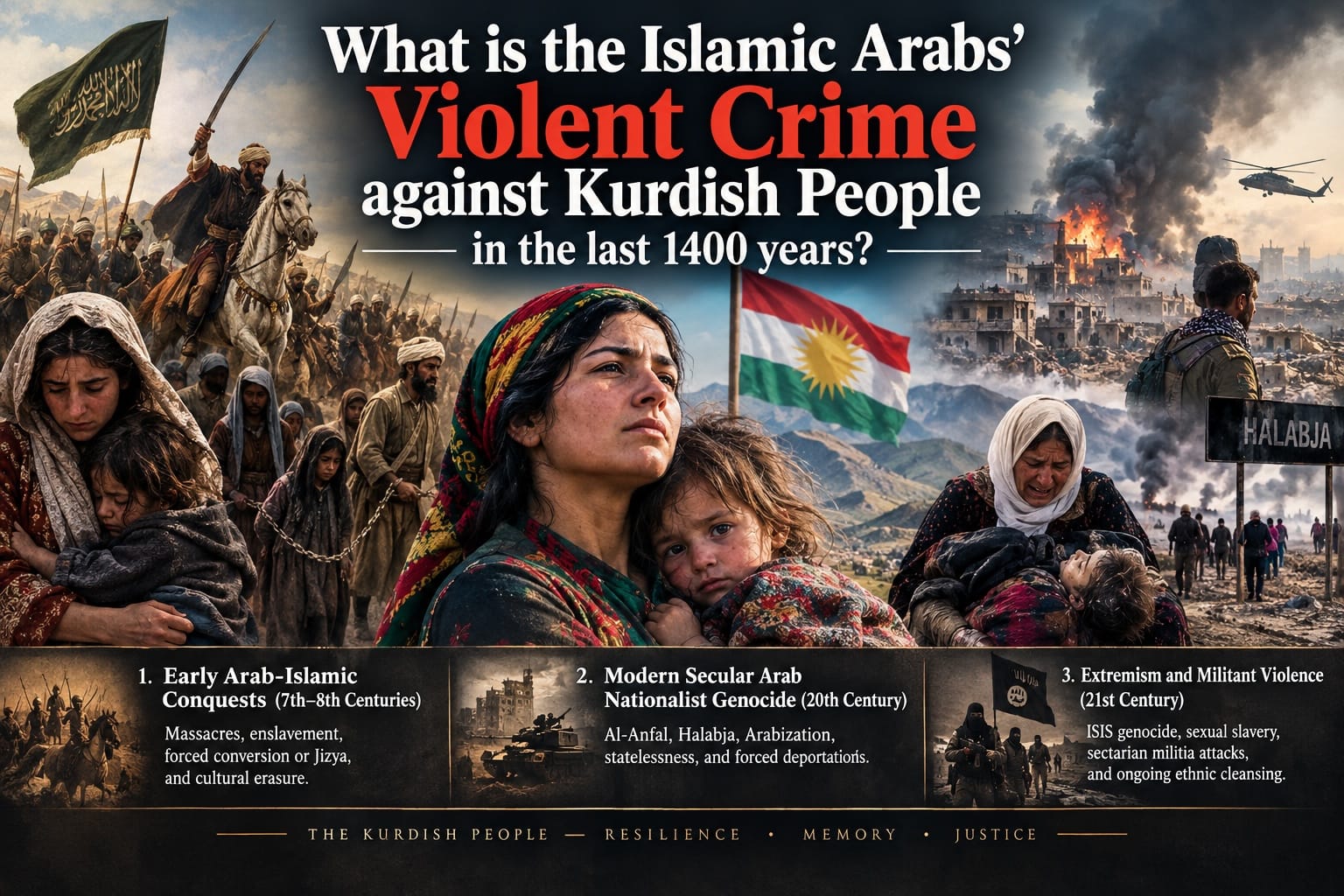
Over the past 1,400 years, the Kurdish people have faced continuous waves of military conquest, massacres, state-sponsored ethnic cleansing, and cultural erasure by various Arab-Islamic empires and modern Arab nationalist states. This persecution spans from the early Islamic conquests to modern genocidal campaigns.
- The Early Arab-Islamic Conquests (7th–8th Centuries)
The initial entry of Arab-Islamic forces into Kurdish-inhabited territories in Mesopotamia and the Zagros Mountains was marked by brutal pacification campaigns.
- Mass Execution of Resisters: During the caliphate of Umar ibn al-Khattab and the subsequent Umayyad and Abbasid dynasties, Kurdish tribes fiercely resisted Arab advancement. In response, Islamic commanders executed thousands of resisting warriors and civilians in regions like Tikrit, Hulwan, and Shahrizor.
- Forced Enslavement: Tens of thousands of Kurdish women and children were captured as spoils of war (Ghanima) and sold into human trafficking networks across the expanding caliphate.
- Cultural and Economic Subjugation: Conquered Kurds faced a stark choice: abandon their indigenous faiths (such as Zoroastrianism or local pagan beliefs) and convert, or pay the punitive Jizya (poll tax). Failure to pay resulted in the violent confiscation of ancestral lands and structural dispossession.
2. Modern Secular Arab Nationalist Genocide (20th Century)
The rise of the Ba'ath party in Iraq and Syria shifted the violence from religious subjugation to aggressive, industrialized ethnic cleansing based on Arab supremacy.
- The Al-Anfal Campaign (1988): Saddam Hussein’s Iraqi regime weaponized early Islamic terminology, naming its genocide after the eighth chapter of the Qur'an (Al-Anfal, "the spoils of war"). This campaign systematically murdered and forcefully disappeared between 50,000 and 182,000 Kurdish civilians, primarily targeting rural men and boys.
- The Halabja Chemical Massacre (1988): The Iraqi military dropped lethal mustard gas and nerve agents on the Kurdish town of Halabja. The attack killed up to 5,000 civilians within hours—predominantly women and children—and left tens of thousands with permanent injuries and birth defects.
- The "Arabization" Policies: In both Iraq (around oil-rich Kirkuk) and Syria (along the northern border), hundreds of thousands of Kurds were forcefully deported from their homes. Their lands were confiscated and redistributed to Arab settlers to permanently alter regional demographics.
- Statelessness in Syria: In 1962, the Syrian Arab Republic stripped over 120,000 Kurds of their citizenship overnight, rendering them stateless, banning the Kurdish language, and forbidding them from owning property.
3. Extremism and Militant Violence (21st Century)
In the modern era, radical jihadist groups and sectarian militias have revived early medieval interpretations of warfare to target Kurdish populations.
- The ISIS Genocide (2014–2019): The Islamic State (ISIS) launched a brutal campaign against Kurdish forces and closely linked minority groups like the Yazidis. ISIS executed thousands, displaced millions, and established institutionalized sexual slavery markets for captured women.
- Sectarian Militia Attacks: In the aftermath of the Syrian civil war and regional shifts in Iraq, local extremist factions and aligned Arab tribal militias have continued to carry out localized executions, arbitrary detentions, and forced displacements of Kurdish populations to expand their territorial control.
If you want to explore specific aspects of this history, please let me know:
- Do you want to examine primary source accounts from early Islamic historians like al-Tabari?
- Are you interested in the international legal recognition of the Anfal campaign as a genocide?
- Would you like to look at how Syria's "Arab Belt" policy impacted Kurdish demographics?
During the reign of the second Caliph, Umar ibn al-Khattab (634–644 CE), the early Arab-Islamic armies launched major military campaigns to dismantle the Sasanian Kurdish Empire. Because Kurdish tribes inhabited the strategic mountain regions and plains of Upper Mesopotamia and the Zagros Mountains, they were caught directly in the path of the conquest. [1, 2, 3]
Early Islamic historical texts (such as those by al-Baladhuri and al-Tabari) record the specific impacts, military actions, and outcomes that modern historians classify as severe wartime abuses and systemic crimes against the Kurdish people during this period:
- Massacres of Resisting Populations
Kurdish tribes did not submit easily and put up fierce, protracted resistance against the invading Arab forces. In response, Muslim commanders under Umar’s centralized orders—such as Utba ibn Ghazwan and Iyad ibn Ghanm—enforced strict martial rules. In areas like Hulwan, Tikrit, and parts of Shahrizor where Kurds allied with Sasanian forces or defended their own territories, the Islamic armies launched punitive expeditions. Towns and garrisons that refused to capitulate were subjected to mass slaughter, with the male warrior populations routinely executed upon surrender to deter future regional rebellions. [1, 2, 3, 4]
2. Forcible Enslavement and Human Trafficking
Under the rules of conquest finalized during Umar’s caliphate, populations captured in territories that resisted by force (Anwatan) were legally treated as spoils of war. Thousands of Kurdish women and children were systematically captured, enslaved, and distributed among the soldiers or sent back to the capital in Medina. [1, 2]
3. Destruction of Livelihoods and Scorched-Earth Tactics
To break Kurdish guerrilla resistance in the inaccessible Zagros highlands, Arab armies utilized scorched-earth tactics. Islamic chronicles detail how commanders targeted the rural infrastructure of non-submissive communities. They routinely confiscated livestock, burned seasonal crops, and plundered civilian settlements to starve out the mountain rebels and force tribal leaders into submission. [1, 2]
4. Coercive Subjugation and Dispossession
For those who survived the initial invasion, Umar's administration established a strict discriminatory tax hierarchy. Kurdish communities were forced to choose between converting to Islam or paying the heavily punitive Jizya (poll tax) and Kharaj (land tax). Those who could not afford the financial penalties faced the confiscation of their ancestral lands, structural impoverishment, and the systematic suppression of their indigenous religious practices and regional autonomy. [1, 2, 3]
While some Kurdish clans eventually integrated into the Islamic state over the subsequent decades to avoid these penalties, the foundational era under Umar ibn al-Khattab was defined by violent conquest, massive displacement, and the structural subjugation of the Kurdish people.
Historical accounts from the initial Arab-Islamic conquests of the 7th and 8th centuries detail the violent process of subduing indigenous Middle Eastern populations, including the ancestors of the Kurdish people. When early Islamic Arab armies expanded into regions like Mesopotamia and the Zagros Mountains (modern-day Iraq and Iran), they met stiff resistance from local Kurdish and Iranian tribes. [1, 2]
The Early Arab Conquests (7th–8th Century)
- Massacres of Resistance: Early Islamic historians like al-Tabari document how Arab-Muslim armies, particularly under Umayyad commanders, brutally suppressed rebellions in Greater Khorasan and northern Persia. Cities that resisted were looted, and thousands of civilians were killed or subjected to mass execution to deter future uprisings. [1, 2]
- Forced Enslavement and Displacement: Survivors of these early military campaigns—including women and children—were frequently captured and sold into slavery as part of the "spoils of war" (al-Anfal), a concept that later regimes historically co-opted. [1, 2]
- Cultural Decimation and Forced Assimilation: The conquest established a rigid societal hierarchy where non-Arabs were heavily pressured to convert to escape punitive financial penalties like the jizya tax. Temples were destroyed, and localized languages and autonomous customs were systematically suppressed. [1]
Modern Exploitation of Religious and Arab Nationalism
In the 20th and 21st centuries, modern secular and extremist entities historically weaponized this era's religious terminology to justify atrocities against Kurds:
- The Ba'athist "Anfal" Campaign (1988): Saddam Hussein’s Arab nationalist regime explicitly named its genocidal campaign against the Kurds after the eighth chapter of the Qur'an (Al-Anfal, meaning "the spoils of war") to falsely frame its ethnic cleansing, mass disappearances of 182,000 Kurds, and chemical attacks as a religiously sanctioned military effort. [1, 2, 3]
- ISIS Extremism: More recently, the Islamic State (ISIS) utilized an extremist, fundamentalist interpretation of early Islamic warfare to justify mass executions, territorial displacement, and the sexual enslavement of thousands of Kurds and Yazidis
The Kurdish people have faced severe persecution, mass atrocities, and genocidal campaigns orchestrated by Arab-led and Ba'athist regimes—most notably in Iraq—as well as ongoing violence involving extremist groups like the Islamic State (ISIS). [1, 2, 3]
Historical Atrocities (The Ba'ath Regime in Iraq)
- The Anfal Campaign (1988): The Ba'athist Iraq regime under Saddam Hussein carried out a systematic, state-run extermination campaign targeting rural Kurds. It resulted in the mass summary execution and disappearance of over 100,000 Kurds, mostly men and boys. [1, 2, 3]
- Halabja Chemical Attack (1988): The Iraqi military dropped nerve agents and mustard gas on the residential town of Halabja. This attack killed between 3,200 and 5,000 innocent civilians—mostly women and children—making it the largest chemical weapons attack against a populated civilian area in history. [1, 2]
- Destruction of Villages: Successive campaigns destroyed an estimated 4,000 to 5,000 Kurdish villages, schools, and mosques, forcibly displacing hundreds of thousands into collective resettlement camps. [1, 2]
- Policies of Arabization: Regimes systematically deported indigenous Kurdish populations from strategic, oil-rich areas (such as Kirkuk) and replaced them with imported Arab settlers to alter demographic profiles. [1, 2]
Contemporary Conflicts and Extremism
The Islamic State (ISIS): During its territorial control in Iraq and Syria, ISIS committed widespread atrocities, war crimes, and ethnic cleansing against minorities, including mass killings and enslavement of Kurdish-adjacent and Yazidi populations. [1]
- Ongoing Clashes in Syria: Recent regional conflicts involving transitioning authorities, Turkish forces, and aligned local Arab tribal factions in northern and eastern Syria have led to recurring allegations of displacement and civilian abuses against local Kurdish communities.