
What is, the Persian forces' violent Crime against The Kurdish People since General Darius, son of Hystaspes, coup of taking over the Median Empire?
General Darius used lord Shiva teaching to destroy and transform the Medes and other Caucasian people (Note: Lord Shiva was the God of his forefather before they convert to the Aryan religion) in the Middle East and Asia, before Arabs, and Turks. Note: Persian, Arabs, and Turks common connection to Lord Shiva teaching.
What is Iran's Persian leader's plan now?
They used Jewish leaders in the past to destroy the Median Empire.
The Jewish scholars helped them in the Western (Europe, and the USA), and Eastern (Russia) to erase the Medes history and claim that everything of Iran is belong to Persian.
Persian joined the Arab Islamic Army to destroy the Aryan religion and destroy the Medes (Lak, Kurd, Lor, Talysh, Gilani, Mazandarani, Parthians (Parni), Khorasani, and other Medes. And they claimed to be members of the Aryan religion.
Persian allied with Turks to destroy Medes.
Persians adopted Islamic Shi’ism, forcing a large part of Medes to convert to Shi’ism. And used them against other parts of Medes whom Turks forced them to convert to Sunni’ism.
Persian allied with Israel-US, Turks, and Europe to destroy the descendent of Medes.
Persian is now an ally of Turkey, Russia, and China, to fight the descendent of Medes.
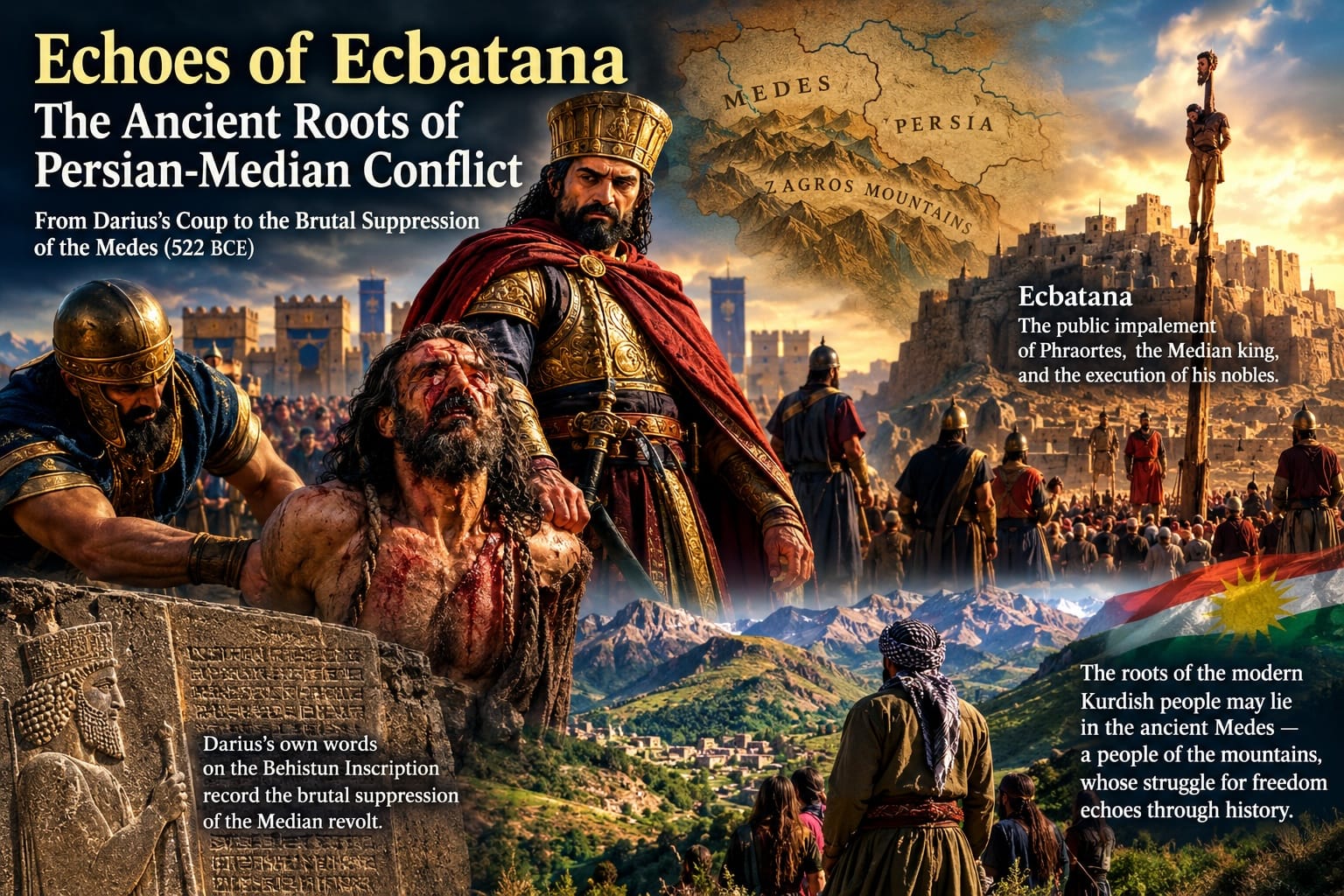
Echoes of Ecbatana: The Ancient Roots of Persian-Median Conflict
The complex relationship between the centralized states of Persia and the indigenous populations of the Zagros Mountains is a narrative spanning millennials.
For many historians and cultural scholars, the modern Kurdish people share deep linguistic, geographical, and ancestral lineages with ancient groups, most notably the Medes. To understand the earliest recorded instances of state-sponsored violence by a centralized Persian authority against these mountain peoples, one must look back to the chaotic dawn of the Achaemenid Empire in 522 BCE—specifically, the brutal suppression of the Median revolt following the coup of Darius the Great.
The Coup of Darius I and the Spark of Rebellion
In 522 BCE, the Achaemenid Empire was thrown into turmoil following the death of King Cambyses II. A figure named Gaumata, a Magian usurper claiming to be Cambyses' brother Bardiya, seized the throne. Recognizing an opportunity to shift the balance of power back to the Persian nobility, a young and ambitious military figure named Darius (the son of Hystaspes), along with six co-conspirators, assassinated Gaumata.
Darius’s seizure of power was not met with universal acclaim; instead, it ignited a massive firestorm of civil war across the empire. The Medes, who had previously occupied a position of near-equality within the imperial framework, refused to accept this new Persian hegemony. Seizing the moment of instability, they launched a sweeping war of independence. They rallied behind Phraortes (known natively as Fravartish), a leader who claimed royal legitimacy by tracing his descent back to the revered Median King Cyaxares.
The Campaign of Kundurus and Imperial Retaliation
The rebellion posed an existential threat to Darius’s fragile grip on power. In response, he mobilized the imperial war machine with uncompromising severity. According to historical records and Darius’s own triumphal testimony etched onto the cliffs of the Behistun Inscription, the Persian forces met the Median resistance with absolute brutality.
Darius initially deployed his general, Hydarnes, to contain the uprising before taking personal command of the imperial armies. The decisive clash occurred at the Battle of Kundurus. The Persian forces broke the Median lines, resulting in a mass slaughter where thousands of Median fighters were killed on the battlefield, effectively crushing the military backbone of the independence movement.
Public Torture and Executions as State Terror.
The violence did not end on the battlefield. For Darius, securing the empire required a campaign of psychological terror to ensure the Medes would never revolt again. The fate of the captured Median king, Phraortes, became a primary vehicle for this message.
Rather than granting his rival a swift execution, Darius subjected Phraortes to graphic, ritualized mutilation designed to strip him of his dignity before his former subjects. As proudly recorded on the Behistun Inscription, Darius personally ordered the removal of Phraortes' nose, ears, and tongue, and had one of his eyes put out. The mutilated leader was then bound in chains and displayed at the palace gates for the public to witness.
The final act of retribution took place in Ecbatana (modern-day Hamadan), the historic capital of the Median Empire. Phraortes was taken to the city and publicly impaled on a stake. To ensure the complete eradication of the rebellion's leadership, Darius rounded up Phraortes' top aristocratic supporters and commanders, executing them by decapitation or flaying them alive inside the city's citadel.
A Legacy of Subjugation and Survival
Following the bloodshed, the geopolitical landscape of the region changed permanently. Darius eventually adopted a policy of integration, allowing Median nobles to serve as high-ranking diplomats, advisors, and generals within his army—even incorporating them into the elite "Immortal" guards. However, the sovereignty of an independent Median kingdom was forever shattered.
For scholars who trace the roots of the modern Kurdish struggle for autonomy back to the ancient Medes, the events of 522 BCE represent a critical historical benchmark. The campaign stands as the earliest recorded instance of a centralized Persian state deploying extreme military force, public torture, and mass execution to suppress the self-determination of the northwestern Iranian mountain peoples—a historical echo that many argue still resonates through the region's contemporary dynamics.
Archaeological and Linguistic Connections Between Ancient Medes and Modern Kurds.
The hypothesis linking modern Kurdish populations to the ancient Medes relies on a combination of historical geography, comparative linguistics, and modern genetic studies. While directly linking an ancient group to a modern identity across 2,500 years is complex, several strong markers support this continuity:
The Linguistic Blueprint: Kurdish belongs to the Northwestern Iranian branch of the Indo-European language family. Old Persian, by contrast, belongs to the Southwestern branch. Scholars note that the few surviving fragments of the Median language (found mostly as loanwords in Old Persian inscriptions) share distinct phonetic traits with Northwestern Iranian languages. Modern Kurdish dialects, particularly Kurmanji and Sorani, preserve grammatical structures, vocabulary, and sound changes that directly trace back to this Northwestern/Median linguistic layer rather than Persian.
Geographical Continuity: The ancient Median Empire was centered in the central and northern Zagros Mountains, spanning modern-day Iranian Kurdistan, parts of Iranian Azerbaijan, and Iraqi Kurdistan. Ecbatana (modern Hamadan) served as their capital. The Kurdish people have continuously inhabited these exact rugged highlands since antiquity, maintaining a mountain-based pastoral and agricultural lifestyle that mirrors ancient accounts of Median society.
Classical Historical Accounts: Ancient Greek historians, such as Herodotus and Strabo, described the Medes and other mountain groups of the Zagros (like the Carduchi or Cyrtians) as distinct but related peoples. Many historians argue that the Carduchi, who famously clashed with Xenophon's retreating Greek army in 401 BCE, represent a transitional ethno-linguistic group between the ancient Medes and the early Kurds.
Genetic Mapping: Contemporary genetic studies of Western Asian populations regularly show that Kurdish populations share a high degree of genetic continuity with ancient DNA samples recovered from Bronze and Iron Age sites in the Zagros Mountains. This suggests that while cultures and empires shifted, the actual ancestral population of the region remained remarkably stable.
2. How the Behistun Inscription Portrays Other Rebellions
The Behistun Inscription, carved into a cliff face in Western Iran, acts as Darius the Great's primary piece of political propaganda. It was designed to legitimize his irregular path to the throne by framing his opponents not as freedom fighters, but as agents of chaos and cosmic falsehood (drauga, or "the Lie”).
Darius boasts of defeating nine "liar-kings" across 19 battles within a single year. The punishments meted out to these other rebels show that the brutal treatment of the Median leader Phraortes was part of a standardized, deliberate doctrine of imperial terror:
The Babylonian Rebellions: Babylon revolted twice under leaders claiming to be Nebuchadnezzar (Nidintu-Bel and Arakha). Darius recaptured the city both times. He executed Nidintu-Bel and his primary followers by impaling them in Babylon, and later crucified Arakha and his top nobles to permanently break Babylon’s wealthy aristocracy.
The Sagartian Revolt: Triton-taechmes, a rebel leader in Sagartia (neighboring Media), claimed descent from the Median King Cyaxares, similar to Phraortes. Darius caught him and inflicted the exact same gruesome ritual mutilation: cutting off his nose and ears, putting out one eye, displaying him in chains at the palace gates, and finally impaling him in Arbela (modern Erbil).
The Elamite and Persian Uprisings: In Elam, the rebel Martiya was killed by his own people out of fear of Darius. In Persia itself, a second false claimant to the throne, Vahyazdata, gathered a massive following. When Darius’s generals captured Vahyazdata, he and his top commanders were publicly crucified in Persia to serve as a direct warning to the Persian homeland.
By displaying these graphic executions across different provinces, the inscription sent a universal message: anyone who challenged the divinely ordained rule of Darius would be stripped of their physical humanity and erased from the political landscape.
3. Later Periods of Conflict and Integration Between Persian Empires and Indigenous Mountain Populations.
The cycle of violent suppression followed by calculated political integration established by Darius I became the definitive blueprint for how successive centralized Persian empires managed the autonomous tribes of the Zagros Mountains for centuries.
The Later Achaemenid Era (Calculated Integration): Following the brutality of 522 BCE, the Medes were deeply integrated into the empire. The media became the second most important province. Median nobles dressed in traditional robes were depicted on the reliefs of Persepolis walking hand-in-hand with Persian nobles. Median generals commanded Achaemenid armies, and the Median capital, Ecbatana, became the summer residence of the Persian kings.
The Parthian and Sasanian Empires (The Boundary of Control): When the native Persian Sasanian Dynasty overthrew the Parthians in 224 CE, they faced immediate resistance from the regional mountain kings. The founder of the Sasanian Empire, Ardashir I, fought fierce campaigns against the "Madig" (frequently interpreted as Medes or proto-Kurds). The Sasanians established fortresses and border marches throughout the Zagros to contain these fiercely independent tribes, alternately hiring them as elite auxiliary cavalry and brutally crushing them when they refused to pay tribute.
The Safavid and Qajar Eras (The Tribal Buffer): Fast-forwarding to the Islamic era, the Safavid Dynasty (1501–1736) used Kurdish principalities as a heavily armed buffer zone against the rival Ottoman Empire. While some Kurdish rulers enjoyed vast autonomy, any hint of independent alignment with the Ottomans resulted in catastrophic reprisal. Under Shah Abbas I, massive forced deportations were enacted; tens of thousands of Kurds were uprooted from the Zagros and forcibly relocated to the distant province of Khorasan to guard the empire's northeastern frontier against Uzbek raids—a community that survives there to this day.
Throughout history, the centralized states of Persia recognized that they could never fully assimilate or tame the geography of the Zagros Mountains. Instead, they relied on a delicate balance: granting local autonomy to mountain chieftains when the state was weak, and deploying overwhelming, public violence the moment those chieftains attempted to convert that autonomy into true independence.