WHEN POWER WRITES HISTORY
Darius the Persian, the Medes, Religion, Politics, and the Long Road to Humanity
From Religion to Politics to Humanity
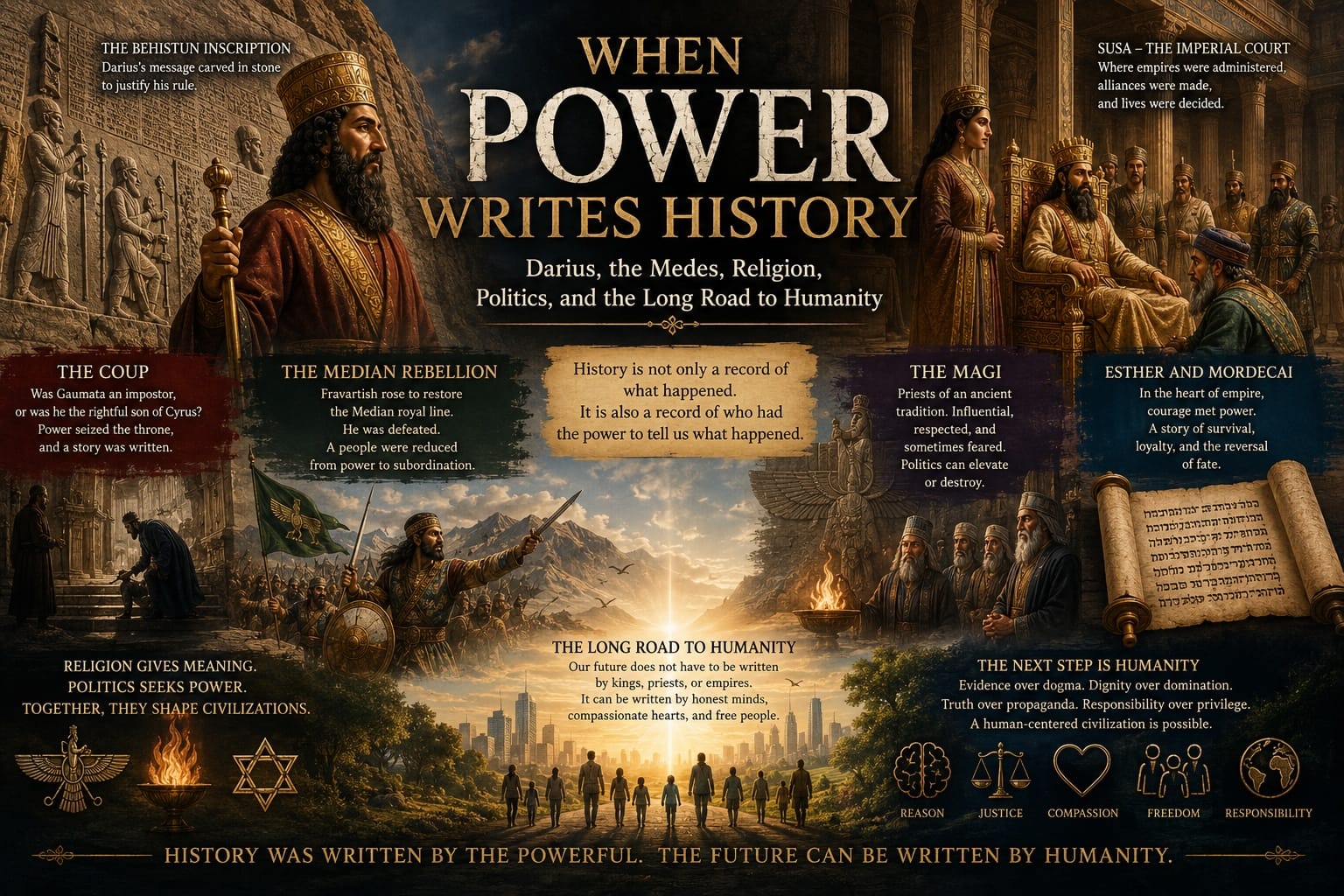
History is not only a record of what happened.
It is also a record of who had the power to tell us what happened.
For thousands of years, human beings have lived inside systems created by those who controlled political authority, religious institutions, armies, laws, education, and eventually the written record itself.
The story of Darius the Great and the rise of the Achaemenid Empire provides a remarkable example.
It is a story of kings and rebellions, religion and political legitimacy, the Medes and Persians, the Magi and Mithra, Jerusalem and Susa, Esther and Mordecai—and, perhaps most importantly, the struggle to control historical memory.
The lesson is not that everything recorded by ancient rulers was false.
The lesson is that we must learn to examine the evidence for ourselves.
That is where the transition from Religion to Politics to Humanity begins.
The First System: Religion
Before modern political institutions existed, religion provided human beings with explanations for the universe, morality, death, nature, social order, and human responsibility.
Religion could unite communities.
It could provide meaning.
It could establish moral rules.
It could help people cooperate.
But religion could also become an institution of authority.
When religious beliefs became connected to political power, the person who controlled the interpretation of the sacred could acquire enormous influence over the living.
Kings could claim divine approval.
Priests could legitimize rulers.
Rulers could protect religious institutions.
Religious institutions could reinforce political authority.
Over time, belief could become law, and law could become power.
The ancient Iranian world provides an important case study in this transformation.
Darius and the Problem of Legitimacy
When Darius came to power, he faced a fundamental political problem:
Why should the empire accept him as king?
His answer survives on the Behistun Inscription.
Darius claimed that Cyrus's son Bardiya had been secretly killed by his brother Cambyses. According to Darius, a Magian priest named Gaumata then impersonated Bardiya and seized the throne.
Darius presented himself as the man who exposed the deception.
He killed Gaumata.
He defeated the rebellions that followed.
And he restored legitimate order.
The political message was extraordinarily powerful:
Darius was not a usurper. He was the restorer of justice.
But historians have long examined the possibility that the story may have been more complicated.
Was Gaumata really an impostor?
Was Bardiya actually killed before Darius took power?
Did Darius participate in a coup against the legitimate ruler?
We cannot simply replace Darius's story with a different story and call the second one proven.
But we can recognize the central historical problem:
The person who wins political power often gains the ability to explain why that power was legitimate.
That is true in ancient empires.
It is also true throughout later human history.
The Behistun Inscription: History or Political Narrative?
The Behistun Inscription is one of the most important surviving documents from the ancient Iranian world.
Darius presented his victories as part of a divine and moral order.
Ahura Mazda supported him.
His enemies were rebels.
His enemies were liars.
His victories restored order.
This is more than a list of military events.
It is a political philosophy.
Darius was telling the empire how to understand the world.
The king was legitimate.
The king was chosen.
The king represented order.
Opposition represented chaos.
This is a pattern humanity has seen repeatedly.
Political systems rarely survive through force alone.
They also require legitimacy.
And legitimacy often requires a story.
The Medes: From Power to Subordination
The Medes occupy a particularly important position in this history.
Before the Achaemenid Empire reached its full imperial form, Median power had already played a major role in the ancient Iranian world.
After Darius seized the throne, however, Median resistance became one of the challenges to his new government.
A leader called Fravartish, or Phraortes in Greek sources, led a rebellion in Media.
Darius defeated him.
The punishment described in the royal record was brutal.
The rebellion was not merely defeated militarily. Its leaders were publicly humiliated and executed.
The message was clear:
The political order of the past would not be allowed to return.
The Medes could remain part of the empire.
But the old independent political order could no longer determine who ruled the empire.
This is one of the most important distinctions in the study of empire.
A people does not have to disappear physically for its political independence to disappear.
Its language can survive.
Its culture can survive.
Its religion can survive.
Its people can survive.
But political power can be transferred from one ruling structure to another.
The Magi: Religion and Political Authority
The story of Gaumata also brings us to the Magi.
Darius identified Gaumata as a Magian.
Herodotus later described a massacre of Magi following the overthrow of Gaumata, an event associated with the festival known as Magophonia.
This is significant because it connects a political struggle directly with a religious class.
But we should be careful.
The evidence does not demonstrate that Darius completely destroyed the Magi.
The Magi continued to exist in Iranian religious history.
What may have changed was their relationship with political authority.
This distinction matters.
A new political system does not necessarily destroy an old religious tradition.
It may instead control it, reorganize it, absorb it, or place it under state authority.
That pattern appears repeatedly in human civilization.
Mithra: The Memory of an Older World
Among the ancient Iranian religious traditions, Mithra—or Mitra—is especially important.
Mithra was associated with agreements, truth, justice, contracts, and social order.
The idea of a cosmic order governed by truth and obligation was deeply important in ancient Iranian thought.
Later, a religion known as Roman Mithraism appeared in the Roman world.
Its temples, initiation ceremonies, symbolism, and famous bull-slaying image became part of the religious landscape of the Roman Empire.
It is tempting to say that the Roman Mithraic Mysteries were simply the underground survival of the Median Magi after Darius's supposed persecution.
But history does not allow us to state that as established fact.
The Roman Mithraic religion appeared many centuries later, and the exact relationship between ancient Iranian Mithra and Roman Mithras remains debated.
Still, the broader lesson remains powerful:
Ideas can survive political systems.
Institutions can disappear.
Empires can collapse.
Kings can die.
But concepts can move from one civilization to another, changing their form while preserving pieces of an older intellectual tradition.
Susa: Where Empire and Story Meet
Centuries later, the Book of Esther places its narrative in Susa, one of the great centers of Achaemenid power.
Archaeological excavations have revealed the enormous royal complex at Susa.
There were monumental halls.
There were courtyards.
There were gateways.
There were royal residential areas.
There was a sophisticated administrative environment.
The physical world discovered by archaeologists provides a meaningful context for the world described in Esther.
But archaeology also teaches us an important lesson:
Context is not the same as proof.
Finding an ancient palace that resembles the setting of a biblical story does not automatically prove every event in the story occurred exactly as described.
It does, however, show that the story's authors understood or portrayed a recognizable Persian imperial environment.
That distinction is essential if we want to move from belief toward historical investigation.
Esther, Mordecai, and Political Power
The Book of Esther describes a dangerous struggle inside the Persian royal court.
Haman attempts to destroy the Jewish population.
Esther and Mordecai ultimately gain the king's favor.
A royal decree allows the Jews to defend themselves.
The story ends with a massive reversal of political power and the deaths of many of those who had been identified as enemies of the Jews.
The story became the foundation of the Jewish festival of Purim.
Whether every event in Esther can be independently confirmed is another question.
But the story itself demonstrates something important about the ancient world:
Political survival often depended upon access to the ruler.
A royal decree could determine life or death.
A court official could become extraordinarily powerful.
A minority community could become vulnerable to political decisions made hundreds of miles away.
And the written record could transform a political struggle into a sacred historical memory.
Language Preserves the Empire
One of the most fascinating features of Esther is its Persian vocabulary.
Words associated with law, royal officials, nobles, and decrees entered the Hebrew text.
The word dat, for example, is generally connected with the Persian concept of law or decree.
Other administrative terms reflect the Persian imperial environment.
This demonstrates something historians should never underestimate:
Language is evidence.
Empires leave traces not only in ruins and weapons.
They leave traces in vocabulary.
A borrowed word can reveal trade.
A political title can reveal administration.
A legal term can reveal institutional influence.
A change in language can reveal contact between civilizations.
Humanity carries history in its words.
Who Gets to Define Truth?
This brings us to the deeper question.
What happens when political power and the power to define truth become concentrated in the same hands?
Darius controlled the army.
He controlled the state.
He controlled the monumental inscription that explained his rise.
His enemies did not have the same opportunity.
That does not make his account false.
But it means we should read it as the account of a victorious ruler.
This principle should apply everywhere.
When a government writes its history, ask questions.
When a religious institution defines its own origins, ask questions.
When a political movement describes its enemies, ask questions.
When a nation teaches its children about its victories and defeats, ask questions.
Not because everything is a lie.
But because human beings are capable of confusing their interests with truth.
From Religion to Politics
This is where the historical story connects directly to the larger transition I call:
FROM RELIGION TO POLITICS TO HUMANITY
The first stage was religion.
Human beings sought answers to the mysteries of existence.
The second stage was politics.
Human beings organized power to control territory, resources, laws, and institutions.
But religion and politics did not remain separate.
They often joined together.
Religion could give political power legitimacy.
Political power could give religious institutions protection.
Together, they could create systems that were extremely difficult for ordinary people to challenge.
The ancient Persian Empire is one example.
But it is certainly not the only one.
The Third Stage: Humanity
The next step should not be another empire.
It should not be another absolute ideology.
It should not be another religious authority claiming exclusive possession of truth.
The next step should be Humanity.
A human-centered civilization begins with a different question.
Instead of asking:
Which king has divine authority?
We ask:
What system best protects human beings?
Instead of asking:
Which religion has the absolute truth?
We ask:
What can human beings establish through evidence, reason, compassion, and honest inquiry?
Instead of asking:
Which political faction should control everyone else?
We ask:
How can ordinary human beings participate meaningfully in decisions affecting their lives?
That is a fundamentally different way of organizing civilization.
Radical Honesty as a Foundation
If humanity is going to move beyond the old systems, there is one principle we cannot avoid:
Radical Honesty.
Radical honesty does not mean pretending that we already know everything.
It means being willing to say:
“This is what the evidence shows.”
“This is what we believe.”
“This is what we suspect.”
“And this is what we do not yet know.”
That distinction may sound simple.
But it could transform how human beings discuss history, religion, science, politics, and civilization.
Imagine a society in which admitting uncertainty is not considered weakness.
Imagine a society where changing one's conclusion after discovering new evidence is considered intellectual strength.
Imagine a society where no individual, government, political party, or religious institution is allowed to declare itself the final owner of truth.
That is the beginning of a human-centered civilization.
We Do Not Need to Destroy the Past
Moving from religion to politics to humanity does not require us to destroy religion.
It does not require us to erase Persian history.
It does not require us to reject the Bible, the Avesta, the Vedas, the Mahabharata, or any other ancient tradition.
Instead, we should learn to read them differently.
Read them as human documents.
Read them as records of civilizations.
Read them as expressions of human hopes and fears.
Read them as evidence of how people understood their world.
Read them critically.
And, above all, distinguish faith from historical evidence.
A person can believe something spiritually without claiming that belief is archaeological proof.
A historian can study a sacred text without either worshiping it or attacking it.
A scientist can investigate the natural world without requiring religious approval.
A citizen can question a government without hating the country.
This is intellectual freedom.
The Real Revolution
The greatest revolution of the future may not be political.
It may be intellectual.
Human beings are beginning to possess tools capable of examining enormous quantities of historical documents, languages, archaeological records, scientific research, and competing interpretations.
Artificial intelligence will increasingly help people compare sources and identify contradictions.
But AI itself must not become another authority that simply tells humanity what to believe.
AI should help humans ask better questions.
It should help distinguish evidence from speculation.
It should expose contradictions.
It should compare competing explanations.
And it should be willing to say:
“We don't know.”
That may be one of the most important sentences in the future of human civilization.
History Belongs to Humanity
Darius could carve his version of history into a mountain.
Kings could build palaces.
Empires could establish laws.
Priests could preserve traditions.
Writers could create sacred narratives.
But none of them could completely control the future.
Because eventually another generation would come along and ask questions.
That generation is us.
We inherit the stories.
We inherit the monuments.
We inherit the religions.
We inherit the political systems.
We inherit the conflicts.
But we do not have to inherit the assumptions that created them.
We can examine them.
We can learn from them.
We can preserve what is valuable.
And we can reject what causes unnecessary suffering.
The Humanity System
The goal of THE HUMANITY SYSTEM is not to create another empire.
It is not to establish another religion.
It is not to create another political ideology that demands unquestioning loyalty.
It is an attempt to ask a much more fundamental question:
What would civilization look like if the human being—not religion, not political power, not wealth, and not ideology—became the central concern?
Such a system would require freedom of thought.
It would require responsibility.
It would require evidence.
It would require compassion.
It would require transparency.
It would require accountability.
And it would require the courage to examine even the beliefs that our ancestors considered unquestionable.
The story of Darius reminds us why this matters.
A ruler can seize power.
A ruler can defeat an enemy.
A ruler can build a monument.
A ruler can write his version of history.
But the responsibility of future generations is to keep asking questions.
From the Mountain of Behistun to the Future of Humanity
More than two thousand years ago, Darius carved his story into stone.
He wanted future generations to know why he believed he deserved to rule.
Today, we have something Darius could never have imagined.
We can compare thousands of sources.
We can study ancient languages.
We can examine archaeological discoveries.
We can analyze inscriptions.
We can question traditional interpretations.
We can use technology to connect information across civilizations.
And we can choose what kind of civilization we want to build next.
The question is no longer simply:
Who was right—Darius or his enemies?
The deeper question is:
Can humanity finally build a civilization in which no ruler, priest, government, or ideology has the power to define reality for everyone else?
That is the transition I believe humanity is beginning to face.
From Religion.
To Politics.
To Humanity.
The future does not belong to the people who control the story.
The future should belong to the people willing to search for the truth.