When the Job Disappears: Why Communities, Not Just Individuals, Need a Plan
A number has been circulating online lately: that 12,400 Americans are being displaced from their jobs every single day. It's a striking figure, and it's often attributed to Goldman Sachs. There's just one problem — it doesn't check out. No Goldman Sachs report, podcast, or research note actually says this. It appears to be a fabricated statistic, the kind that spreads because it sounds plausible, not because anyone verified it.
The real numbers, though, are unsettling enough on their own.
What Goldman Sachs Has Actually Said
Goldman Sachs economist Joseph Briggs, who co-leads the bank's global economics team, has put out a set of estimates worth taking seriously:
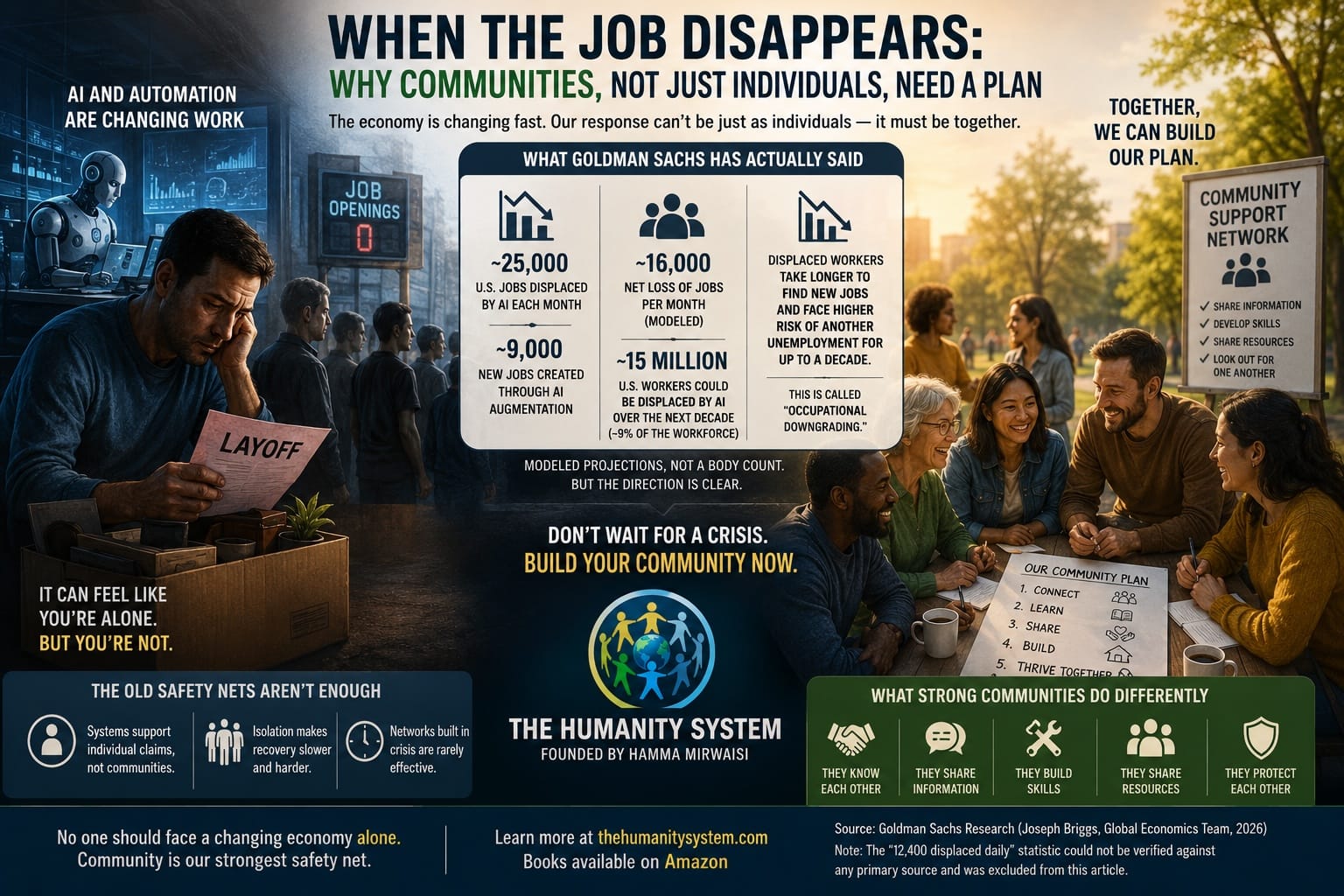
- AI-driven labor substitution is displacing roughly 25,000 U.S. positions a month, while AI augmentation creates about 9,000 new ones — a modeled net loss of around 16,000 jobs per month.
- Over the next decade, Goldman estimates AI could displace roughly 15 million American workers, or about 9% of the U.S. workforce.
- Workers who lose jobs to AI don't just struggle to find new ones — they take longer to land new work, and even after re-employment, face elevated risk of another bout of unemployment for up to a decade. Goldman calls this "occupational downgrading": moving into roles that require fewer skills, and paying less, than the ones lost.
These are modeled projections, not a running body count — Goldman is explicit about that. But the direction is clear, and it isn't limited to any one sector. The bank's researchers point to customer service, back-office administration, and other roles built around repeatable cognitive tasks as facing the most immediate exposure — jobs that, until recently, felt stable precisely because they required a desk rather than a hard hat.
Why the Old Safety Nets Don't Fit This Shape
Past waves of economic disruption — a factory closing, a recession, a regional downturn — tended to be local and visible. This one is diffuse. It shows up as a role quietly eliminated here, a team "restructured" there, a hiring freeze that never lifts. There's no single event for a community to rally around, no plant gate to picket. The people affected can spend months not recognizing that their situation is part of a much larger pattern, because from the inside it just feels like personal bad luck.
That isolation is often the hardest part. Unemployment support systems are built to process individual claims, not to help people find each other, share what they're learning, or organize any kind of collective response. Someone losing a job to automation this year is, in a very real sense, on their own — even though hundreds of thousands of other people are going through the identical thing at the identical time.
The Case for Organizing Now, Before the Crisis Hits
This is the argument for building mutual-support networks before they're urgently needed, not after. A group of neighbors, former colleagues, or community members who already know and trust each other — who've already agreed on how they'll share information, skills, and resources — can respond to a job loss in days instead of months. A network built from scratch in the middle of a personal crisis almost never works as well.
This is the space THE HUMANITY SYSTEM, founded by Hamma Mirwaisi, is trying to occupy — not as a religion and not as a political movement, but as a framework for people to organize around one straightforward premise: that everyone's wellbeing matters enough to actually act on. Its stated commitments — to honesty about what's working and what isn't, to helping people develop and use their skills, and to building durable, non-dogmatic community structures — are aimed at exactly this kind of gap: the space between "the economy changed" and "my neighbors and I have a plan for that."
If you're reading this and the labor market numbers above sound less like an abstraction and more like something already touching your work, your family, or your town, the practical next step isn't to wait for a single dramatic layoff to force the issue. It's to find or build the kind of community — however small — where people are already looking out for one another before the hard time arrives.
You can read more about the framework at thehumanitysystem.com, and the books that lay it out in full are available on Amazon.
Note on sourcing: the figures above are drawn from reporting on Goldman Sachs Research estimates (Joseph Briggs, Goldman Sachs global economics team, 2026). The "12,400 displaced daily" statistic could not be verified against any primary source and was deliberately excluded from this article.