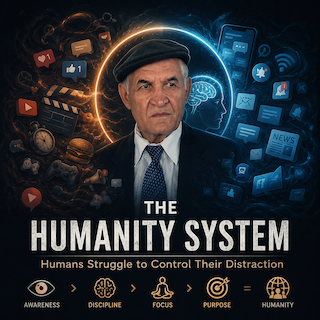
Who Can Stop Religious and Political Wars?
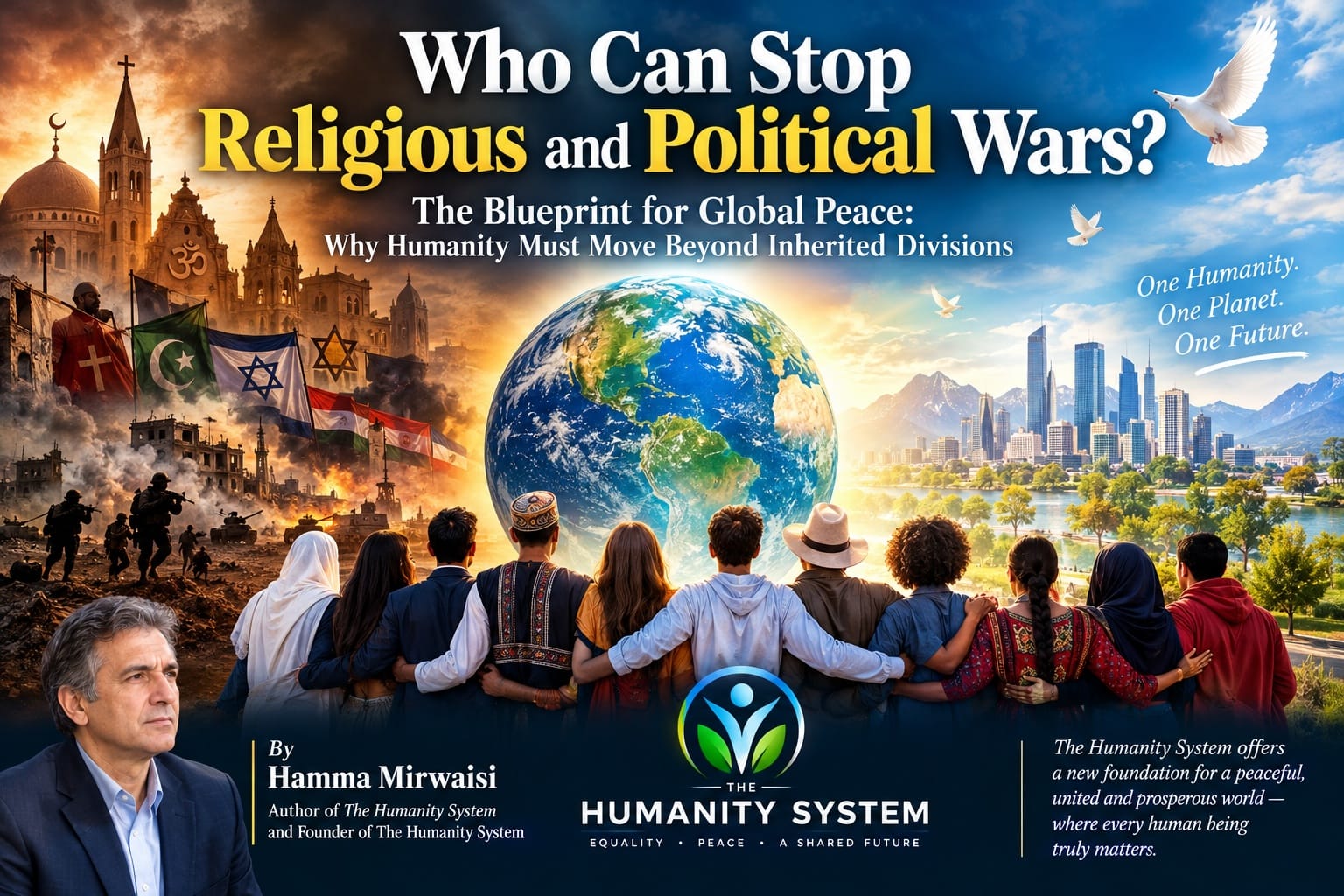
The Blueprint for Global Peace: Why Humanity Must Move Beyond Inherited Divisions
By Hamma Mirwaisi
Author of The Humanity System and Founder of The Humanity System
Dedication
To every human being on Earth—regardless of where you were born, what you were taught, what religion you inherited, or what political boundaries divide us.
This work is dedicated to freedom of thought, equal human dignity, peaceful coexistence, and the hope that one day humanity will no longer accept war as an unavoidable part of human life.
Who Can Stop the Wars?
A question has followed humanity throughout recorded history:
When will religious and political wars finally stop?
Wars come and go. Empires rise and fall. Governments change. Religious movements appear and disappear. Borders are redrawn. Yet humanity repeatedly returns to the same cycle: division, competition, fear, violence, and war.
The Middle East provides some of the most painful examples of this continuing cycle. But the problem is not limited to one region, one religion, or one political system. Religious and political conflicts have appeared in many parts of the world throughout history.
So we must ask a deeper question:
If the systems that humanity has inherited continue to produce division and conflict, should humanity begin thinking about a new system?
I believe the answer is yes.
I call that possibility The Humanity System.
The Cycle of Inherited Beliefs
Most human beings do not choose their first worldview after conducting years of independent research.
A child is born into a family, a community, a language, a culture, and usually a religious tradition. Parents teach children what they themselves were taught. Communities reinforce those beliefs. Political institutions may reinforce them further.
This does not mean that religious people are unintelligent or that every religious belief is false. It means something more fundamental:
Human beings often inherit their starting beliefs before they are old enough to investigate them independently.
A person born into one family may become Muslim. Another may become Christian. Another may become Jewish, Hindu, Buddhist, or follow another tradition. Another may grow up without religion.
The child did not choose the location of birth.
The child did not choose the family.
The child did not choose the historical period.
And the child did not choose the beliefs that were presented as truth.
That raises an important question:
Should an idea become unquestionable simply because we inherited it?
I believe every human being should have the freedom to ask that question.
Faith, Evidence, and the Freedom to Question
Religious traditions contain enormous bodies of philosophy, morality, literature, history, and cultural experience. Millions of people find meaning, community, and comfort in them.
At the same time, many supernatural claims made by religions cannot be established through the same kind of empirical evidence used to establish claims in the natural sciences.
Claims about gods, miracles, supernatural beings, or extraterrestrial visitors therefore deserve careful examination rather than automatic acceptance or automatic rejection.
For me, this is not an argument against individual believers.
It is an argument for freedom of inquiry.
A human being should be able to say:
"I inherited this belief, but I want to investigate it for myself."
That simple freedom is essential to human intellectual development.
We should be able to examine ancient texts.
We should be able to compare traditions.
We should be able to investigate archaeology and history.
We should be able to study science.
We should be able to ask difficult questions.
And we should be able to change our minds when evidence requires it.
Why Do Religious Differences Become Wars?
A difference in belief does not automatically produce violence.
Two people can believe different things and still live peacefully together.
The danger begins when belief becomes connected to political power, territory, identity, institutions, military force, or the claim that one group possesses an unquestionable authority over another.
Then a religious difference can become a political conflict.
A political conflict can become a national conflict.
A national conflict can become a military conflict.
And ordinary human beings can eventually be asked to sacrifice their lives for causes they did not personally create.
This is one of the patterns humanity must learn to break.
People should never be required to hate another human being simply because they were born into a different tradition.
Politics Can Continue the Same Division
Religion is not the only source of division.
Politics can create powerful identities of its own.
People become divided by nations, parties, ideologies, ethnic identities, economic systems, borders, and competing visions of political power.
Again, political organization itself is not necessarily the problem.
Human societies need ways to make decisions, establish laws, resolve disputes, protect rights, and organize public institutions.
The deeper question is:
Should political power remain more important than human life and dignity?
My answer is no.
A political system should exist to serve human beings—not human beings to serve a political system.
What Comes After Religion and Politics?
For thousands of years, humanity has experimented with different ways of organizing human life.
Religion provided systems of meaning and moral authority.
Politics provided systems of government and power.
Economic systems attempted to organize production and distribution.
Science and technology transformed our understanding of the universe and dramatically increased human capabilities.
Yet humanity still struggles with war, poverty, inequality, exploitation, displacement, and the misuse of power.
Perhaps the next step is not simply another religion.
Perhaps it is not another political ideology.
Perhaps humanity needs a human-centered foundation capable of working with different cultures while placing human dignity at its center.
That is the idea behind The Humanity System.
The Humanity System
The Humanity System begins with a simple principle:
Every human being has equal human worth.
It does not matter whether someone was born in America, Iran, Iraq, Afghanistan, Turkey, Europe, Africa, Asia, or anywhere else.
It does not matter whether someone is religious or nonreligious.
It does not matter whether someone is rich or poor.
It does not matter what language they speak.
Human beings remain human beings.
The Humanity System therefore seeks to place human dignity, freedom of thought, equal opportunity, peaceful cooperation, and the rule of humane law at the center of civilization.
It does not ask people to hate religion.
It does not ask people to hate politics.
Instead, it asks humanity to reconsider whether religious identity and political power should continue to determine the destiny of the human species.
A System for Everyone
The Humanity System is intended to be universal.
Its foundation is not based on belonging to one religion, one nation, one ethnic group, or one political party.
A person should be able to enter the conversation simply by being human.
The goal is not to create another group that says:
"We are right and everyone else is wrong."
That would simply reproduce the same problem.
The goal is to create a framework in which human beings can disagree without becoming enemies.
A framework in which religious people can live beside nonreligious people.
A framework in which different political systems can coexist while respecting fundamental human dignity.
A framework in which disagreements are resolved through dialogue, evidence, law, mediation, and peaceful institutions rather than violence.
Can Humanity End War Forever?
I believe humanity should pursue that goal.
But no honest person can promise that a new idea will automatically eliminate war forever.
A system is only as peaceful as the people and institutions that operate it.
The Humanity System therefore should not be presented as a magical solution.
It should be understood as a new direction.
If humanity wants a different future, humanity must build different institutions, develop different habits, educate future generations differently, and create mechanisms capable of preventing the concentration and abuse of power.
Peace requires more than good intentions.
It requires a foundation.
The Question I Ask Every Human Being
I have spent many years thinking about one question:
Why should humanity continue repeating the same patterns simply because they are ancient?
We inherited many of our beliefs.
We inherited many of our borders.
We inherited many of our political institutions.
We inherited many of our conflicts.
But inheritance does not mean destiny.
The next generation does not have to inherit every division of the previous generation.
Human beings created many of the systems under which we live.
Human beings can also create something new.
The Humanity System: A New Beginning
I am Hamma Mirwaisi.
I came to America as a refugee with my wife and two small children and have spent much of my life thinking about the future of humanity.
For many years, I have been developing the idea that I call The Humanity System.
I do not claim that one person can solve humanity's problems.
I do not claim that I possess all the answers.
I am asking humanity to begin a conversation.
A conversation about whether we can build a civilization in which human dignity comes before inherited division.
A civilization in which a child is not taught to hate another child because of religion.
A civilization in which political disagreement does not require violence.
A civilization in which human beings are free to question what they inherited.
A civilization in which the purpose of institutions is ultimately to serve human beings.
When Will Religious Wars Stop?
Perhaps the better question is:
When will human beings decide that religious and political differences are not sufficient reasons to kill one another?
No calendar can answer that question.
No government can answer it for all humanity.
No religious authority can answer it for everyone.
The answer depends on what human beings choose to build.
If future generations continue inheriting division without questioning it, the cycle can continue.
If future generations learn to examine inherited beliefs, respect differences, protect human dignity, and build institutions designed around peaceful cooperation, humanity may gradually move in another direction.
That is the possibility I call The Humanity System.
A Message to Every Human Being
You do not have to abandon your family.
You do not have to hate your religion.
You do not have to hate another nation.
You do not have to hate another political group.
But you can ask questions.
You can investigate.
You can think independently.
You can listen to another human being.
And you can refuse to believe that war is inevitable.
The future belongs to all of us.
The Earth is our shared home.
And every human being deserves the opportunity to live with dignity, freedom, security, and peace.
The Humanity System is my proposal for beginning that journey.
The question is now open to everyone:
Can humanity build a system in which being human comes before every inherited division?
I believe we should try.
Join the Conversation
The Humanity System is still a developing idea. It needs thoughtful people who are willing to question, criticize, improve, and discuss it honestly.
If you believe humanity can build something better than endless cycles of religious and political conflict, I invite you to learn more and join the conversation.
Together, we can begin imagining a future in which humanity—not inherited division—is the foundation of civilization.
🌐 www.thehumanitysystem.com
📧 thehumanitysystem@gmail.com
🌍 the-humanity-system.ghost.io
📬 hammamirwaisiu.substack.com