
Why Iran Rejected Turkey and Pakistan’s Demands?
The Shift in Regional Leverage:
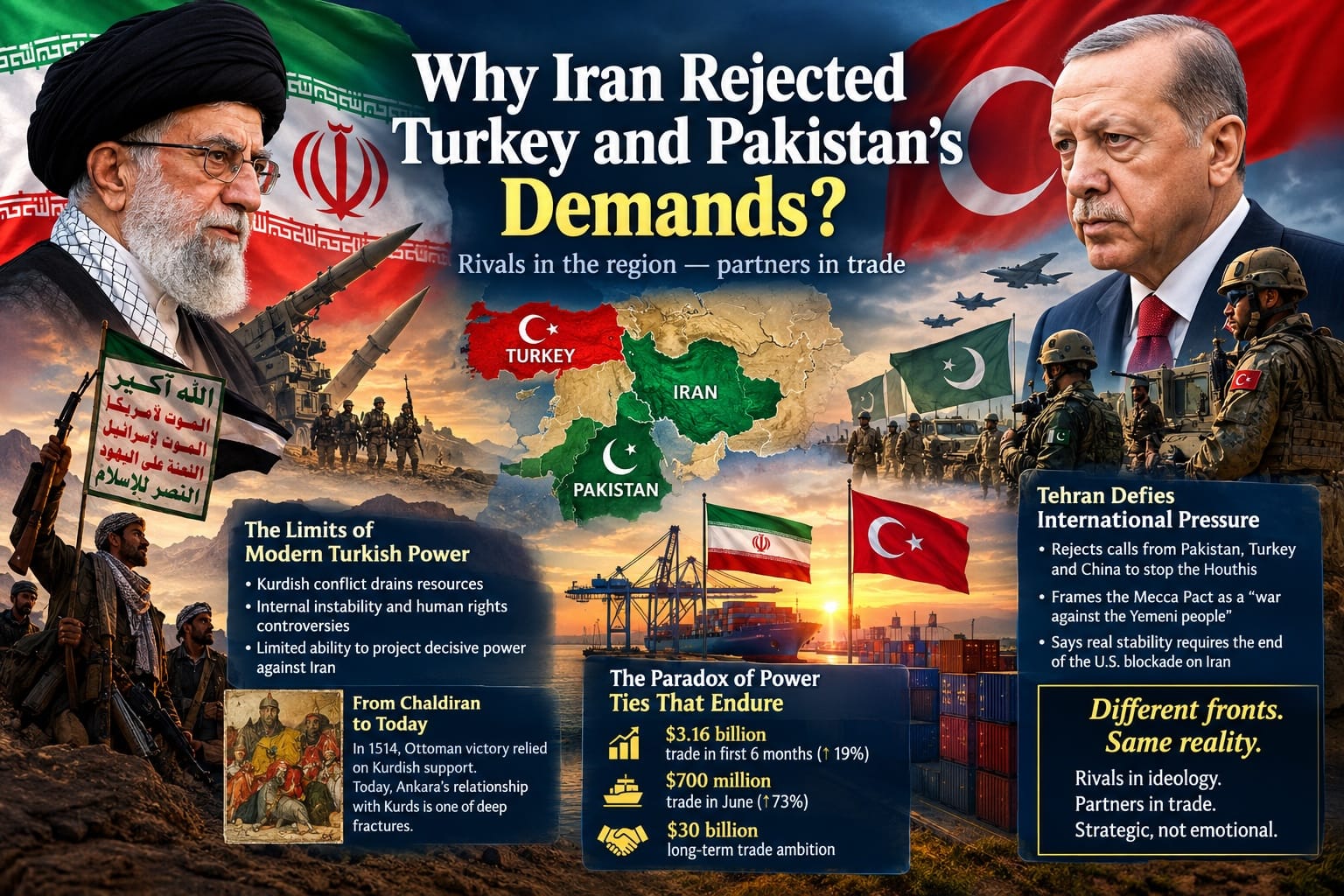
The dynamic of Middle Eastern alliances has shifted sharply following the operational rollout of the trilateral Mecca Defense Pact between Saudi Arabia, Pakistan, and Turkey on October 5, 2026. As Houthi drone and missile strikes continue to target Saudi infrastructure, Turkey and Pakistan have deployed troops, intelligence frameworks, and air defenses inside Saudi Arabia. However, acting from what it views as a position of strategic dominance, Iran has publicly rejected direct warnings from Islamabad and private pressure from China to rein in the Houthi movement. Behind Tehran's firm stance lies a calculated assessment of its neighbors' current internal limitations and deep historical precedents.
The Limits of Modern Turkish Power vs. Historical Precedent
Tehran’s rejection of the joint Turkish-Pakistani request to halt Houthi operations reflects an underlying belief that Turkey’s modern military and political apparatus—specifically its nationalist assets—lacks the capability to project decisive power against Iran. Iranian strategic planners view Turkey's current regional policies as constrained by severe internal conflict and human rights controversies.
This modern reality stands in stark contrast to the Ottoman-Safavid era. When Sultan Selim I (Selim the Grim) decisively defeated Safavid Shah Ismail I at the historic Battle of Chaldiran on August 23, 1514, the Ottoman victory relied heavily on crucial diplomatic and military support from Kurdish leaders, orchestrated by the Kurdish scholar and statesman Idris al-Bitlisi. Today, however, Ankara's relationship with the Kurdish population is defined by deep fractures rather than cooperation.
The Debate Over the Kurdish Conflict and Comparative Scale
A central element of Turkey's modern vulnerability is its long-running conflict with Kurdish political and insurgent groups, such as the Kurdistan Workers' Party (PKK). Critics and local observers argue that the Turkish government's actions against Kurdish communities involve heavy political repression, extensive armed clashes, and mass displacement across southeastern Turkey, northern Iraq, and Syria.
Some regional observers go so far as to claim that the scale of abuses under the administration of President Recep Tayyip Erdoğan matches or exceeds notorious historical atrocities, arguing that Kurdish communities simply lack the global organizational infrastructure to document these actions effectively.
However, historians, genocide scholars, and international bodies maintain a strict distinction between these situations:
- The Holocaust: Under Adolf Hitler and the Nazi regime (1933–1945), a state-sponsored, industrial-scale genocide systematically murdered approximately six million European Jews alongside millions of Romani people, Soviet prisoners, and political dissidents.
- The Kurdish Repression: While human rights groups like Amnesty International and Human Rights Watch frequently condemn state abuses and restrictions on Kurdish cultural expression, these actions are categorized as state-level political repression and counter-insurgency rather than a demographic or industrial extermination campaign.
Regardless of these international classifications, the internal friction generated by the Kurdish issue severely restricts Turkey's ability to present a unified front against Iran. Because Turkey's security apparatus remains heavily bogged down in operations against Kurdish groups, Tehran views Ankara's regional threats as fundamentally limited.
Tehran Defies International Pressure
Confident that neither Pakistan nor Turkey can risk a full-scale regional escalation, Iranian President Masoud Pezeshkian and Foreign Minister Abbas Araqchi have successfully deflected international diplomatic pressure. Even as Saudi Arabia petitioned Beijing to protect critical Red Sea shipping lanes, Iran maintained its stance that the Houthis operate as an independent entity.
By framing the Mecca Pact as an aggressive move—with Iranian state media characterizing Turkey and Pakistan as joining a "war against the Yemeni people"—Tehran has successfully reversed the diplomatic pressure. For Iran, regional stability will not be bought with concessions to Turkey or Pakistan, but will only be negotiated when the broader U.S.-led blockade against Iran itself is dismantled.
The Paradox of Power: Iran-Turkey Trade Volumes
Despite the fiery rhetoric surrounding the Mecca Defense Pact and Turkey’s troop deployments to Saudi Arabia, Ankara and Tehran maintain deep, pragmatic economic ties. For both nations, economic survival outranks ideological posturing, turning their relationship into a masterclass in compartmentalization.
- Current Trade Figures: Data from Turkey's Economy Ministry shows that bilateral trade between Iran and Turkey reached $3.16 billion in the first six months of the year, tracking a 19% increase over the same period in 2025. [1]
- The June Spike: When maritime trade routes faced renewed restrictions, the interdependency of the two nations intensified. In June alone, bilateral trade skyrocketed by 73% to nearly $700 million in a single month. Turkish exports to Iran hit $1.56 billion for the half-year, while Turkish imports of Iranian goods—primarily energy and gas—rose 35% to $1.6 billion. [1, 2]
- The $30 Billion Ambition: Rather than backing away due to geopolitical friction, Turkey and Iran have doubled down on an ambitious $30 billion long-term bilateral trade target. To achieve this, the neighbors are actively pursuing infrastructural integration, including logistics upgrades, accelerated truck clearance at checkpoints, new rail links, and a proposed Khoy–Van–Mersin free trade zone. [1, 2]
For Iran, Turkey acts as a vital land-based economic lung that bypasses maritime chokepoints. For Turkey, Iran remains an indispensable third-largest trading partner and a crucial gas supplier that it cannot afford to decouple from, regardless of its obligations to Saudi Arabia. [1, 2, 3]
China’s Next Diplomatic Steps in the Red Sea Crisis
As the principal buyer of Iranian crude—absorbing roughly 90% of Iran's oil exports—Beijing holds immense behind-the-scenes leverage over Tehran. However, Houthi chokepoint disruptions in the Red Sea have driven up global shipping fuel costs by 120% and forced massive maritime rerouting, directly threatening Chinese export efficiencies. [1, 2]
Moving forward, China's next diplomatic maneuvers are expected to follow a multi-pronged, risk-averse strategy:
- Leveraging the Crude Oil Lifeline Privately: China will likely eschew public denouncements of the Houthis to protect its alignment with the Global South. Instead, Beijing will use its status as Iran's ultimate economic lifeline to pressure Tehran. Future backchannel diplomacy will make continued Chinese capital investment and oil purchases contingent on Iran establishing strict "no-go" parameters for the Houthis regarding vessels linked to Chinese commerce or vital neutral supply chains. [1]
- Implementing a Parallel Naval Escort Framework: Rather than joining Western-led task forces or the newly minted Mecca Pact, China's People's Liberation Army Navy (PLAN) is expected to expand its independent naval escort presence around the Gulf of Aden and the Bab el-Mandeb strait. This allows Beijing to protect its commercial interests and secure maritime redundancy without validating Western security structures or alienating regional Arab partners.
- Conditioning Stability on Western Sanctions Relief: Diplomatically, China will echo Iran's talking points in global forums like the UN Security Council. Beijing's diplomats will argue that the Red Sea crisis cannot be solved by military deterrence alone. By linking Houthi restraint to the dismantling of U.S.-led economic blockades against Iran, China positions itself as a balanced mediator while undercutting Western influence in the Middle East.
Conclusion: The Pragmatic Middle Eastern Chessboard
Ultimately, Iran’s rejection of the Turkish-Pakistani mandate exposes the complex reality behind Middle Eastern geopolitics. While the newly minted Mecca Defense Pact creates high-profile military positioning on paper, the underlying economic realities tell a completely different story. The dramatic 73% spike in June trade and the pursuit of a $30 billion trade target prove that Turkey and Iran remain fundamentally codependent, prioritizing economic survival over regional posturing.
At the same time, Beijing’s quiet influence highlights the shifts in global power. As the ultimate financial lifeline for Tehran, China will continue to protect its own trade routes using backchannel diplomacy and independent naval maneuvers, rather than relying on Western security frameworks.
In this regional chessboard, historical grievances and modern military alignments may dominate the headlines, but trade, energy dependencies, and quiet economic leverage will dictate the actual boundaries of conflict and cooperation.