Why Politics Is Failing Us Today
An Honest Examination of the Global Political Crisis
By Hamma Mirwaisi — Author and Founder of THE HUMANITY SYSTEM
Opening — The Crisis Every Human Being Can Feel
Something is genuinely wrong with the political systems governing human civilization today.
Not wrong in the way that systems are sometimes temporarily imperfect — malfunctioning in ways that honest reform can correct. Wrong in a deeper and more structural way. Wrong in ways that the most sophisticated political reform movements — working within the existing frameworks — have consistently failed to address.
Human beings across every culture — every political tradition — every economic circumstance — are experiencing the same fundamental recognition.
The systems that claim to govern in their name are not genuinely serving them.
This recognition is not confined to any one country or any one political tradition. The Pew Research Center documents it in the United States — where large majorities across the political spectrum believe that the political system is fundamentally broken. The Freedom House global freedom assessments document it worldwide — showing consistent decline in genuine democratic governance across multiple regions and multiple political systems. And the lived experience of billions of ordinary human beings — who watch their political systems produce outcomes that serve concentrated wealth and political power rather than their genuine needs — confirms what the data shows.
Politics is failing us.
Not in every respect. Not without genuine achievements alongside the failures. But in ways that are structural — systemic — and increasingly urgent.
This article examines those failures honestly. And it proposes what THE HUMANITY SYSTEM offers as a genuine alternative.
Part One — The Structural Failures of Modern Political Systems
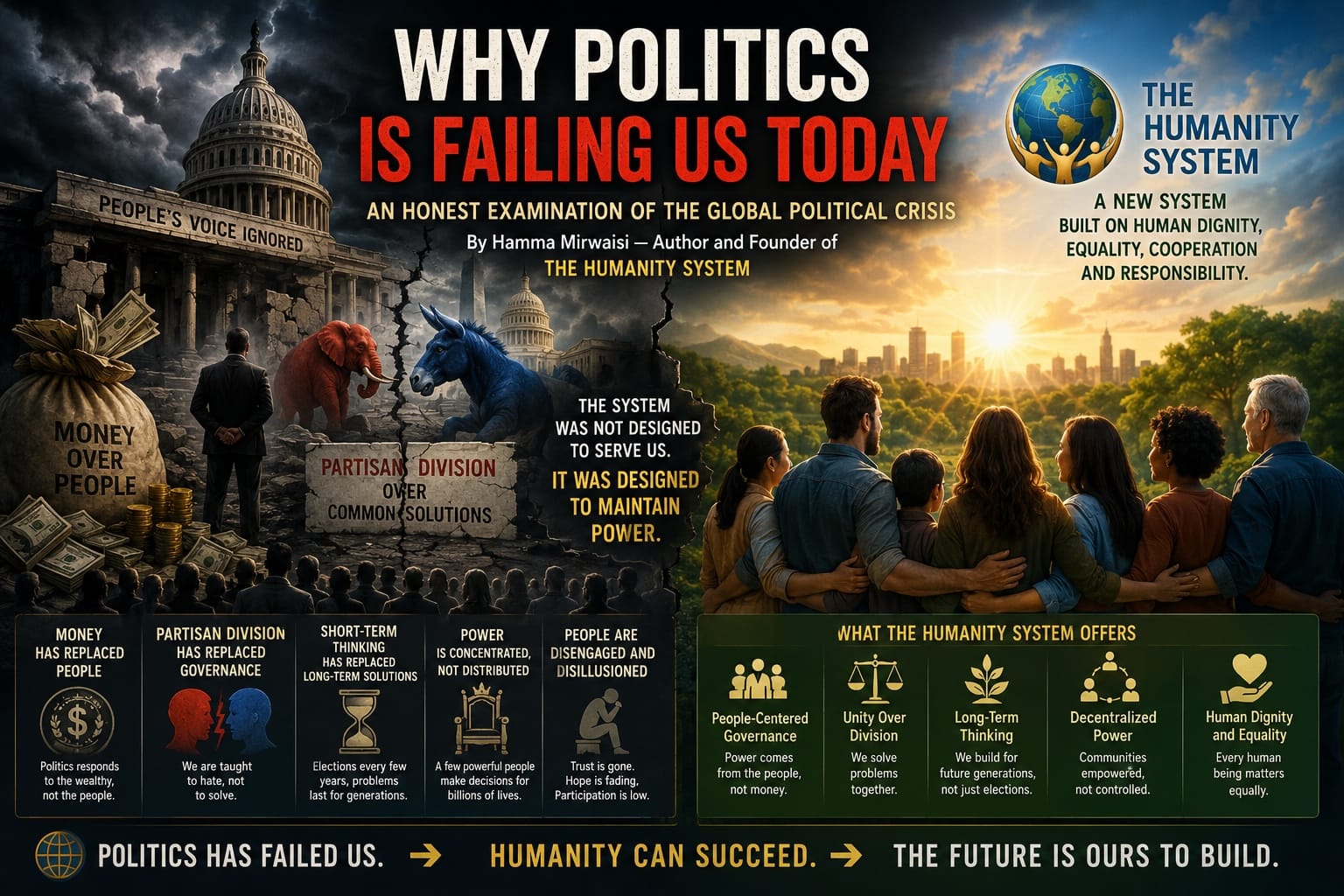
Failure One — Money Has Replaced People
The most fundamental structural failure of modern democratic political systems is the most difficult to honestly confront. Because it strikes at the very claim that makes democratic governance legitimate.
The claim that democratic systems govern in the name of the people.
In theory — democratic political systems derive their authority from the genuine consent and the genuine participation of the citizens they govern. Every citizen's voice counts equally. Every citizen has genuine power to influence the decisions that affect their life.
In practice — the reality is dramatically different.
The unlimited role of money in political campaigns — documented extensively by the Pew Research Center and the Brookings Institution — means that the political process is systematically more responsive to those who can afford to fund campaigns — hire lobbyists — and shape the information environment through media ownership and advertising — than to the ordinary citizens who cast their votes every few years.
The result is a system that produces outcomes — on taxation — on healthcare — on environmental regulation — on labor rights — on financial regulation — that consistently favor the interests of concentrated wealth over the interests of ordinary human beings. Not because every politician is corrupt. But because the structural incentives of the system — the need to raise money — to maintain relationships with powerful donors — to avoid the organized opposition of well-funded interest groups — consistently bias political outcomes toward the interests of those with the most resources to invest in the political process.
The Brennan Center for Justice has documented the corrupting influence of what researchers call dark money — unlimited political spending that flows through organizations not required to disclose their donors — in ways that make the systematic bias of the political process toward concentrated wealth genuinely measurable rather than merely suspected.
This is not what democracy was supposed to be. And the gap between what democracy promises — genuine governance in the name of every citizen — and what it delivers — governance systematically biased toward the interests of concentrated wealth — is one of the most important sources of the political crisis that the modern world is experiencing.
Failure Two — Partisan Division Has Replaced Genuine Governance
Modern democratic political systems — particularly those based on winner-take-all electoral models — are structurally incentivized to produce division rather than genuine governance.
The phenomenon that political scientists call hyper-partisanship — the increasing polarization of political systems into competing camps whose primary orientation toward each other is hostility rather than genuine collaboration — has reached levels in many democratic countries that make genuine governance genuinely difficult.
Legislative gridlock — the inability of political institutions to address pressing challenges because of the paralysis produced by extreme partisan division — is not an accident. It is the predictable product of political systems organized around electoral competition rather than genuine service to the human beings within them.
The practice of partisan gerrymandering — in which politicians manipulate the boundaries of electoral districts to maximize their party's advantage — produces a situation of extraordinary political perversity. Congressional approval ratings consistently fall below twenty percent. Yet incumbent re-election rates consistently exceed ninety percent. Because the system has been deliberately designed — by those who benefit from it — to protect incumbents from genuine accountability.
This is not genuine democratic governance. It is the institutional capture of democratic forms by political parties whose primary commitment is to their own survival rather than to the genuine service of the human beings they claim to represent.
The research of political scientists including those at Harvard Business School has documented the systematic way in which the two-party political systems of countries like the United States have evolved to serve the interests of the parties themselves rather than the genuine interests of citizens — producing a system in which the competition between parties generates more heat than light and more division than genuine governance.
Failure Three — Technology Has Amplified Division Without Increasing Understanding
The development of social media and the algorithmic amplification of emotionally engaging content has added a new and genuinely devastating dimension to the structural failures of modern political systems.
Political discourse — which in a genuinely functioning democracy requires the capacity for sustained honest engagement with complex reality — has been increasingly replaced by the algorithmically optimized production and distribution of outrage-generating content designed not to inform but to engage — not to illuminate but to enrage.
The social atomization that researchers at Protect Democracy and elsewhere have documented — the increasing isolation of citizens within information environments that confirm their existing beliefs and amplify their existing fears — has produced political landscapes in which genuine cross-difference dialogue has become extraordinarily rare.
And the spread of deliberate misinformation — amplified by the same algorithmic systems that amplify genuine political outrage — has made the shared factual foundation that any genuinely functioning democracy requires increasingly difficult to maintain.
The World Economic Forum has identified misinformation as one of the top global risks of our time. And the political systems that should be addressing this risk are — in too many cases — actively contributing to it. Because the same political actors who benefit from misinformation have consistently resisted the regulatory frameworks that might constrain it.
Failure Four — Executive Overreach Has Undermined Democratic Accountability
The global trend toward executive overreach — the concentration of political power in the hands of executive leaders who progressively undermine the institutional checks and balances designed to hold them accountable — has produced what the Brookings Institution describes as democratic decline across multiple regions and political systems.
The checks and balances that democratic constitutions provide — independent judiciaries — free press — legislative oversight — civil society organizations — were designed to ensure that no single person or faction could accumulate unchecked power within democratic systems.
But these checks and balances are only as strong as the political culture and the institutional commitment to upholding them. And the global trend — documented by Freedom House — of declining genuine freedom across the world's political systems reflects the systematic weakening of these constraints by political leaders whose primary commitment is to their own power rather than to the democratic principles they claim to serve.
Failure Five — Political Systems Cannot Keep Pace with Change
Perhaps the most fundamental structural failure of modern political systems — in the context of the extraordinary pace of change that the development of artificial intelligence and related technologies is producing — is their inability to keep pace with the genuine challenges that change presents.
Political systems that take years — sometimes decades — to develop genuine regulatory responses to new technological realities are not merely slow. They are increasingly inadequate to the governance challenges of a world that is changing faster than any previous generation of political institutions was designed to manage.
The development of artificial intelligence. The climate crisis. The restructuring of labor markets by automation. The global spread of misinformation. These are genuinely urgent challenges that require rapid — evidence-based — genuinely collaborative governance responses.
Political systems paralyzed by partisan division — captured by concentrated interests that benefit from the absence of regulation — and structurally resistant to the kind of genuine change that urgent challenges require — cannot provide those responses.
Part Two — Why These Failures Are Not Accidental
The failures documented above are not the result of bad luck or the inadequacy of individual political leaders.
They are structural. They are the predictable products of political systems organized around the wrong purposes.
Political systems were not — as this series has argued — designed primarily to serve every human being equally. They were designed to manage the competition for power among organized groups with the resources to compete for it. And the outcomes they produce — however much they may fall short of what democratic theory promises — are largely the outcomes that the structural logic of those systems predictably generates.
This is the most important insight that THE HUMANITY SYSTEM brings to the analysis of political failure.
The problem is not that the wrong people are in power. It is that the system itself — organized around the management of political competition rather than the genuine service of every human being — consistently produces outcomes that serve the interests of the politically powerful more generously than the interests of ordinary citizens.
Changing the people within the system — without changing the system itself — produces temporary improvement at best. And the historical record of political reform movements — however genuine their achievements — consistently demonstrates the limits of reform within systems whose fundamental structure remains oriented toward political competition rather than genuine human service.
Part Three — What THE HUMANITY SYSTEM Proposes
THE HUMANITY SYSTEM does not propose a new political party. It does not propose a new political ideology. It does not ask human beings to choose between the existing political options that failing political systems have generated.
It proposes something genuinely different.
A system organized not around political competition but around the genuine service of every human being.
With specific structural features that address the specific structural failures that modern political systems have produced.
Annual Honest Review
Every year — in every HUMANITY SYSTEM community — the honest question is asked about every law and every practice governing community life.
Is this genuinely serving every human being within this community? Where is it failing? What needs to change?
And the answers — arrived at through genuine community participation — produce genuine changes in genuine laws. Not eventually — after decades of political resistance from those who benefit from the existing arrangements. Every year.
This is the institutional response to the structural failure of political systems to honestly evaluate and honestly change the arrangements that are failing the human beings within them.
Genuine Democratic Participation
THE HUMANITY SYSTEM's participatory governance model provides every community member with a genuine voice in the decisions that affect their life. Not the formal right to vote once every few years in elections whose outcomes are increasingly shaped by concentrated money and partisan manipulation. Genuine continuous participatory power — in the ongoing governance of the community they live in.
Removing the Money Problem
THE HUMANITY SYSTEM does not depend on fundraising or electoral competition. It derives its authority not from the ability to raise money and win elections — but from the genuine demonstration that it is genuinely serving the human beings within it.
This removes — structurally — the most corrosive influence on modern democratic governance. The systematic bias toward the interests of those who can afford to invest in political outcomes.
Using AI for Genuine Governance
THE HUMANITY SYSTEM uses artificial intelligence as a partner in genuine governance — analyzing the actual outcomes of existing laws and practices — identifying where they are genuinely serving human beings and where they are failing — and supporting the development of genuine evidence-based improvements.
This is the institutional response to the structural failure of political systems to keep pace with the pace of change that modern technological development requires.
Conclusion — The Honest Assessment
Modern political systems are failing the human beings within them. Not in every respect. Not without genuine achievements. But in ways that are structural — predictable — and increasingly urgent.
The concentration of political influence in the hands of concentrated wealth. The paralysis of partisan division. The amplification of misinformation by technological systems that political institutions cannot effectively regulate. The systematic bias of political outcomes toward the interests of the politically powerful rather than the genuine needs of ordinary citizens. And the inability of political systems to keep pace with the genuine challenges that the modern world presents.
These are not problems that can be solved by electing better politicians within the existing framework. They are structural problems that require structural solutions.
THE HUMANITY SYSTEM is that structural solution.
Not a political party competing within the existing framework. A genuinely new framework — organized around the genuine service of every human being — with specific institutional mechanisms designed to address the specific structural failures that five thousand years of political governance have produced.
Politics tried to organize us.
It could not genuinely serve us.
THE HUMANITY SYSTEM was built to do both.
Join us. 🌍❤️✨
"The political systems of the modern world are failing not because human beings have become less capable of genuine governance — but because the systems within which they govern were designed for purposes other than the genuine service of every human being. Changing the people within those systems — without changing the systems themselves — produces temporary improvement at best. THE HUMANITY SYSTEM proposes to change the systems. Structurally. Honestly. And with specific institutional mechanisms designed to ensure that the genuine service of every human being is not merely proclaimed — but actually delivered."
— Hamma Mirwaisi
Author and Founder — THE HUMANITY SYSTEM
About THE HUMANITY SYSTEM:
THE HUMANITY SYSTEM by Hamma Mirwaisi represents the next step in human civilization — from the religious era that began 12,000 years ago — through the political era that began 5,000 years ago — to a genuinely new era centered on the equal dignity and equal flourishing of every human being. Not a religion. Not a political party. A practical framework — updated every year by the communities it serves — using Artificial Intelligence as a partner to develop the best laws for every human being.
📖 www.amazon.com/dp/B0GZ1788G7
🌐 www.thehumanitysystem.com
📧 thehumanitysystem@gmail.com
🌍 the-humanity-system.ghost.io
📬 hammamirwaisiu.substack.com