POLITICS — HONEST EXAMINATION
When It Started — Why It Has Failed — And What Comes Next
POLITICS honest examination
THE HUMANITY SYSTEM
Hamma Mirwaisi
when did POLITICS start
POLITICS failed humanity
By Hamma Mirwaisi — Author and Founder of THE HUMANITY SYSTEM
Opening — The Honest Question
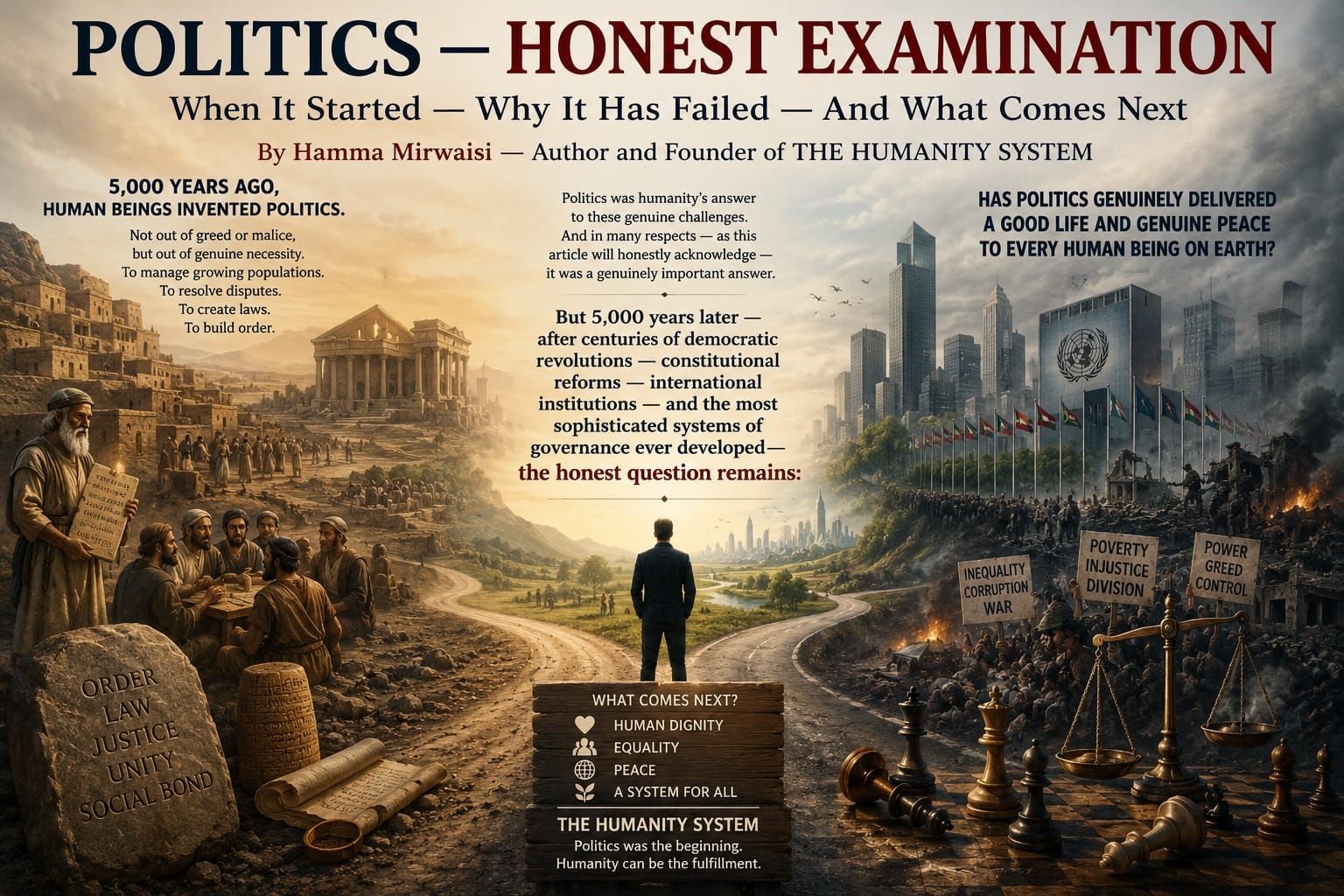
Five thousand years ago — human beings invented politics.
They did not invent it out of greed or malice. They invented it out of genuine necessity. Populations were growing. Communities were becoming too large and too complex to be governed by the informal social bonds of small tribal groups. Resources needed to be managed. Disputes needed to be resolved. Laws needed to be written and enforced.
Politics was humanity's answer to these genuine challenges. And in many respects — as this article will honestly acknowledge — it was a genuinely important answer.
But five thousand years later — after centuries of democratic revolutions — constitutional reforms — international institutions — and the most sophisticated systems of governance ever developed — the honest question remains:
Has politics genuinely delivered a good life and genuine peace to every human being on Earth?
The honest answer is no.
And this article explains why — honestly — carefully — and with genuine respect for both the achievements and the failures of the political systems that have governed human civilization for the past five thousand years.
Part One — When Politics Started and Why
5000 Years Ago — The Birth of Political Systems
As the first article in this series established — human beings have been on Earth for approximately 300,000 years. For the first 295,000 of those years — human beings lived in small communities governed primarily by informal social bonds — shared customs — and the kind of direct personal accountability that is only possible among people who know one another personally.
Politics — in the sense of formal institutional governance — began approximately 5000 years ago. In the great river valley civilizations of Mesopotamia — Egypt — the Indus Valley — and China — growing populations and growing complexity created the need for something new.
The first political systems combined religious and secular authority — with rulers claiming divine mandate to govern. The first written laws — like Hammurabi's Code in ancient Babylon — represented genuine progress. For the first time — the rules governing human life were explicit — publicly known — and at least theoretically applicable to all members of society.
Over the following millennia — political systems evolved through monarchy — aristocracy — democracy — republicanism — colonialism — nationalism — communism — fascism — and the complex hybrid systems of the modern world. Each new form represented an attempt to address the failures of what came before. Each produced genuine achievements alongside genuine failures.
Part Two — What Politics Genuinely Gave Humanity
Honest examination requires acknowledging what politics genuinely achieved.
Rule of Law
The development of written law — applied consistently and publicly — represented genuine moral progress over the arbitrary exercise of personal power. The principle that even the most powerful members of society are subject to law — however imperfectly realized — was a genuine achievement of political civilization.
Democratic Participation
The great democratic revolutions of the modern era — whatever their limitations — represented genuine moral progress in the recognition that ordinary human beings have the right to participate in the governance of their own lives. The extension of voting rights — the abolition of slavery — the recognition of human rights — these were genuine achievements won through genuine political struggle.
International Cooperation
The development of international institutions — the United Nations — the Universal Declaration of Human Rights — the International Criminal Court — represented humanity's first serious attempts to establish frameworks of rights and accountability that applied across national boundaries. Imperfect. Inconsistently enforced. But genuinely important beginnings.
These achievements deserve honest acknowledgment. THE HUMANITY SYSTEM builds upon them — not by rejecting what politics achieved — but by addressing what it could not.
Part Three — Why Politics Has Failed Humanity
The Structural Failures
For all its genuine achievements — political systems carry structural failures that five thousand years of reform have never been able to fully overcome. Understanding these failures honestly is essential to understanding why THE HUMANITY SYSTEM is necessary.
Failure One — Politics Serves Power — Not People
The most fundamental structural failure of every political system ever created is also the simplest to state.
Politics is — at its core — about power. About who has it — how it is acquired — and how it is maintained. And power — by its very nature — tends to serve those who hold it more generously than those who do not.
Political leaders spend enormous energy maintaining their positions — defeating rivals — and serving the interests of those who fund and support them. The genuine well-being of ordinary human beings is consistently treated as secondary to the genuine interests of political survival.
This is not a criticism of individual politicians. Many politicians are genuinely good people who genuinely want to serve the public. It is a criticism of the structure of political systems — which consistently reward the prioritization of power over people — and consistently punish politicians who challenge the interests of those who control the system.
Failure Two — Political Honesty Has Been Replaced by Political Performance
Modern political discourse has developed a deeply troubling split in its understanding of honesty.
On one side — politicians who speak in evidence-based terms — who ground their claims in verifiable data and honest analysis — are increasingly perceived as cold — technocratic — and disconnected from the genuine concerns of ordinary people.
On the other side — politicians who speak in emotionally resonant terms — who share personal convictions and intuitive judgments regardless of their relationship to evidence — are increasingly perceived as authentic and relatable — even when their statements are demonstrably false.
This split has produced political environments in which misinformation thrives — in which emotional manipulation is more politically rewarded than honest analysis — and in which the genuine capacity of democratic citizens to make informed decisions about their own governance is systematically undermined.
The World Economic Forum has identified misinformation as one of the top global risks of our time. And the political systems that should be addressing this risk are — in too many cases — actively contributing to it.
Failure Three — Political Systems Are Designed to Resist Genuine Change
Political institutions are designed — often deliberately — to resist rapid change. This was originally intended as a protection against tyranny — ensuring that no single person or faction could quickly accumulate unchecked power.
But in a world that changes as rapidly as ours — this structural resistance to change has become a genuine danger. The challenges facing human civilization today — climate change — artificial intelligence — global inequality — the erosion of democratic institutions — require rapid — evidence-based — genuinely collaborative responses.
Political systems that take years — sometimes decades — to respond to new realities are not merely inefficient. They are increasingly inadequate to the scale and the urgency of the challenges human beings face.
Failure Four — Political Systems Divide Rather Than Unite
Modern political systems — particularly those based on competitive electoral models — are structurally incentivized to divide rather than unite.
Electoral systems that reward appeals to specific demographic or geographic blocs — at the expense of inclusive platforms that serve all citizens — produce politicians who benefit from division and suffer from genuine cooperation.
Ideological purity tests within political parties enforce rigid conformity — reducing the likelihood of genuine compromise and genuinely nuanced responses to complex problems.
And the algorithmic amplification of political division — through social media platforms designed to maximize engagement by maximizing outrage — has accelerated these divisive dynamics to levels that threaten the basic social fabric of democratic societies.
Failure Five — Politics Has Not Delivered Peace
Perhaps the most fundamental measure of any political system is the simplest — does it deliver genuine peace to the human beings within it?
By this measure — the political systems of the past five thousand years have failed.
Wars continue to be fought — not merely between nations but within them — driven by the political exploitation of ethnic — religious — and ideological division. Political violence — terrorism — civil conflict — and state repression continue to claim millions of human lives every year. And the political systems that should be addressing the underlying causes of conflict too often exploit those causes for electoral advantage.
Genuine peace — not merely the absence of active military conflict but the positive conditions of genuine human security — genuine human dignity — and genuine human community — has never been fully delivered by any political system that has ever existed.
Part Four — The Modern Crisis of Political Honesty
The honest examination of politics in the modern era must confront a specific and deeply troubling development — the systematic erosion of political honesty as a value in public life.
Maintaining intellectual honesty in political speeches and debates is crucial for voters to properly evaluate candidates and avoid manipulation. Yet the incentive structures of modern politics consistently reward performance over substance — emotional manipulation over honest analysis — and the exploitation of fear and division over the patient building of genuine consensus.
This erosion of political honesty is not merely an ethical problem. It is a practical crisis. Democratic systems depend — fundamentally — on an informed electorate capable of making genuine judgments about the genuine merits of competing political proposals. When political discourse becomes systematically disconnected from honest engagement with verifiable reality — democratic self-governance becomes increasingly impossible.
Foster an honest political climate is a shared responsibility. It requires an active — informed electorate that prioritizes factual verification over simple rhetoric — as well as political systems that reward rather than punish transparency and ethical behavior.
THE HUMANITY SYSTEM is committed to this standard of honesty — in its own governance — in its own communication — and in the political culture it works to build.
Part Five — What THE HUMANITY SYSTEM Offers Instead
THE HUMANITY SYSTEM is not a political party. It does not seek political power. It does not ask anyone to vote for it or to align with any political ideology.
It offers something different — and something that five thousand years of political systems have never been able to fully deliver.
Governance that genuinely serves every human being.
Not the powerful. Not the wealthy. Not the politically organized. Every human being — without exception — and without the selective application that has characterized every political system in history.
Laws that can be honestly changed.
Every year — in every HUMANITY SYSTEM community — the laws and the practices governing the community are honestly reviewed. What is working? What is failing? What needs to change? And the answers — honestly arrived at through genuine community deliberation — produce real changes.
No political system has ever been genuinely designed to do this. The HUMANITY SYSTEM is.
Honest governance without misinformation.
THE HUMANITY SYSTEM's commitment to Radical Honesty means that the system measures its own performance honestly — acknowledges its own failures publicly — and communicates with the human beings it serves without the manipulation — the distortion — and the strategic dishonesty that modern political discourse has normalized.
Peace through genuine community.
Genuine peace does not come from political treaties or military deterrence alone. It comes from the genuine recognition of the equal dignity of every human being — from the genuine community that crosses every line of difference — and from the genuine commitment to the well-being of every person that THE HUMANITY SYSTEM places at the center of everything it does.
Part Six — Join Us
Five thousand years of political systems have given humanity much.
They have not given humanity enough.
Not genuine peace. Not genuine equality. Not genuine honest governance. And not the specific — practical — annually renewed commitment to the genuine well-being of every human being that the extraordinary challenges of our time genuinely require.
THE HUMANITY SYSTEM is building something genuinely new.
Starting small — as every genuine system in history has started. With a few committed human beings — in specific communities — committed to specific principles — building honestly and patiently toward a vision of a world that genuinely serves every human being.
Not in some distant future. Now. In the actual communities where actual human beings actually live.
You are invited to be part of it.
Not because THE HUMANITY SYSTEM has all the answers. It does not. No honest system claims to.
But because it is honestly committed to finding them — together — with genuine respect for every human being who joins the search.
Here is how to join:
Read the books:
https://www.amazon.com/dp/B0GZ1788G7
Visit the website:
www.thehumanitysystem.com
Subscribe to the newsletter:
hammamirwaisiu.substack.com
Read the blog:
the-humanity-system.ghost.io
Contact us:
thehumanitysystem@gmail.com
Start a HUMANITY SYSTEM Center
in your community:
Email us at the address above
with the subject line:
HUMANITY SYSTEM CENTER —
[Your City — Your Country]
Conclusion — The Honest Assessment
Politics began five thousand years ago as humanity's genuine attempt to organize collective life fairly — to resolve disputes peacefully — and to build the institutional frameworks that large and complex human societies require.
It gave humanity genuine achievements — the rule of law — democratic participation — international cooperation.
And it failed humanity in fundamental ways — serving power over people — dividing rather than uniting — resisting the genuine change that genuine service to every human being requires — and too often replacing honest governance with political performance.
THE HUMANITY SYSTEM honors the genuine achievements of political civilization. It builds upon them. And it addresses — honestly — practically — and with specific institutional mechanisms — the structural failures that five thousand years of political reform have never been able to fully overcome.
Politics tried to organize us. It could not fully serve us. THE HUMANITY SYSTEM was built to do both.
Join us.
"Five thousand years of politics gave humanity law — but not justice. Order — but not peace. Governance — but not genuine service to every human being. THE HUMANITY SYSTEM was built to give humanity what politics could not — a framework genuinely designed — from its very foundation — to serve every human being on Earth. Fully. Honestly. And without exception."
— Hamma Mirwaisi, Author and Founder — THE HUMANITY SYSTEM
About the Author
Hamma Mirwaisi is the author of two books and the founder of THE HUMANITY SYSTEM.
📖 Books on Amazon: https://www.amazon.com/dp/B0GZ1788G7
🌐 Website: www.thehumanitysystem.com
📧 Contact: thehumanitysystem@gmail.com
🌍 Ghost Blog: the-humanity-system.ghost.io
📬 Newsletter: hammamirwaisiu.substack.com
Please share this article with every human being who believes that the world is capable of something genuinely better than what five thousand years of political systems have delivered. ❤️