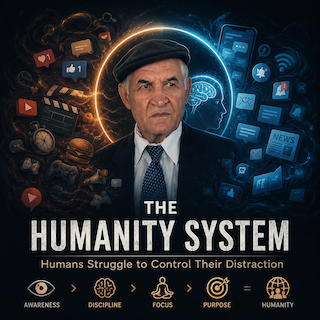
The Most Dangerous Crisis Nobody Is Talking About — And Why It Is Destroying the Future of Every Human Being on Earth
By Hamma Mirwaisi — Author and Founder of THE HUMANITY SYSTEM Published: May 2026
"The greatest prison that human beings have ever lived in is not made of iron bars or stone walls. It is made of distraction — division — and the deliberate fragmentation of human attention. And unlike every previous prison in human history — this one has been designed to feel like freedom."
Introduction — The Crisis That Hides in Plain Sight
Every generation faces its defining crisis.
For some generations — that crisis was obvious. Visible. Undeniable. A world war. A pandemic. A great depression. A social upheaval so large and so immediate that no honest human being could look away from it or pretend it was not happening.
For our generation — the crisis is different. It is not hidden, exactly. Its symptoms are everywhere — in the epidemic of loneliness sweeping through the most connected societies in human history — in the unprecedented crisis of mental health among young people who have never known a world without smartphones — in the paralysis of democratic systems that seem constitutionally incapable of addressing any challenge that requires sustained collective attention over a period longer than the next electoral cycle — in the growing sense, felt by billions of human beings across every culture and every continent, that the systems governing their lives are not serving them. That the promises made to them — of peace, of justice, of meaning, of security — are not being kept.
The symptoms are visible. What is not yet visible — what has not yet been honestly named and honestly confronted — is the underlying cause.
The underlying cause is not technology. Not economic inequality. Not political polarization. Not the decline of religion or the corruption of politics — though all of these are real and all of them are consequential.
The underlying cause is something more fundamental. Something that operates beneath all of these surface manifestations and makes all of them worse. Something that — once honestly understood — reveals an entirely new way of seeing what is wrong with the world we inhabit and what it will genuinely take to build something better.
The underlying cause is the systematic destruction of the human capacity for genuine attention.
Part One — What Attention Actually Is — And Why It Is the Most Valuable Thing You Possess
Before we can understand the crisis — we need to understand what is at stake.
Attention is not simply the act of looking at something. It is not merely a cognitive function among many. It is — when genuinely understood — the most fundamental capacity that a human being possesses. The capacity upon which every other human capacity depends.
What we pay attention to shapes what we know. What we know shapes what we believe. What we believe shapes how we feel. And how we feel shapes how we act — and therefore what kind of world we create — both for ourselves and for every human being whose life intersects with ours.
In the most literal and most consequential sense — attention is the mechanism through which every human being participates in the ongoing creation of the world. Where you direct your attention is where you direct your life. And where billions of human beings direct their collective attention — over time — is where human civilization goes.
This means that the question of who controls human attention is not merely a question about media or technology or the psychology of habit formation. It is a question about power. About freedom. About the most fundamental conditions of genuine human self-determination.
And it is a question whose answer — in the world we currently inhabit — should alarm every human being who takes their own freedom seriously.
Because the honest answer is this: in the modern world — for billions of human beings — the control of human attention has been systematically transferred from the individual human beings to whom it belongs to the commercial systems that have learned how to capture it, hold it, and sell it — at enormous profit — to the highest bidder.
This is not an exaggeration. It is not a conspiracy theory. It is the straightforward, well-documented, openly acknowledged business model of the most valuable corporations in human history.
Part Two — How the Attention Economy Was Built — And What It Has Done to Us
The story of how human attention became the most valuable commodity on Earth begins — as so many stories of unintended consequence do — with a genuinely good idea.
The internet — in its earliest conception — was a genuinely liberating technology. A tool for the free, democratic, universally accessible exchange of information and ideas. A technology that could — and in many ways did — give every human being on Earth access to the accumulated knowledge of human civilization. That could — and in many ways did — connect human beings across geographic and cultural boundaries that had previously made genuine human understanding across difference nearly impossible.
Those genuine goods were real. And they remain real. The internet — properly governed and properly used — is one of the most powerful tools ever created for the genuine democratization of knowledge, opportunity, and human connection.
But something happened on the way from that early vision to the world we actually inhabit today. Something that transformed the internet from a tool for the liberation of human attention into a system for its systematic capture, exploitation, and commercial sale.
That something was the discovery — made by a small number of extraordinarily talented engineers, psychologists, and entrepreneurs in the early years of the 21st century — that human attention could be not merely attracted but engineered. That the specific features of the human psychological architecture — the reward systems, the social monitoring systems, the threat detection systems, the novelty-seeking systems that evolution designed for entirely different purposes — could be systematically exploited to create patterns of engagement that were, for practical purposes, compulsive. Addictive. Difficult or impossible to choose to stop.
The result was the attention economy — a global system in which the primary product being manufactured — the primary commodity being bought and sold — is not information or entertainment or connection, but the human attention that information and entertainment and connection have been engineered to capture.
Every major social media platform. Every algorithmic content recommendation system. Every personalized news feed. Every notification system. Every feature of every app on every smartphone carried by every one of the approximately five billion people on Earth who own one — has been designed, tested, refined, and optimized with a single primary goal: to capture your attention and hold it for as long as possible.
And here is what that has done to us.
It has destroyed our capacity for sustained deep thought — the kind of slow, patient, genuinely difficult thinking that produces genuine understanding rather than the passing familiarity that comes from quickly consuming a summary.
It has destroyed our capacity for genuine self-knowledge — the honest, sustained, genuinely courageous examination of our own inner lives that is the foundation of every form of genuine human wisdom.
It has destroyed our capacity for genuine human connection — replacing the deep, sustaining, mutually enriching relationships that human beings most fundamentally need with the engineered simulacrum of connection that social media provides.
And — perhaps most consequentially of all — it has destroyed our collective capacity for the kind of sustained, informed, genuinely deliberative public discourse that genuine democratic self-governance requires.
A population that cannot sustain attention to complex problems. That cannot engage seriously with perspectives different from its own. That processes its understanding of the world through algorithmically curated filter bubbles that systematically reinforce existing beliefs and amplify tribal hostility. That makes its political judgments primarily on the basis of emotional reaction to carefully engineered outrage rather than careful consideration of evidence and argument.
That population is not free. Whatever its formal political institutions may say. Whatever rights its constitution may proclaim. It is not — in any meaningful sense — genuinely self-governing. It has surrendered the most essential precondition of genuine freedom — the capacity to direct its own attention — to systems whose interests are not its own.
Part Three — The Ancient Roots of Distraction — This Is Not New
What makes the modern attention economy so consequential — and so genuinely dangerous — is not that it represents something entirely new in the human story. The management of human attention as a tool of social control is, in fact, one of the oldest and most consistently effective strategies in the entire history of human power.
The ancient Romans understood it. Their policy of panem et circenses — bread and circuses — the provision of free grain and spectacular public entertainment to the urban masses — was a deliberately designed system for directing popular attention away from the enormous inequalities and injustices of Roman society and toward the dramatic pleasures of the arena. The circus was not merely entertainment. It was a technology of social control. And the Roman political class knew it.
Religious institutions understood it. The great cathedrals and temples and mosques of the ancient and medieval worlds were not merely places of worship. They were extraordinarily sophisticated environments — engineered with centuries of accumulated psychological wisdom — designed to produce specific states of consciousness in the human beings who entered them. States of awe, humility, reverence, and submission that made those human beings more receptive to religious authority and less inclined toward the critical questioning that might have challenged the enormous power and privilege of religious institutions.
The great doctrines of religious afterlife — heaven and hell, karma and rebirth, divine judgment and divine reward — served a similar function. By directing human attention toward the infinite stakes of eternal spiritual destiny, these doctrines powerfully redirected human attention away from the conditions of the present world. Keep your eyes on heaven, they taught — implicitly but unmistakably — and you will be less likely to notice — or to object to — the injustice, the poverty, and the exploitation that surround you in this life.
What is genuinely new about the modern attention economy is not its purpose — which is as old as human power — but its precision, its scale, and its extraordinary effectiveness. Previous systems of attention management were crude by comparison. They could direct human attention in broad strokes — toward the afterlife, toward external enemies, toward the drama of the arena. But they could not individualize. They could not learn from each specific human being's specific pattern of engagement and use that learning to optimize, in real time, the specific content most likely to capture that specific person's specific attention most effectively.
The modern attention economy can. And does. For every human being who uses its platforms. Every single day. Every single hour. Every single moment.
Part Four — What the HUMANITY System Proposes
The HUMANITY System does not propose that the internet should be destroyed — or that technology is inherently dangerous — or that the only solution to the attention crisis is a retreat into some pre-technological simplicity that never actually existed and that would not serve human flourishing even if it had.
What the HUMANITY System proposes is something more nuanced and more genuinely ambitious: the fundamental reorientation of the technological ecosystem from a system designed to serve the commercial interests of those who control it to a system designed to serve the genuine flourishing of every human being who uses it.
This reorientation operates at three levels simultaneously.
At the structural level — through the regulation of the attention economy. The companies that have built their business models on the systematic exploitation of human psychological vulnerabilities must be held accountable for the consequences of that exploitation — just as manufacturers of other products that harm human health are held accountable for the consequences of the design choices that produce those harms. The HUMANITY System advocates for the development of a new generation of regulatory frameworks — genuinely democratic, genuinely international, and genuinely oriented toward human well-being rather than commercial interest — that can make this accountability real.
At the educational level — through the integration of genuine media literacy, attention management, and the cultivation of deep thinking into educational systems at every level and in every part of the world. The capacity for sustained, directed, genuinely free attention is not merely a personal virtue. It is a fundamental cognitive skill — one that can be taught, practiced, and developed — and one that every human being deserves the opportunity to develop. The HUMANITY System commits to making this education genuinely universal.
At the individual level — through the cultivation of what the great contemplative traditions of every human culture have always recognized as among the most essential and most distinctively human of all capacities: the capacity for genuine, sustained, freely chosen presence. Presence to the world. Presence to the people we love. Presence to the genuinely important questions of our time. And presence to the quiet, persistent, irreplaceable inner life that is the source of everything genuinely valuable that any human being has ever created, discovered, or contributed to the human story.
This is not a call for passive resignation or individualistic self-improvement in the face of structural problems that require structural solutions. It is a recognition that genuine structural change begins with genuine individual clarity — that the systems that are most harming human beings survive, in large part, because the human beings within them have been kept too distracted, too divided, and too disoriented to see clearly enough to demand something genuinely different.
See clearly. Think deeply. Pay genuine attention. And then — from that foundation of genuine clarity — march forward. Together. Peacefully. And without stopping.
Part Five — The Most Revolutionary Choice Available to a Human Being Today
There is a revolution available to you right now. Not at some future moment when the conditions are more favorable. Not when you have more time, more resources, or more certainty about exactly the right thing to do.
Right now. In the actual conditions of your actual life.
It does not require a political party. It does not require a religious conversion. It does not require money, status, or influence. It does not require the permission of any authority — religious or political or commercial.
It requires only the willingness to do one thing.
To pay genuine attention.
Not the fragmented, algorithmically directed, commercially motivated pseudo-attention that the modern attention economy has substituted for the real thing. But genuine attention — deep, sustained, freely chosen, directed toward the things that actually matter — toward the people you love, the work you find genuinely meaningful, the questions you most deeply care about, and the world you most genuinely want to help build.
In a world that has been so comprehensively engineered to prevent exactly this kind of attention — choosing to pay it is genuinely revolutionary. It is an act of resistance against the commercial forces that profit from your distraction. It is an act of resistance against the political forces that benefit from your confusion and your division. And it is an act of reclamation — of the most fundamental freedom that any human being possesses.
The freedom to direct your own mind.
The freedom to choose your own focus.
The freedom to live a life that is genuinely your own — rather than one that has been manufactured for you by systems whose interests are not your own.
This is where the HUMANITY System begins. Not in institutions or in laws or in international treaties — though all of these are necessary and all of them are being built. It begins in the choice of each individual human being to reclaim their own attention. To think clearly. To see honestly. And to act — from that clarity and that honesty — in genuine service of every human being on this shared and extraordinary Earth.
Conclusion — The Crisis and the Opportunity
The most dangerous crisis nobody is talking about is real. The systematic destruction of human attention — the deliberate engineering of human distraction at a scale and with a sophistication that no previous era of human history has approached — is genuinely one of the most serious threats to human freedom, human dignity, and genuine human flourishing that the modern world has produced.
But within this crisis — as within every genuine crisis in human history — lies an extraordinary opportunity.
The opportunity to see — clearly and honestly — what is actually happening to us. To name it honestly. To refuse to accept it as natural or inevitable. And to begin — individually and collectively — the difficult but genuinely possible work of building a world in which human attention is treated not as a commodity to be captured and sold but as the most precious resource that any human being possesses. The resource from which every genuine human achievement — every act of genuine love — every moment of genuine understanding — and every step of genuine collective progress — ultimately derives.
The HUMANITY System was built on the conviction that this world — this genuinely better world in which every human being's attention, every human being's potential, and every human being's dignity is genuinely honored — is not merely desirable but achievable.
Not easily. Not quickly. Not without the sustained, patient, genuinely difficult work that genuine human progress always requires.
But achievable. And worth every step of the journey toward it.
The crisis is real. The opportunity is real. The choice — as always — is yours.
"The most precious resource any human being possesses is not money — not time — not talent — but attention. For it is attention that determines what we know — what we feel — what we value — and ultimately what kind of world we create. Guard it. Direct it wisely. And never surrender it to those who would use it against you."
— THE HUMANITY SYSTEM
About the Author

Hamma Mirwaisi is the author of two groundbreaking books and the founder of THE HUMANITY SYSTEM — a genuinely new framework for human civilization designed to serve every human being on Earth fully — honestly — and without exception.
📖 Book One: From Religion to Politics to Humanity: A Journey of Human History and a Vision for Our Future 📖 Book Two: THE HUMANITY SYSTEM: Humans Struggle to Control Their Distraction — A Blueprint for a World Where Every Human Being Truly Matters
🔗 Both available on Amazon: https://www.amazon.com/dp/B0GZ1788G7 🌐 Website: www.thehumanitysystem.com 📧 Contact: thehumanitysystem@gmail.com
https://www.linkedin.com/in/hamma-mirwaisi-1b985440/
https://www.linkedin.com/in/hamma-mirwaisi-1b985440/
https://www.instagram.com/hmir_waisi/
https://www.facebook.com/stories/create
SEO KEYWORDS FOR THE ARTICLE
Use these keywords when publishing online to help people find it
- THE HUMANITY SYSTEM
- New framework for human civilization
- After religion and politics
- Human-centered system
- Hamma Mirwaisi
- Every human being matters
- The third way beyond religion and politics
- New system for humanity
- Human rights framework
- Future of civilization
If this article has resonated with you — please share it with every human being in your life who has ever felt that the world is capable of something genuinely better than what we have built so far. The conversation that changes the world begins with a single honest human being sharing a genuine idea with another.
Thank you for reading. Thank you for caring. And thank you for being part of the human family. ❤️