
What is the Turkish Forces' violent Crime against Kurdish People since their arrival from Central Asia?
What is Turkey's plan now?
They used NATO in the past to fight Kurdish people.
They did not help the US war in Iraq, and in the US-Iran Conflict.
They played between the US and Russia against one another.
And now they signed the Mecca Joint Defense Agreement!
They are doing all this to continue with their unjust practice against
The Kurdish people’s interest in the world at large.
What direction are they taking now?
Fight Iran expansion or join Iran, Russia, and China, by dumping NATO allies including the US for good!
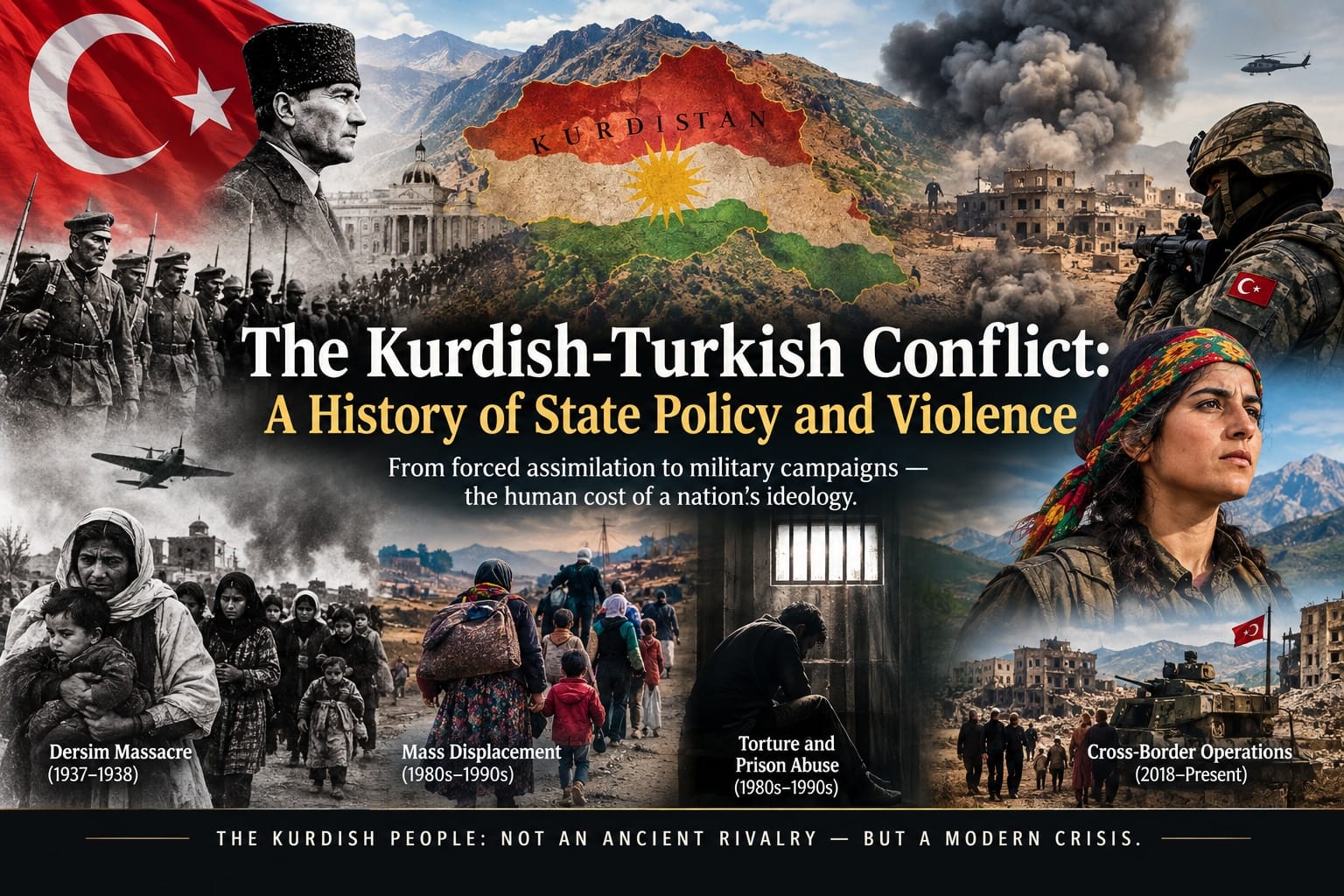
The Kurdish-Turkish Conflict: A History of State Policy and Violence
The complex relationship between the Turkish state and its Kurdish population represents one of the most enduring geopolitical and human rights crises in the modern Middle East. While popular narratives sometimes frame this friction as an ancient ethnic rivalry dating back to the medieval migrations of Turkic tribes from Central Asia, historical and political consensus shows that the systematic conflict is primarily a product of the modern era. Specifically, it stems from the nation-building policies of the Turkish Republic established in 1923 and the subsequent decades of military counterinsurgency.
The Foundations of State Suppression (1923–1930s)
Following the collapse of the Ottoman Empire, the newly formed Republic of Turkey, under the leadership of Mustafa Kemal Atatürk, adopted a rigid model of civic nationalism. The state’s central doctrine aimed to create a homogenous Turkish identity. This "Turkification" policy explicitly denied the distinct ethnic, linguistic, and cultural identity of the Kurdish people.
For decades, official state rhetoric referred to Kurds as "Mountain Turks," claiming they were merely a subset of the Turkish populace who had forgotten their native tongue. The Kurdish language was banned from public life, education, and broadcasting, and traditional Kurdish dress, names, and geographical placenames were systematically outlawed.
The Dersim Massacre (1937–1938)
Early resistance to these assimilation policies was met with severe military force. The most devastating of these early actions occurred during the Dersim Massacre (1937–1938) in the region known today as Tunceli. Following a localized rebellion by Kurdish Alevis against central state authority, the Turkish military launched a massive pacification campaign.
The military response included aerial bombardments and sweeping ground operations. Historical records and subsequent admissions by Turkish officials indicate that between 13,000 and tens of thousands of Kurdish civilians were killed, while thousands more were forcibly displaced to western Turkey to accelerate their cultural assimilation.
The PKK Insurgency and Scorched-Earth Counterinsurgency (1984–Present)
The conflict entered its most violent and protracted phase in 1984, when the Kurdistan Workers' Party (PKK) launched an armed separatist insurgency against the Turkish state. The resulting war has claimed over 40,000 lives and led to severe human rights violations, particularly during the peak of the fighting in the 1990s.
In its effort to isolate the PKK from its civilian support base, the Turkish military instituted a scorched-earth policy in the predominantly Kurdish southeast. Human rights monitors, including Human Rights Watch and Amnesty International, have extensively documented the following actions from this era:
- Village Destruction: Over 2,400 Kurdish villages and hamlets were partially or completely destroyed or evacuated by state forces.
- Mass Displacement: Between 1 million and 3 million Kurdish civilians were forced from their rural homes, creating massive waves of internal displacement into urban centers.
- Extrajudicial Executions: Thousands of "enforced disappearances" and political assassinations targeting Kurdish activists, journalists, and intellectuals were carried out by state forces or state-sponsored paramilitary groups.
- Systemic Torture: Military and state prisons—most notoriously the Diyarbakır Prison in the 1980s and 1990s—became institutional centers for systematic torture and severe abuse of political detainees.
Cross-Border Operations and Contemporary Warfare
In recent years, the theater of conflict has expanded beyond Turkey’s borders. Citing national security threats and the presence of Syrian Kurdish militias (YPG) linked to the PKK, the Turkish military launched several major cross-border incursions into northern Syria—such as Operation Olive Branch in Afrin (2018) and Operation Peace Spring (2019)—as well as ongoing operations in northern Iraq.
United Nations commissions and international human rights organizations have raised serious concerns regarding the conduct of Turkish forces and their local proxy militias in these regions. Documented violations include arbitrary detentions, widespread confiscation of civilian property, and systematic harassment aimed at altering the demographic makeup of traditionally Kurdish enclaves.
Conclusion
The violent friction between Turkish forces and the Kurdish population is rooted not in ancient tribal animosities, but in the structural friction between a highly centralized nation-state and its largest ethnic minority. While Turkey maintains that its military actions are strictly anti-terror operations aimed at preserving territorial integrity against the PKK, international observers continue to emphasize the heavy toll these decades of state policy and military campaigns have extracted from Kurdish civilian populations.
Universal Justice and the Kurdish-Turkish Conflict: Legal Frameworks and Global Responses
To write for an audience that "loves humanity" is to focus the lens on human dignity, the universal rule of law, and the pursuit of institutional accountability. When examining the Kurdish-Turkish conflict through this humanitarian perspective, the discussion shifts from simple battlefield reports to the rigorous legal designations and international human rights mechanisms that seek to protect vulnerable populations.
International bodies, human rights monitors, and legal treaties offer a structured look at how the world measures, categorizes, and responds to this decades-long struggle.
1. International Legal Designations of the Conflict
The classification of the conflict under international law determines the rules of engagement and the specific protections guaranteed to civilians.
- Non-International Armed Conflict (NIAC): International legal bodies, including the International Committee of the Red Cross (ICRC), classify the internal hostilities between the Turkish state and the Kurdistan Workers’ Party (PKK) as a Non-International Armed Conflict. This designation means that both parties are legally bound by Common Article 3 of the Geneva Conventions and customary international humanitarian law, which strictly prohibit summary executions, torture, and the targeting of civilians. [1]
- Terrorist Designations: The PKK is formally designated as a terrorist organization by Turkey, the United States, and the European Union. From a human rights lens, while states possess a legal right to counterterrorism and self-defense under Article 51 of the UN Charter, international observers emphasize that counterterrorism legislation cannot be used to bypass fundamental human rights or criminalize peaceful political dissent. [1, 2, 3, 4]
- The Law of Occupation in Northern Syria: In cross-border regions such as Afrin and parts of northern Syria, international legal monitors—including Human Rights Watch (HRW) and the UN—state that Turkey operates as an occupying power. Under the Fourth Geneva Convention, an occupying power is legally responsible for maintaining public order, protecting civilians from violence, and preventing proxy forces from seizing private property. [1, 2]
2. European Court of Human Rights (ECtHR) Binding Judgments
Because Turkey is a member of the Council of Europe, its domestic legal system is subject to the oversight of the European Court of Human Rights. The ECtHR has issued thousands of binding judgments condemning state overreach against Kurdish citizens. [1, 2]
- The Demirtas and Kavala Precedents: The ECtHR has repeatedly ruled against Turkey for the arbitrary detention of Kurdish political figures, most notably former party leader Selahattin Demirtaş. The Court ruled that his prolonged imprisonment violated Article 18 of the European Convention on Human Rights, finding that his detention was driven by political motives to stifle pluralism and limit freedom of political debate. [1, 2]
- Non-Compliance and Structural Strain: Humanitarian and legal groups like the Human Rights Association (İHD) track Turkey’s continued non-compliance with these binding European rulings. This refusal to implement international legal decisions remains a central point of friction between Ankara and European democratic institutions. [1, 2]
3. United Nations and International Monitoring Mechanisms
The global community routinely utilizes UN fact-finding bodies to document abuses and appeal to the shared humanity of all parties involved.
- UN Commission of Inquiry on Syria: The UN Independent International Commission of Inquiry on the Syrian Arab Republic regularly publishes detailed findings on areas under Turkish military control. UN reports have documented severe, systemic abuses committed against the Kurdish population by Turkish-backed proxy militias (the Syrian National Army, or SNA), including arbitrary detentions, forced disappearances, extortion, and gender-based violence. [1, 2, 3, 4]
- The Call for Accountability: UN Rapporteurs consistently urge the Turkish government to exercise its command responsibility over these factions, investigate allegations of torture, halt arbitrary demographic shifts, and allow displaced Kurdish families to safely return to their ancestral homes. [1, 2]
4. Recent Developments: De-escalation and Fragile Peace Steps
A humanitarian perspective also looks toward avenues for healing and structural reform. Landmark diplomatic shifts have altered the legal landscape of the conflict:
- PKK Full Dissolution (2025): Following back-channel peace overtures, jailed leader Abdullah Öcalan issued an extraordinary appeal for peace. In May 2025, the PKK officially announced its full dissolution and disarmament, opting to pursue Kurdish political and cultural rights exclusively through peaceful, democratic means. [1, 2, 3, 4, 5]
- Draft Reintegration Laws (2026): To formalize the end of the 40-year conflict, the Turkish parliament introduced the "National Solidarity and Social Integration" bill. This draft framework establishes legal paths to reintegrate former militants into society, though international human rights groups note that a lasting peace requires deeper structural reforms, such as securing minority language education rights and ending arbitrary local anti-terror crackdowns. [1, 2, 3, 4, 5]
Summary of International Frameworks
|
Legal Body / Mechanism |
Status / Finding |
Primary Human Rights Impact |
|
Geneva Conventions (Common Article 3) |
Applicable to Non-International Armed Conflicts (NIAC) |
Bans the torture, extrajudicial execution, and mistreatment of civilians. |
|
European Court of Human Rights (ECtHR) |
Issued multiple binding judgments against Turkey |
Condemns political detentions and demands the release of jailed Kurdish leaders. |
|
UN Syria Commission of Inquiry |
Documents systemic abuses in occupied territories |
Demands Turkey curb extortion, property theft, and violence by proxy militias. |
|
Turkish Parliament (2026 Legislation) |
National Solidarity and Social Integration Bill |
Attempts to build a legal path for post-PKK disarmament and societal reconciliation. |