Why Human Civilization Is Ready for Its Next Great Step Forward
THE HUMANITY SYSTEM
The New System After Religion and Politics
Why Human Civilization Is Ready for Its Next Great Step Forward
By Hamma Mirwaisi — Author and Founder of THE HUMANITY SYSTEM Published: May 2026
"Every great civilization in human history has been organized around a foundational system — a framework of meaning — of law — of purpose — and of the relationship between human beings and the world they inhabit. We have lived under religion. We have lived under politics. The time has come to live under something genuinely new. The time has come to live under humanity."
Opening — The Most Important Question of Our Time
There are moments in human history when the existing systems — however powerful — however deeply embedded — however genuinely valuable in the contexts that produced them — are no longer adequate to the world that human beings actually inhabit.
We are living in one of those moments right now.
Not because religion has given humanity nothing. It has given humanity extraordinary things — communities of shared meaning — moral frameworks that have guided billions of human lives — art and architecture and music and philosophy of breathtaking beauty and depth — and the genuine comfort of a framework that addressed the most fundamental questions of human existence in terms that human beings could hold onto through the most difficult experiences of their lives.
Not because politics has given humanity nothing. It has given humanity the institutional frameworks through which human beings have organized their collective life — systems of law that have protected human rights — democratic institutions that have given ordinary people genuine power over the conditions of their existence — and the practical mechanisms through which the extraordinary complexity of modern societies has been managed.
Both systems have given humanity much.
Neither system can give humanity enough.
Not for the world we now inhabit. Not for the challenges we now face. Not for the extraordinary opportunities that the current moment in human history presents — opportunities that will be realized only if humanity can find a way to organize itself around something more honest — more adaptive — more genuinely committed to the equal dignity and the equal flourishing of every human being on Earth — than anything religion or politics has ever been able to fully deliver.
That something is THE HUMANITY SYSTEM.
And this article is the honest — carefully considered — and genuinely hopeful argument for why the time for it has come.
Part One — Understanding What Came Before
The Age of Religion
To understand why THE HUMANITY SYSTEM represents the next necessary step in the evolution of human civilization — it is essential to understand honestly and fairly what the systems that preceded it actually were — what genuine needs they served — and why those needs are no longer adequately served by the systems that emerged to address them.
Religion was not an accident. It was not a mistake. It was not — as some of its most dismissive critics have suggested — merely a primitive attempt to explain natural phenomena that science would eventually render obsolete.
Religion was humanity's first great systematic attempt to address the most fundamental questions that conscious existence poses to every human being who has ever lived.
Why are we here? What happens when we die? How should we treat one another? What is the source of the suffering that pervades human life? And is there a purpose — a meaning — a significance — to the extraordinary fact of conscious existence in this vast and ancient universe?
These are not questions that science alone can answer. They are not questions that economics or political theory can address. They are the questions that arise from the deepest and most distinctively human feature of human existence — the feature of consciousness itself. The feature of being aware — of being able to reflect on one's own existence — and of caring — deeply and inescapably — about what that existence means.
Religion arose as humanity's first great systematic response to these questions. And in its finest expressions — in the profound wisdom of the Buddha — in the extraordinary ethical vision of the Hebrew prophets — in the revolutionary compassion of Jesus of Nazareth — in the magnificent spiritual architecture of Islamic thought — in the deep contemplative traditions of Hinduism and of the indigenous spiritual practices of peoples on every continent — religion produced some of the most genuinely beautiful and genuinely wise expressions of human understanding that civilization has ever generated.
These achievements were real. And they deserve honest acknowledgment — not as a courtesy to religious believers — but as a genuine recognition of what the best of the religious traditions actually accomplished in the service of genuine human flourishing.
But religion also carried within it — from the very beginning — a structural limitation that the world we now inhabit can no longer afford to ignore.
The authority of religion rests on the claim that its foundational teachings are not merely wise or helpful or practically effective — but divinely revealed. Eternally true. Unchangeable.
And that claim — however sincerely held — however genuinely comforting — creates a structural rigidity that makes genuine adaptation to new knowledge — new challenges — and new conditions extraordinarily difficult.
When the authority of a teaching derives from divine revelation — questioning that teaching becomes not merely intellectually challenging but spiritually dangerous. When a moral framework is declared eternal and unchanging — updating it in response to new understanding about human nature — human society — or the consequences of specific practices — requires overcoming not merely intellectual resistance but the weight of sacred tradition and the social pressure of religious community.
In a world that changes slowly — this structural rigidity was a manageable limitation. The pace of change was slow enough that ancient wisdom could reasonably be expected to provide adequate guidance for the challenges of each successive generation.
But the world we now inhabit does not change slowly. It changes with a speed and a comprehensiveness that no previous era of human history has approached. And a system of meaning and governance that cannot adapt — that cannot update — that cannot honestly acknowledge when its previous understanding was incomplete or mistaken — is a system that will inevitably fall further and further behind the actual conditions of human life.
This is not a criticism of the sincerity of religious faith. It is a recognition of a structural reality. And it is the first reason why THE HUMANITY SYSTEM — with its foundational commitment to Continuous Renewal — its built-in process of annual review and honest self-correction — represents a genuinely necessary advance beyond what religion alone can provide.
The Age of Politics
If religion was humanity's first great attempt to answer the question of meaning — politics was humanity's first great attempt to answer the question of order. How do human beings — with their genuine diversity of interest — their genuine conflicts of need and desire — their genuine capacity for both extraordinary cooperation and extraordinary violence — organize their collective life in ways that are sustainable — predictable — and at least minimally just?
The political systems that human civilization has developed in response to this question represent — at their best — genuine achievements of human ingenuity and human moral progress.
The great legal traditions of the ancient world — establishing for the first time the principle that even the powerful are subject to law. The democratic revolutions of the 17th — 18th — and 19th centuries — proclaiming the rights of ordinary human beings and establishing the principle that legitimate governance requires the consent of the governed. The development of international law and international institutions in the 20th century — representing humanity's first serious attempt to establish a framework of rights and responsibilities that applied across national boundaries.
These were genuine achievements. And they deserve genuine acknowledgment.
But political systems — like religious ones — carry a structural limitation that no amount of reform has ever been able to fully overcome.
Politics is — at its core — about power. About who has it — how it is acquired — how it is exercised — and how it is maintained. And power — by its very nature — tends to serve those who hold it more generously than those who do not.
This is not a cynical observation. It is a structural reality — one that the most thoughtful political philosophers of every tradition have recognized and grappled with throughout the history of political thought. Every political system ever devised has sought — with varying degrees of sincerity and varying degrees of success — to constrain the tendency of power to serve itself at the expense of those it is supposed to govern.
None has fully succeeded.
Not democracy — which has consistently demonstrated the capacity to be captured by concentrated wealth and converted into a system that serves the interests of the economically powerful while maintaining the formal trappings of popular governance.
Not socialism — which has consistently demonstrated the capacity to be captured by concentrated political power and converted into a system that serves the interests of those who control the state while claiming to serve the interests of the people.
Not any of the hybrid systems that have attempted to combine elements of both — each of which has demonstrated its own specific patterns of capture — corruption — and systematic failure to serve the human beings it was supposed to represent.
The problem — as THE HUMANITY SYSTEM has consistently argued — is not primarily the people within these systems. It is the systems themselves. And the specific structural feature that makes political systems — like religious ones — ultimately inadequate as the primary organizing framework for a genuinely just and genuinely human-centered civilization.
That feature is the absence of a genuine — binding — institutionally enforced commitment to the equal dignity and the equal flourishing of every human being — regardless of their power — their wealth — their connections — or the political coalition they belong to.
Part Two — Why This Moment Is Different
The Perfect Storm
We are living through a convergence of forces that makes the transition from the Age of Religion and Politics to the Age of Humanity not merely desirable but genuinely urgent.
The Speed Gap
The world is changing faster than any previous human system was designed to accommodate.
In the last fifty years alone — human civilization has been transformed more radically and more comprehensively than in any previous period of recorded history. The internet has restructured human communication — commerce — community — and culture in ways that previous generations could not have imagined. Artificial intelligence is restructuring human cognitive labor — human creativity — and human decision-making in ways that we are only beginning to understand. Biotechnology is approaching the threshold of the capacity to redesign the human organism itself. Climate change is restructuring the physical conditions of human life on Earth in ways that will define the human future for generations to come.
Each of these forces raises profound questions about human values — human rights — human dignity — and the kind of future the human family wants to build. And each of them is developing faster than any religious doctrine or political ideology can meaningfully address.
The Crisis of Distraction
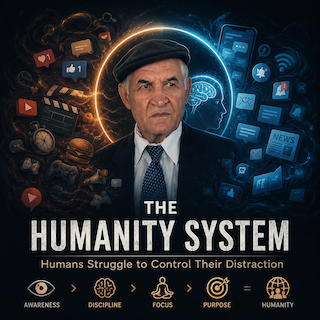
At the same time — the capacity of human beings to engage thoughtfully and collectively with these extraordinary challenges is being systematically undermined by the deliberate engineering of human distraction on a scale and with a sophistication that no previous era of human history has approached.
The attention economy — built by some of the most brilliant engineers and psychologists of our generation — has created a technological ecosystem specifically designed to capture and fragment human attention — to amplify outrage and division — to reduce complex human beings to reactive consumers of algorithmically curated content — and to make the kind of sustained — informed — genuinely deliberative collective attention that genuine democratic self-governance requires almost impossibly difficult to maintain.
This crisis of distraction is not merely a personal inconvenience. It is a civilizational threat. A humanity that cannot pay sustained attention to the challenges it faces — cannot think clearly about the solutions those challenges require — and cannot act collectively with the wisdom and the coordination those solutions demand — is a humanity that is genuinely at risk of being overwhelmed by the very forces its own ingenuity has unleashed.
The Collapse of Institutional Trust
Alongside the speed gap and the distraction crisis — the institutions through which previous generations managed their collective challenges are experiencing an unprecedented collapse of public trust.
Trust in religious institutions has declined sharply across every region of the world where systematic measurement has been attempted — driven by documented failures of religious leadership to live up to the moral standards they proclaimed — and by the growing recognition that the structural rigidity of religious institutions makes them unable to adapt to the genuinely new moral challenges that the modern world presents.
Trust in political institutions has declined even more dramatically — driven by decades of documented failures to deliver the genuine improvements in human well-being that political leaders have consistently promised — by the growing visibility of the role that concentrated wealth plays in shaping political outcomes in formally democratic systems — and by the recognition — increasingly widely shared across the full spectrum of political opinion — that the political systems of most nations are simply not designed to address the scale and the complexity of the challenges those nations face.
This collapse of institutional trust is not merely a social phenomenon to be studied and managed. It is a signal — a clear and urgent signal — that the existing systems are genuinely failing the human beings they were created to serve. And that the human family needs something genuinely new.
Part Three — What THE HUMANITY SYSTEM Is
A New Foundation for Human Civilization
THE HUMANITY SYSTEM is the answer to that need.
Not a perfect answer — because perfection is not available to human beings or to the institutions human beings create. But a genuine answer — an honestly grounded — carefully designed — practically oriented answer that addresses the specific structural failures of the systems that preceded it while preserving and building upon the genuine achievements those systems produced.
Let us be precise about what THE HUMANITY SYSTEM actually is — and what it is not.
It is not a new religion.
It does not claim divine authority. It does not ask for faith in the absence of evidence. It does not declare its foundational principles to be eternally true and beyond question. And it does not organize human beings into communities of shared belief defined by their distinction from — and their potential opposition to — communities of different belief.
What it takes from the best of the religious traditions — and genuinely honors — is the recognition that the deepest questions of human existence are real questions that deserve honest engagement. That the spiritual dimension of human life — the dimension of meaning — of consciousness — of the experience of connection to something larger than the individual self — is a genuine and important dimension that any adequate framework for human civilization must take seriously. And that the cultivation of genuine compassion — genuine care for every human being — is not merely a religious ideal but a practical necessity for any civilization that aspires to be genuinely worthy of the human beings within it.
It is not a new political ideology.
It does not seek political power. It does not propose to govern human beings through the mechanisms of the state. It does not claim that any particular arrangement of economic or political institutions represents the final — correct — scientifically determined answer to the question of how human beings should organize their collective life.
What it takes from the best of the political traditions — and genuinely honors — is the recognition that human beings are social creatures whose flourishing requires institutional frameworks — systems of law — systems of rights — systems of accountability — that constrain the tendency of power to serve itself at the expense of those it governs. And that the equal dignity and the equal rights of every human being are not merely admirable aspirations but genuine obligations — obligations that any legitimate system of human governance must take seriously and must work — continuously — to fulfill.
What it genuinely is — is something new.
A framework for human civilization that combines the genuine achievements of both religious and political traditions while addressing the structural limitations that have prevented either tradition from fully delivering the world that every human being deserves.
A framework built on six core principles — Radical Honesty — Continuous Renewal — Universal Equality — Human Development — Spiritual Honesty — and Technological Wisdom — that together define a genuinely new approach to the organization of human collective life.
A framework governed by Eight Universal Laws — applying equally to every human being on Earth — without exception — without qualification — and without the selective application that has characterized every previous system of rights and justice that human civilization has produced.
A framework committed to Continuous Renewal — reviewed and updated every year — never becoming the rigid — self-serving — change-resistant institution that every previous foundational system of human civilization has eventually become.
And a framework that takes seriously — as no previous system has fully taken seriously — the equal dignity and the equal potential of every specific — particular — never-to-be-repeated human being on Earth. Not as an abstraction. Not as a theoretical principle. But as a practical commitment — backed by specific institutional mechanisms — specific enforcement structures — and specific processes of accountability — that make the commitment real in the actual daily lives of actual human beings.
Part Four — How THE HUMANITY SYSTEM Differs
Three Fundamental Differences
The differences between THE HUMANITY SYSTEM and the systems that preceded it are not merely matters of emphasis or degree. They are fundamental structural differences — differences that address the specific structural failures that have prevented both religion and politics from fully serving the human beings within them.
Difference One — It Is Designed to Change
Every previous foundational system of human civilization has been designed — explicitly or implicitly — to resist change. Religious systems resist change because their authority derives from the claim of eternal truth. Political systems resist change because change threatens the interests of those who currently hold power within them.
THE HUMANITY SYSTEM is designed to change. Not randomly — not in response to the shifting winds of political opinion or cultural fashion — but systematically — honestly — and in response to genuine evidence about what is working and what is failing in the actual service of actual human beings.
The Continuous Renewal process — the annual review of every principle — every law — every institutional mechanism — by a genuinely diverse — genuinely representative — genuinely accountable body of human beings committed to the equal service of every person on Earth — is not a peripheral feature of the system. It is its most essential structural innovation. It is the feature that ensures that THE HUMANITY SYSTEM will never become what every previous foundational system of human civilization has eventually become — a self-serving institution that prioritizes its own survival over the genuine needs of the human beings it was created to serve.
Difference Two — Its Authority Is Human — Not Divine or Political
The authority of religious systems derives from the claim of divine revelation — a claim that cannot be questioned without risking spiritual and social exclusion. The authority of political systems derives from the claim of democratic mandate or historical necessity — claims that are subject to manipulation by those with the resources and the organizational capacity to shape democratic outcomes or construct historical narratives in their own favor.
The authority of THE HUMANITY SYSTEM derives from something different — and something more genuinely robust. It derives from the honest — evidence-based — continuously reviewed and continuously updated assessment of what actually serves the genuine flourishing of every human being. Not what serves the interests of those who claim to speak for God. Not what serves the interests of those who have the power to shape political outcomes. But what genuinely — verifiably — and equitably serves every human being.
This is a higher standard than either religious authority or political legitimacy has ever been held to. And it is the standard that a system genuinely designed to serve every human being must be held to.
Difference Three — It Serves Every Human Being — Without Exception
Every previous foundational system of human civilization has been selective in who it fully served. Religious systems have served believers more fully than non-believers — and within religious communities — have consistently served men more fully than women — the orthodox more fully than the questioning — and the institutionally powerful more fully than the ordinary faithful. Political systems have served the wealthy more fully than the poor — the organized more fully than the dispersed — and the nationally powerful more fully than the globally marginalized.
THE HUMANITY SYSTEM is committed — as its most fundamental and most non-negotiable principle — to serving every human being on Earth with the same completeness — the same honesty — and the same genuine commitment. Not as an aspiration. Not as a rhetorical flourish. But as a structural commitment backed by specific mechanisms of accountability — specific standards of measurement — and the specific institutional willingness to honestly acknowledge — and genuinely correct — every specific way in which that commitment is falling short.
This is the difference that makes THE HUMANITY SYSTEM genuinely new. Not merely a reformed religion or an improved political system. A genuinely different kind of human institution — one that begins where both religion and politics have consistently failed to begin — with the unconditional recognition of the equal dignity and the equal worth of every specific human being on Earth.
Part Five — The Transition
How Civilization Moves Forward
The transition from the Age of Religion and Politics to the Age of Humanity is not a revolution in the conventional sense. It is not the violent overthrow of existing institutions — the dramatic proclamation of a new order — or the sudden replacement of one foundational system with another.
It is something slower — more organic — more genuinely human — and ultimately more lasting than any of these.
It is the gradual — patient — persistently nonviolent building of a new framework — one community at a time — one institution at a time — one human being at a time — that demonstrates through the concrete evidence of its actual performance that a system genuinely committed to serving every human being genuinely produces better outcomes — for more people — more consistently — than the systems it is gradually and peacefully replacing.
This building has already begun.
It has begun in the communities around the world where THE HUMANITY SYSTEM's principles are being implemented in educational programs — in governance experiments — in human development initiatives — and in the daily practice of treating every human being encountered with the genuine dignity that THE HUMANITY SYSTEM insists is every person's birthright.
It has begun in the growing global network of human beings — connected across every line of difference that the old systems have used to divide the human family — who share the conviction that every human being matters and who are committed to building a world that proves it.
It has begun in the books and the articles and the translations and the educational materials and the digital communities that are carrying the vision of THE HUMANITY SYSTEM to human beings in every language — in every culture — and in every corner of the world.
And it has begun — most fundamentally of all — in the hearts and minds of the human beings who have encountered this vision — have recognized in it something genuinely new — and have made the personal decision to participate in its building.
The transition is not complete. It will not be complete in any single generation. It is the work of many decades — perhaps many generations — of patient — honest — persistent — and genuinely human effort.
But it has begun. The direction is clear. The destination is real. And every human being who chooses to participate in the building — in whatever specific way their specific life and their specific gifts make possible — is contributing to the most important project that the human family has undertaken since the great civilizational transitions of the ancient world.
Part Six — What This Means for You
The Personal Dimension of a Civilizational Transition
Great civilizational transitions are not merely historical events that happen to masses of anonymous human beings. They are lived — personally — by specific individual human beings who must decide — in the conditions of their specific lives — what relationship they will have to the change that is occurring.
The transition from the Age of Religion and Politics to the Age of Humanity is being lived right now — by you — the specific human being reading these words.
And the question it poses to you is not abstract or philosophical. It is immediate and personal.
What do you believe about the world you live in?
Do you believe that the systems you have inherited — the religious and political frameworks that have shaped your understanding of who you are — what you deserve — and what is possible for the human family — are genuinely adequate to the challenges you face and the opportunities you could seize?
Or do you sense — perhaps have always sensed — that something is missing? That the world as it is does not match the world as it should be? That the promises made by both religion and politics have been only partially — and in too many cases tragically inadequately — fulfilled?
If you sense that — then this article has been written for you. And the vision it describes — THE HUMANITY SYSTEM — has been built for you.
Not to replace whatever genuine meaning you have found in religious tradition. Not to dismiss whatever genuine value you have found in political participation. But to offer you a framework — honest — adaptive — and genuinely committed to your equal dignity and your equal flourishing — that can carry you and the human beings you love — and the billions of human beings you will never meet but who share this extraordinary world with you — toward the world that every one of them genuinely deserves.
The world where every human being matters.
The world where every human life has irreplaceable worth.
The world where the systems that govern human existence are built — honestly — continuously — and with genuine love for every human being — to prove it.
Conclusion — The Next Chapter of the Human Story
Every great chapter of the human story has been shaped by the foundational system around which the civilization of its era was organized.
The Age of Religion gave humanity meaning — community — moral framework — and the first great attempts to grapple honestly with the deepest questions of conscious existence.
The Age of Politics gave humanity institutional order — systems of law — the principle of human rights — and the first great attempts to organize collective life in ways that constrained the arbitrary exercise of power.
Both ages produced genuine achievements. Both ages also produced genuine failures — genuine injustices — genuine costs borne by real human beings whose lives were diminished by the structural limitations of the systems governing them.
The Age of Humanity — the age that THE HUMANITY SYSTEM is building — is the next chapter.
It will build on the genuine achievements of both previous ages. It will learn — honestly and specifically — from their genuine failures. And it will carry the human family forward — not in a single dramatic leap — but in the patient — persistent — step-by-step — community-by-community — generation-by-generation building that genuine civilizational progress has always required.
This is not a small thing. It is perhaps the largest thing that any human generation has ever been called to participate in.
And the extraordinary truth — the truth that this article wants to leave with every human being who reads it — is that this building is not the exclusive responsibility of leaders — of scholars — of institutional founders — or of any other specially qualified category of human being.
It is the responsibility — and the extraordinary privilege — of every human being alive.
Including you.
The Age of Religion gave us the question of meaning. The Age of Politics gave us the question of order. The Age of Humanity gives us the answer to both:
Every human being matters. Every human life deserves dignity. And together — we can build a world that proves it.
The next chapter of the human story has already begun.
And it begins — as every genuinely important human story has always begun — with the choice of a specific human being to participate in its writing.
Make that choice.
Write the next chapter.
Together — we are THE HUMANITY SYSTEM. ❤️
"We have lived under religion. We have lived under politics. But we have not yet truly lived under humanity. The time has come. The system is being built. And every human being on Earth is invited to help build it."
— Hamma Mirwaisi Author and Founder — THE HUMANITY SYSTEM
About the Author
Hamma Mirwaisi is the author of two groundbreaking books and the founder of THE HUMANITY SYSTEM — a genuinely new framework for human civilization designed to serve every human being on Earth fully — honestly — and without exception.
📖 Book One: From Religion to Politics to Humanity: A Journey of Human History and a Vision for Our Future
📖 Book Two: THE HUMANITY SYSTEM: Humans Struggle to Control Their Distraction — A Blueprint for a World Where Every Human Being Truly Matters
🔗 Both available on Amazon: https://www.amazon.com/dp/B0GZ1788G7
🌐 Website: www.thehumanitysystem.com
📧 Contact: thehumanitysystem@gmail.com
If this article has resonated with you — please share it with every human being in your life who has ever felt that the world is capable of something genuinely better than what we have built so far.
The conversation that changes the world begins with a single honest human being sharing a genuine idea with another.
Thank you for reading. Thank you for caring. And thank you for being part of the human family. ❤️